Polyurethane Adhesives: The Complete Guide to Types, Uses, and Applications in Automotive Filter Manufacturing
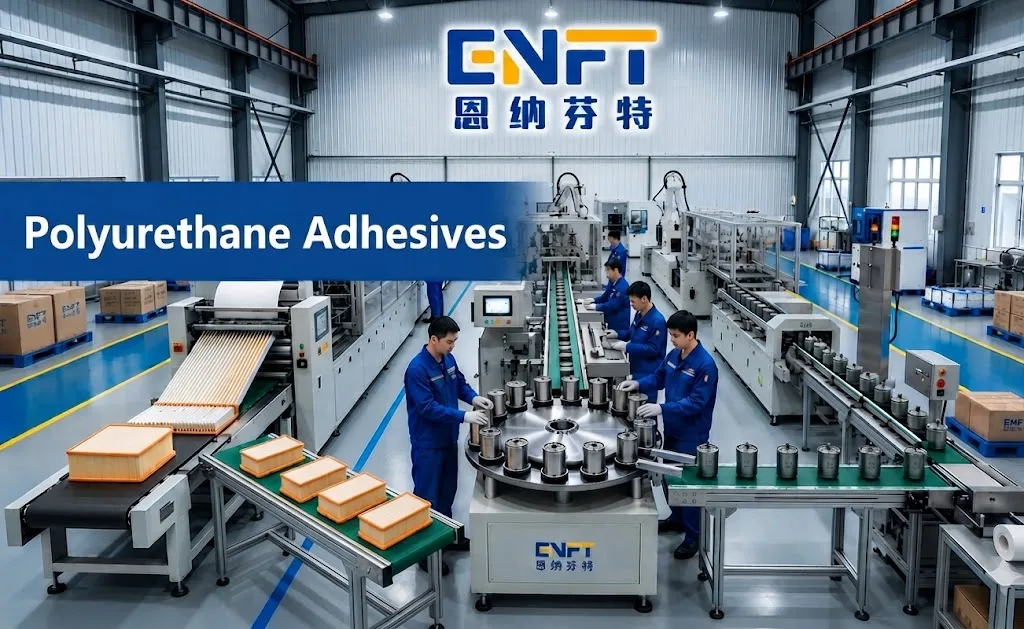
Polyurethane adhesives are important solutions in many industries that require high bonding strength, good flexibility, and resistance to moisture and various operating conditions. These materials are used across multiple sectors, including automotive, construction, furniture, electronics, packaging, and engineering industries. They also represent an important component in some air filter, oil filter, and automotive filter manufacturing processes.
The properties of polyurethane adhesive vary depending on its chemical composition, curing method, and the surface to be bonded. Therefore, choosing the right type does not depend solely on bonding strength; it also involves temperature, humidity, production speed, material type, and application method.
What Are Polyurethane Adhesives?
Polyurethane adhesives are bonding materials based on polymers known as polyurethanes. They are used to bond two or more surfaces made of different materials by forming a strong and flexible bond after curing.
Liquid polyurethane is known for its ability to spread across surfaces and reach small gaps before transforming into a cohesive adhesive layer. Other formulations are available as pastes, films, or two-component materials that are mixed before use.
These materials can be used with a wide range of materials, including:
Metals.
Plastics.
Rubber.
Paper and fibrous materials.
Fabrics.
Wood.
Certain types of foam.
Composite materials.
For this reason, polyurethane adhesive has become an important option for applications that require a combination of bonding strength, flexibility, and resistance to environmental conditions.
How Do Polyurethane Adhesives Work?
The working mechanism of polyurethane adhesive is based on forming a bond between the adhesive and the surfaces to be assembled, followed by a curing process that increases the cohesion of the adhesive layer.
In simple terms, the process can be divided into the following steps:
Surface preparation: Cleaning the surfaces and removing dust, oils, and substances that may prevent proper adhesion.
Adhesive application: Applying the appropriate amount to one or both surfaces, depending on the product type.
Surface assembly: Pressing the parts together to achieve proper adhesive distribution.
Curing: The material hardens according to the curing mechanism of the formulation.
Achieving the required bonding strength: Once curing is complete, the joint becomes capable of withstanding loads and vibrations according to the material specifications.
Some types rely on moisture present in the environment for curing, while two-component types rely on a chemical reaction between two components that are mixed before application.
Application example: When using polyurethane adhesive to bond a plastic component to a metal frame, surface cleaning, determining the correct amount of adhesive, and controlling the setting time can have a significant impact on the final joint quality.
Types of Polyurethane Adhesives
There are different types of polyurethane adhesives based on their composition, curing method, and end use.
Type | Curing Method | Main Applications |
|---|---|---|
One-component polyurethane | Typically reacts with moisture | Assembly, construction, and some industrial applications |
Two-component polyurethane | Reaction between two components | Industrial applications and high-performance bonding |
Thermally reactive polyurethane | Used with specific thermal processes | Certain manufacturing and assembly processes |
Polyurethane film | Used as an adhesive layer | Composite industries and specialized applications |
Liquid polyurethane | Applied directly to the surface | Industrial assembly and various materials |
The type should not be selected based on its name alone, as the appropriate formulation depends on the materials to be bonded and the nature of the production line.
Components and Composition of Polyurethane Adhesives
The composition of an adhesive varies from one product to another. However, industrial formulations may contain a range of components that control adhesion, flexibility, curing time, and viscosity.
The formulation may include:
Polyurethane polymers.
Isocyanate compounds in some systems.
Polyols.
Catalysts.
Fillers.
Stabilizers.
Viscosity-modifying agents.
Additives that improve environmental resistance.
Pigments or functional additives when required.
In two-component systems, the components are kept separate until use or mixed according to the ratios specified by the manufacturer.
Important: There is no single formulation suitable for every application. The formulation used in automotive manufacturing may differ significantly from one used in construction, furniture, or packaging.
Key Properties of Polyurethane Adhesives
Polyurethane adhesives have a range of properties that make them suitable for many industrial applications.
1. Bonding Strength
Some formulations can provide strong adhesion to a wide range of materials, with performance varying according to the surface type, surface preparation, and formulation.
2. Flexibility
Many polyurethane formulations offer better flexibility than some rigid adhesives. This is important when the joint is exposed to vibration, expansion, or contraction.
3. Moisture Resistance
Some types can provide good resistance to water and moisture after curing is complete.
4. Vibration Resistance
Flexibility helps reduce the impact of vibrations on certain industrial joints.
5. Ability to Bond Different Materials
Certain formulations can be used to bond different materials, such as plastic and metal, rubber, and some fibrous materials.
6. Customization
Formulations can be manufactured with different properties in terms of viscosity, curing time, flexibility, and temperature resistance.
What Materials Can Be Bonded Using Polyurethane Adhesive?
Successful bonding depends on the formulation used and the nature of the surface. However, suitable polyurethane adhesive types can be used with a wide range of materials.
Some of the most common include:
Material | Suitability | Notes |
|---|---|---|
Metals | Good with the appropriate formulation | Requires proper surface preparation and cleaning |
Plastics | Varies depending on the plastic type | Some plastics require surface treatment |
Rubber | Suitable for certain applications | Proper formulation selection is important |
Wood | Common | Affected by moisture and wood type |
Fabrics | Possible | Depends on the nature of the fabric |
Paper and fibrous materials | Possible | Used in various industrial applications |
Foam | Certain types | Care must be taken to avoid damaging the material |
Composite materials | Possible | Depends on the composition and surface |
Therefore, the right question is not simply: Can polyurethane bond this material? Rather, it is: What formulation is appropriate? How has the surface been prepared? And what are the operating conditions?
Applications of Polyurethane Adhesives
The uses of polyurethane are diverse due to the wide range of available formulations.
Automotive Industry
Adhesives are used in assembly, bonding, sealing, and certain interior and exterior components.
Furniture Industry
They are used in certain processes for bonding wood and composite materials.
Construction Sector
Polyurethane has applications in construction materials, insulation, assembly, and joint sealing, depending on the product type.
Packaging Industry
Some formulations are used to bond layers of different materials.
Engineering Industries
They are used in applications requiring flexibility and vibration resistance.
Filter Manufacturing
Suitable adhesives can be used to secure filter elements and bond certain components during the filter manufacturing process.
Using Polyurethane Adhesives in Automotive Filter Manufacturing
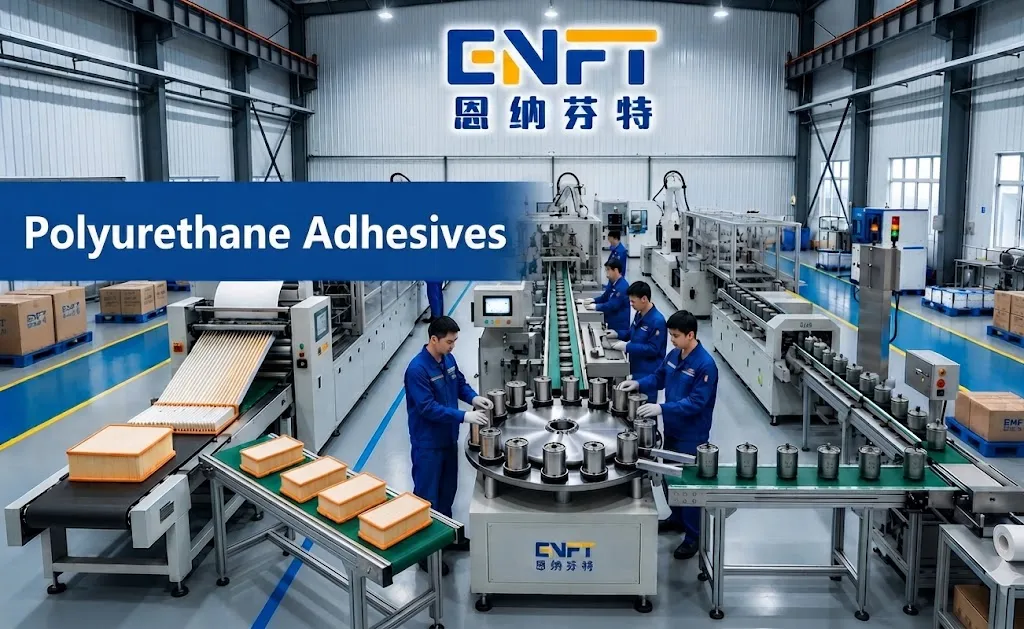
Automotive filter manufacturing requires multiple components to be assembled in a way that maintains the filter's shape, prevents leakage, and keeps the filter element securely in place.
Depending on the filter design, adhesives may be used at different stages, such as:
Securing the filter element.
Bonding certain components to the frame.
Securing filter components.
Helping achieve proper sealing.
Bonding certain rubber or plastic materials.
Securing specific parts during assembly.
In automotive air filter manufacturing, the quality of the adhesive bond can affect the stability of the filter element and help prevent air from passing through unwanted areas.
Illustrative Application Example
Suppose an air filter consists of:
Pleated filter paper + frame + sealing components + adhesive.
The adhesive is applied in a controlled amount to the required area, after which the filter element is installed and secured until the curing process is complete.
In this case, using more adhesive is not necessarily better. Excessive adhesive may result in unnecessary material consumption, longer curing times, or an impact on the product's shape.
Therefore, the industrial process depends on the amount, viscosity, application method, setting time, and production line speed.
Difference Between Polyurethane Adhesives and Other Adhesives
There is no single adhesive type that is suitable for every application. Therefore, materials should be compared according to the requirements of the application.
Factor | Polyurethane | Epoxy | Cyanoacrylate | Some Rubber Adhesives |
|---|---|---|---|---|
Flexibility | Good in many formulations | Generally lower | Relatively low | Good |
Vibration Resistance | Good | Good depending on formulation | Limited in some applications | Good |
Adhesion to Different Materials | Good | Very good in many applications | Good for certain surfaces | Depends on the type |
Curing Speed | Varies | Varies | Usually very fast | Varies |
Moisture Resistance | Good for some formulations | Good depending on type | Varies | Varies |
Industrial Use | Wide | Wide | More specialized | Wide |
The selection should not be based solely on the adhesive name, but rather on the requirements of the final product.
How to Use Polyurethane Adhesives?
To achieve good results, the manufacturer's instructions for the specific product should be followed, as application conditions vary from one formulation to another.
Basic Steps
1. Surface Cleaning
Remove dust, oils, grease, and any substances that may prevent proper adhesion.
2. Surface Preparation
Some materials may require sanding, surface treatment, or the use of a primer, depending on the product recommendations.
3. Determine the Adhesive Amount
An appropriate layer should be applied without excessive use.
4. Distribute the Material
Use a manual tool or an automated application system to achieve uniform distribution.
5. Assemble the Parts
Secure the components in the correct position before the adhesive's available working time is exceeded.
6. Allow the Adhesive to Cure
The joint should not be subjected to loads before reaching the required level of curing.
7. Quality Inspection
The appearance, adhesive position, cohesion, and absence of gaps or leaks can be inspected according to the product specifications.
How to Choose the Right Polyurethane Adhesive?
Choosing the right polyurethane material should begin with the application rather than simply selecting from the products available.
Consider the following factors:
Type of Materials to Be Bonded
Are they metal, plastic, rubber, filter paper, or composite materials?
Temperature
What are the maximum and minimum operating temperatures?
Moisture and Water
Will the product be exposed to water, moisture, or oils?
Vibration
Will the product operate in an environment with continuous vibrations?
Production Line Speed
Do you need a fast-curing material, or do you have more time available for curing?
Application Method
Will the adhesive be applied manually or by machine?
Viscosity
The viscosity should be suitable for the application system being used.
Final Product Requirements
In filter manufacturing, for example, the adhesive must be suitable for the filter design and its sealing and stability requirements.
How Are Polyurethane Adhesives Manufactured?
Polyurethane adhesives are manufactured through chemical and industrial processes that vary according to the product type and formulation.
In general, the process includes:
Selecting the raw materials.
Determining the component ratios.
Carrying out the chemical reaction under controlled conditions.
Controlling temperature and mixing.
Adjusting viscosity and the required properties.
Adding modifiers when necessary.
Conducting quality tests.
Packaging the product appropriately.
Storing it according to the manufacturer's conditions.
Industrial adhesive manufacturing requires suitable mixing, measurement, and control equipment, in addition to safety, ventilation, and storage systems that are appropriate for the nature of the chemicals used.
For filter manufacturers, using polyurethane adhesive does not mean that they manufacture the adhesive themselves. In many production lines, industrial adhesive is purchased according to the required specifications and then integrated into the filter manufacturing process.
Are Polyurethane Adhesives Waterproof?
Polyurethane adhesives can be resistant to water and moisture to varying degrees, but this depends on the specific formulation and product.
There is a difference between:
Moisture resistance.
Resistance to water for limited periods.
Continuous exposure to water.
Full immersion.
Exposure to water at elevated temperatures.
Therefore, not all polyurethane products should be considered equally waterproof.
If the application requires high water resistance, refer to the product's Technical Data Sheet (TDS) and verify the permitted conditions of use.
Can Polyurethane Adhesive Withstand High Temperatures?
Heat resistance depends on the chemical formulation, product type, and curing conditions.
Some polyurethane types can operate at relatively high temperatures, while other formulations are not suitable for high-temperature applications.
When selecting an adhesive, you should determine:
Continuous operating temperature.
Maximum temperature.
Duration of heat exposure.
Presence of moisture or oils.
Presence of vibrations.
Nature of the bonded materials.
Example: If the adhesive will be used in a component operating in an automotive environment with temperature fluctuations, testing adhesion at room temperature alone is not sufficient. The joint's performance should also be evaluated under the expected operating conditions.
Advantages of Using Polyurethane Adhesives from ENFT
ENFT specializes in filter manufacturing equipment and machinery. Therefore, its solutions focus on supporting production processes that require precision and consistency when manufacturing air filters, oil filters, and automotive filters.
When designing a production process that relies on adhesives, the key industrial advantages may include:
More Consistent Application
Using suitable application systems helps control the amount and distribution of the material instead of relying entirely on manual application.
Support for Continuous Production
When adhesive application is integrated into the production line, it can be organized to match the manufacturing speed.
Reduced Waste
Controlling the amount of material used helps reduce excessive consumption, particularly in high-volume production.
Improved Product Consistency
Repeating the same application and curing steps helps reduce variations between products.
Integration with Filter Manufacturing
The method of using the adhesive can be studied within the filter production stages according to the design, filter type, and components used.
Customized Solutions for Factory Requirements
The requirements of an air filter factory differ from those of an oil filter factory or production lines that manufacture more than one type of filter. Therefore, the solution should be designed according to the production capacity, product types, and required level of automation.
Get the Right Filter Production Solution for Your Factory with ENFT
If you are planning to establish an automotive filter factory or upgrade an existing air and oil filter production line, selecting the right machinery and adhesive application method are among the stages that deserve careful consideration before production begins.
With ENFT, you can evaluate your production line requirements based on filter types, production capacity, automation level, raw materials, and the required assembly method.
Contact ENFT now to discuss your project and get a suitable solution for automotive, air, and oil filter production machinery and lines.
Start by defining your filter type and target production capacity, and let the ENFT team help you determine the right equipment for your manufacturing process.