
Oil Filters and Their Accessories: Complete Guide to Types, Components, Manufacturing, and Production Lines
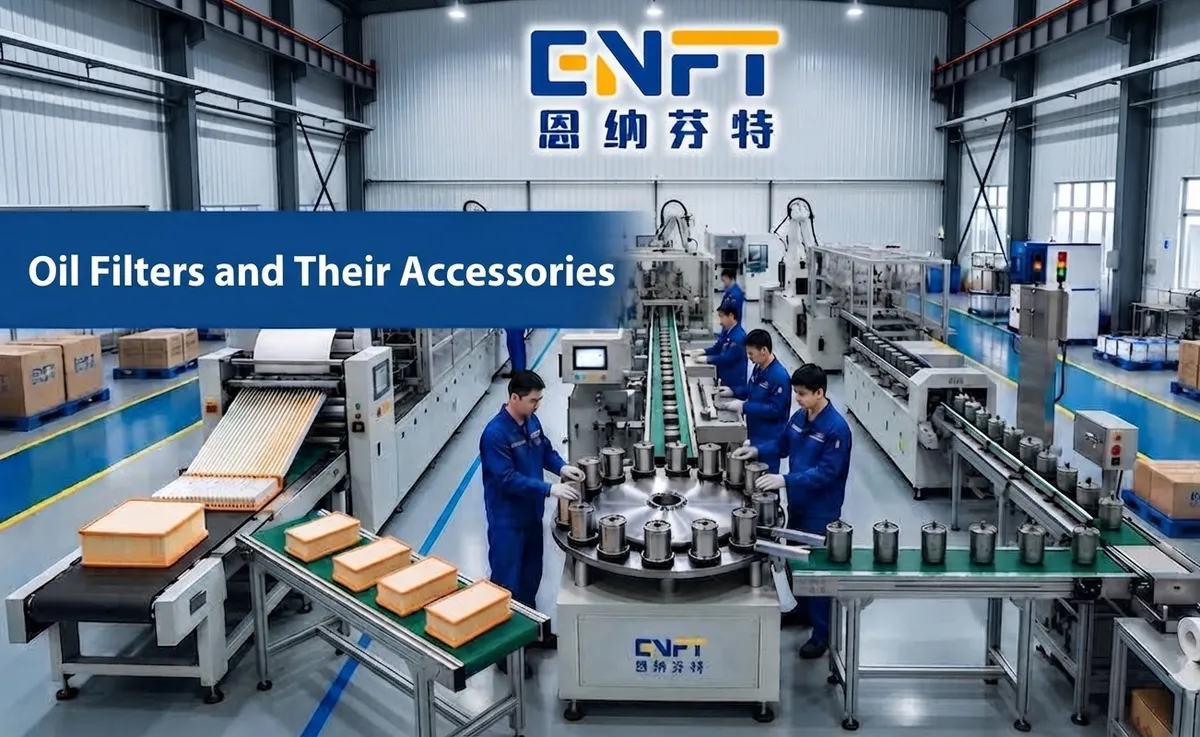
Oil filters and their accessories are essential components of a car engine's lubrication system. They work to remove impurities and fine particles from engine oil that may affect lubrication efficiency and increase wear on internal components. The importance of the filter is not limited to the filtration element itself; it also includes a range of components and accessories such as the filter housing, valve, gasket, springs, end covers, and adhesives used during the assembly process.
From a manufacturing perspective, automotive oil filter manufacturing has become an advanced industrial process that relies on a group of specialized machines working together within an integrated production line, starting with the preparation and forming of the filter media and continuing through assembly, testing, and packaging.
What Are Oil Filters and Why Are They Important?
An oil filter is a component designed to remove particles and impurities from engine oil that accumulate in the oil during engine operation.
Although engine oil performs important functions such as reducing friction and helping cool and lubricate internal components, over time it can carry:
Metal particles resulting from wear.
Dust and fine impurities.
Combustion residues.
Deposits.
Particles resulting from oil degradation.
Foreign materials that may enter the lubrication system.
This is where the filter plays its role by capturing these particles before the oil continues circulating through the engine.
Why Is an Oil Filter Important?
Its importance can be summarized as follows:
Maintaining the cleanliness of engine oil.
Reducing the amount of harmful particles reaching internal components.
Helping maintain the efficiency of the lubrication system.
Reducing the likelihood of deposit buildup.
Supporting the service life of engine components when the appropriate filter and oil are used.
Therefore, the quality of an original oil filter or a replacement filter that meets the required specifications is not related only to its external appearance. It also depends on the efficiency of the filtration media, the precision of the internal components, and manufacturing quality.
How Does an Oil Filter Work Inside a Car Engine?
The oil filter operates as part of the engine lubrication cycle.
In simple terms:
Oil Pump → Oil Filter → Oil Passages → Engine Components → Oil Return → Pump
When the oil pump pushes oil through the filter, the oil passes through the filtration media, while particles and impurities exceeding the media's specified passage capability are captured.
The exact oil flow path varies depending on the engine and filter design.
Practical Example
If the oil contains fine particles generated by internal engine friction, the filtration media captures some of these particles as the oil passes through.
As contaminants accumulate, resistance to oil flow increases. For this reason, some filter designs include valves that help handle certain conditions, such as increased pressure differential.
This demonstrates that oil filter design must balance:
Filtration Efficiency + Oil Flow Rate + Pressure Resistance + Service Life.
Types of Oil Filters
There are several oil filter designs, and the choice depends on the vehicle, engine, and lubrication system design.
1. Spin-On Oil Filter
The filter comes as a sealed unit that is installed and replaced as a complete unit.
This design is common in many applications and typically consists of a metal housing, filtration element, end covers, internal components, a valve, and a gasket.
2. Cartridge Oil Filter
With this design, the internal filtration element is replaced while some parts of the filter housing already installed in the vehicle are retained.
3. High-Efficiency Oil Filters
Some filters are designed with filtration media and engineering configurations intended to achieve higher levels of particle retention according to the specifications required for the application.
Comparison of Common Designs
Item | Spin-On | Cartridge |
Replacement Method | Complete unit | Usually filtration element |
Metal Housing | Usually present | May be outside the element |
Ease of Installation | High | Depends on vehicle design |
Manufacturing | Requires several assembly processes | Focuses more on the element and associated components |
Applications | Widely used in different applications | Common in many modern vehicles |
Therefore, it is not possible to determine the best types of oil filters independently of the vehicle and engine specifications.
Oil Filter Components
An oil filter consists of several components that work together to achieve filtration, oil flow, and sealing.
Some of the main components include:
Component | Function |
Filtration Media | Captures impurities and particles |
Outer Housing | Protects internal components |
End Cover or End Cap | Secures the filtration element and connects it to other components |
Center Tube | Supports the filtration element and provides an oil flow path |
Valve | Controls the oil flow path according to the filter design |
Gasket | Provides sealing when the filter is installed |
Spring | Maintains pressure and secures certain components |
Adhesive | Secures certain parts of the filtration element and assembly |
Base Plate | Connects the filter to the mounting system in applicable designs |
These components vary depending on the filter design, manufacturer, and vehicle requirements.
What Are Oil Filter Accessories?
Oil filter accessories refer to the components that support filter installation, sealing, oil flow control, or filtration element retention.
Some of the main accessories include:
Gaskets and seals.
Valves.
Springs.
Metal end covers.
Center tubes.
Mounting bases.
Rubber components.
Sealing materials and adhesives.
Auxiliary components specific to the filter design.
These accessories should not be considered secondary components. A failure in any one of them can affect filter performance even if the filtration media itself is of good quality.
Importance of Oil Filter Accessories in Filter Performance
The quality of the final filter depends on the integration of all its components.
For example, the filtration media may be of high quality, but a problem with the gasket could result in oil leakage at the mounting point.
Likewise, inaccurate positioning of the filtration element inside the filter housing can affect oil flow or the stability of the components.
Therefore, the automotive oil filter manufacturing process focuses on several factors at the same time:
Component Precision + Material Quality + Assembly Quality + Adhesive Quantity Control + Final Testing.
Types of Filtration Media Used in Oil Filters
Filtration media is one of the most important parts of the filter because it largely determines the filter's ability to capture particles while maintaining the required oil flow.
The filter industry may use different types of filtration media, such as:
Filter paper designed for oil applications.
Synthetic fibrous materials.
Composite materials.
Multi-layer filtration media.
Filtration media with enhanced properties for specific applications.
The selection of filtration media depends on factors such as:
Target particle size.
Oil flow rate.
Operating temperature.
Oil type.
Pressure.
Required service life.
Engine specifications.
Example
If the goal is to increase particle retention efficiency, this does not simply mean using a denser material, because increased flow resistance may affect performance.
Therefore, the design of the filtration media must achieve a balance between filtration efficiency and oil flow.
What Contaminants Does an Oil Filter Remove?
An oil filter captures a range of particles and contaminants present in the oil, including:
Metal particles.
Dust.
Combustion residues.
Deposits.
Particles generated by wear of engine components.
Some contaminants resulting from oil degradation.
This does not mean that the filter removes all contaminants present in the oil. Its primary function is related to the particles that the filtration media is designed to capture.
The quality of the oil itself, the condition of the engine, and maintenance intervals also affect the amount of contaminants reaching the filter.
Signs of a Damaged or Clogged Oil Filter
Some indicators may appear when the filter needs inspection or replacement, but these signs may also be associated with other problems in the engine system.
Possible indicators include:
An oil pressure warning.
Abnormal changes in lubrication system performance.
Leakage around the filter area.
Visible damage to the filter housing.
Exceeding the recommended replacement interval.
Oil flow problems identified through professional diagnosis.
Important: A single sign should not be considered conclusive evidence that the filter is clogged, especially in cases involving oil pressure, because the problem may be related to the oil pump, pressure sensor, or other system components.
When Should You Change the Oil Filter?
The oil filter is generally replaced according to the maintenance schedule recommended by the vehicle manufacturer or based on operating conditions, oil type, and filter type.
It is advisable to consider:
Manufacturer recommendations.
Mileage.
Time interval.
Driving conditions.
Type of oil used.
Engine characteristics.
Filter quality.
In many maintenance procedures, the oil filter is replaced when the engine oil is changed. However, the correct interval depends on the vehicle and the manufacturer's instructions.
How Do You Choose the Right Oil Filter for a Car?
Choosing an oil filter does not depend solely on size or price.
Follow these steps:
Step One: Identify the Vehicle Specifications
Find out:
Manufacturer.
Model.
Year of manufacture.
Engine type.
Step Two: Identify the Filter Part Number
The Part Number helps identify the appropriate filter.
Step Three: Match the Specifications
Make sure that the filter is compatible with the vehicle's specifications and application.
Step Four: Check Material Quality
Check the quality of the filtration media, internal components, gasket, and housing.
Step Five: Choose a Reliable Source
Whether you choose an original oil filter or a replacement filter from a specialized manufacturer, the product should meet the required specifications.
How Are Oil Filters Manufactured?
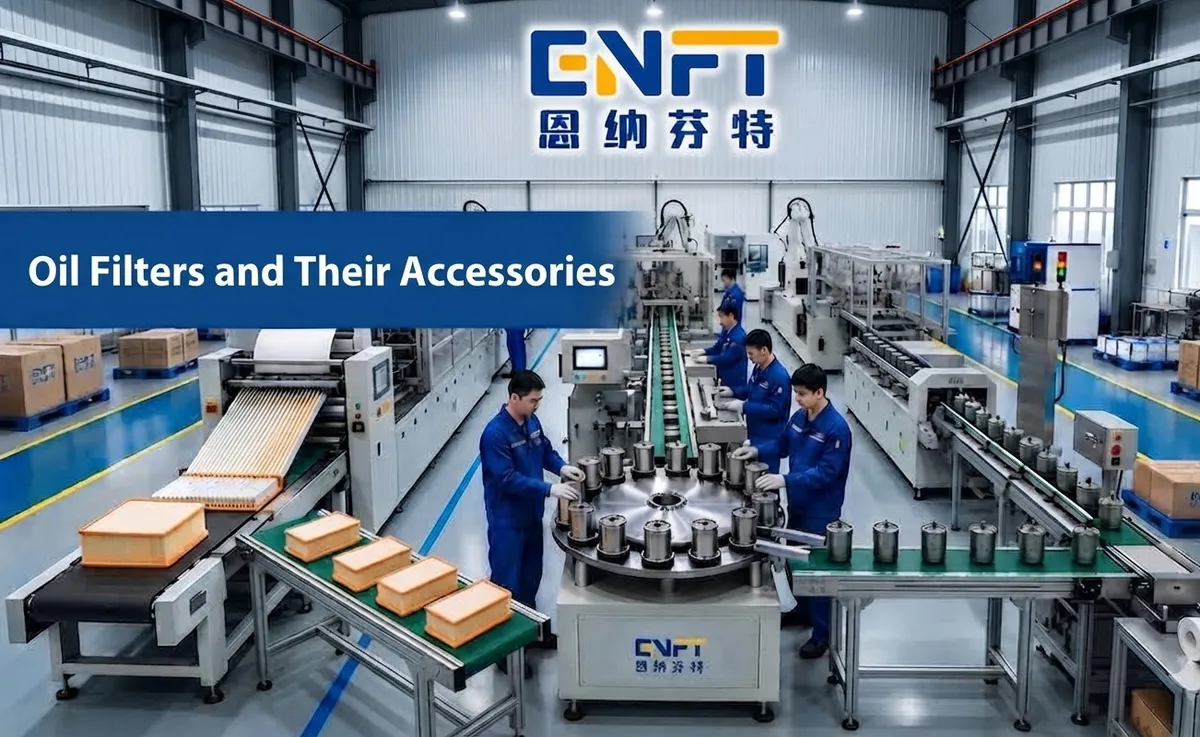
The automotive oil filter manufacturing process involves several industrial stages. The exact details vary depending on the filter design, automation level, and production capacity.
In general, the process begins with preparing the filtration media and metal components, followed by forming and assembling the filtration element with the other components. Final inspections are then performed.
The main manufacturing stages include:
Preparing the filtration media.
Cutting the media to the required dimensions.
Pleating the filtration media.
Forming and preparing metal components.
Installing the end covers.
Securing the filtration element.
Installing internal components.
Applying adhesives when required.
Installing the gasket and final components.
Closing the filter according to the design.
Conducting quality tests.
Cleaning and packaging the product.
Oil Filter Production Line
An oil filter production line consists of a group of machines that operate sequentially or as an integrated system to perform the manufacturing stages.
The line may include:
Filter media unwinding and preparation machine.
Filter paper pleating machine.
Filter media cutting or preparation machine.
Metal component forming equipment.
End Cap installation machine.
Adhesive application equipment.
Filter assembly machine.
Internal component installation equipment.
Gasket installation machine.
Testing equipment.
Packaging equipment.
The final line configuration is determined according to:
Filter Type + Dimensions + Production Capacity + Automation Level + Number of Models + Testing Requirements.
Example of a Production Line Configuration
A factory targeting high-volume production of Spin-On oil filters may require an automated or semi-automated line focused on media pleating speed, assembly, adhesive application, component installation, and testing.
Meanwhile, a factory producing several models in different quantities may require greater flexibility when changing dimensions and molds.
Oil Filter Manufacturing Stages Within the Production Line
The oil filter manufacturing stages within the line can be summarized as follows:
Raw Material → Pleating → Cutting → Filtration Element Forming → Assembly → Adhesive Application → Component Installation → Closing → Testing → Packaging
1. Preparing the Filtration Media
The media is fed into the preparation machine at the appropriate dimensions.
2. Pleating the Media
The pleats are formed to achieve an appropriate filtration area within the available space.
3. Cutting and Preparing the Element
The required dimensions are achieved according to the filter design.
4. Installing the End Covers
End Caps or equivalent components are secured.
5. Applying the Adhesive
The appropriate adhesive is used to secure specific components according to the design.
6. Assembly
The filtration element is assembled with the internal components and outer housing.
7. Installing the Accessories
Components such as the gasket, valve, and springs are installed according to the filter type.
8. Testing
The product is inspected according to the required quality standards.
9. Packaging
After passing the tests, the filter is prepared for packing, storage, or shipment.
Raw Materials Used in Oil Filter Manufacturing
The raw materials vary according to the product design, but may include:
Material | Application |
Filter paper or filtration media | Filtration element |
Metal sheets | Filter housing or certain components |
Plastic materials | Certain components depending on the design |
Rubber | Gaskets and seals |
Adhesives | Securing certain components |
Metal springs | Supporting certain filter mechanisms |
Packaging materials | Final packaging |
Raw materials should not be selected based on price alone. Their quality and compatibility with the final product specifications must also be evaluated.
Role of Adhesives in Oil Filter Manufacturing
Adhesives play an important role in certain oil filter designs. They can be used to secure specific parts of the filtration element or help achieve proper bonding between particular components.
Key factors to consider when selecting an adhesive include:
Bonding strength.
Viscosity.
Curing speed.
Oil resistance.
Temperature resistance.
Compatibility between the adhesive and filter materials.
Production line speed.
Application method.
Why Is Adhesive Quantity Important?
Using too little adhesive may result in weak bonding, while excessive adhesive may lead to:
Increased cost.
Longer curing time.
Material accumulation in unwanted areas.
Changes in product appearance.
An impact on process efficiency.
Therefore, precision application systems can be used within industrial production lines to achieve greater consistency.
How Do You Choose an Oil Filter Manufacturing Machine?
Choosing automotive filter manufacturing machines should begin with the factory's requirements rather than focusing solely on machine specifications.
1. Determine the Filter Type
Will you manufacture:
Spin-On?
Cartridge?
Oil filters for car engines?
Industrial applications?
More than one design?
2. Determine the Production Capacity
Determine the target number of filters to be produced:
Per Hour → Per Shift → Per Day → Per Month.
3. Determine the Automation Level
Level | Suitable For |
Manual | Limited production and prototypes |
Semi-Automatic | Medium-production factories requiring greater flexibility |
Automatic | High-volume production and high consistency requirements |
4. Check Size Changeover Capability
If you plan to produce multiple models, it is important to understand how easily molds and machine settings can be changed.
5. Review the Control System
The operating system should preferably be clear and provide the ability to monitor the key process parameters.
6. Ask About Spare Parts
The availability of spare parts and technical support is an important part of long-term operating costs.
7. Do Not Look Only at the Machine Price
You should compare:
Price + Production Capacity + Material Consumption + Maintenance + Labor + Technical Support + Service Life.
Practical Example for Selecting an Oil Filter Manufacturing Machine
Suppose a factory targets production of 500 filters per hour.
If the factory operates 8 hours per day for 26 days:
500 × 8 × 26 = 104,000 filters per month
This figure is an illustrative calculation and not a promise of a specific production capacity, because actual capacity depends on the selected machinery, filter design, line speed, model changeover time, and downtime rate.
If the factory wants to produce multiple models, flexibility may be more important than achieving the highest nominal speed.
Therefore, machinery should be selected after studying the product and target production capacity.
Advantages of Buying an Oil Filter Manufacturing Machine from ENFT
ENFT provides solutions and equipment for manufacturing air filters, oil filters, and automotive filters, with a focus on connecting machinery to actual production requirements.
Some of the key points a factory can benefit from when working with a specialized supplier such as ENFT include:
Solution Design Based on the Product
An oil filter manufacturing machine differs from an air filter manufacturing machine, and production line requirements also vary according to dimensions and design.
Ability to Build an Integrated Production Line
Instead of selecting each machine separately without studying how the machines work together, the production stages can be planned as one integrated system.
Focus on Productivity
Equipment is selected according to the target production capacity rather than relying on a single speed figure that is disconnected from the rest of the process.
Automation Support
The required level of automation can be evaluated according to project size, budget, and production capacity.
Improved Manufacturing Consistency
Appropriate automation helps reduce variations resulting from repetitive manual processes.
Support for Expansion
When planning the project, the possibility of adding equipment or upgrading the production line in the future can be considered as demand increases.
How Do You Compare Automotive Filter Manufacturing Machines Before Buying?
Before purchasing any machine, use a practical comparison table such as the following:
Comparison Criterion | What to Check |
Production Capacity | Number of units per hour |
Filter Types | Supported models and sizes |
Automation Level | Manual / Semi-Automatic / Automatic |
Precision | Manufacturing process consistency |
Size Changeover | Time and ease of changing settings |
Material Consumption | Especially adhesive and filtration media |
Maintenance | Ease of accessing components |
Spare Parts | Availability and delivery speed |
Technical Support | Installation, training, and after-sales service |
Scalability | Ability to upgrade the production line in the future |
This approach makes the machine purchasing decision based on total cost and production value, rather than the initial price alone.
Practical Example of Improving Oil Filter Manufacturing
Suppose a factory is experiencing variations in the amount of adhesive applied from one filter to another during manual application.
The industrial solution may include:
Determining the required adhesive quantity.
Selecting an appropriate application system.
Adjusting the application speed.
Adjusting the nozzle position.
Determining the curing time.
Conducting regular product inspections.
Recording the results and comparing them with the specifications.
The goal here is not only to increase production speed, but also to achieve greater repeatability, reduce waste, and improve final product consistency.
This is an illustrative application example and not an actual ENFT customer case study; therefore, specific results should not be attributed to customers without documented data.
Start Your Oil Filter Manufacturing Project with ENFT
Are you planning to establish an automotive oil filter factory or looking to develop an existing production line?
Do not start purchasing machinery before determining the filter types, production capacity, automation level, raw materials, and testing requirements.
ENFT helps you evaluate the requirements of oil and automotive filter production lines and select the right equipment for your project.
Request a Suitable Production Solution for Your Factory Now
Send ENFT the type of filter you want to manufacture, the required dimensions, and your target production capacity, and start building a production line that meets your industrial requirements.