Oil Filter Production Line: The Complete Guide to Automotive Oil Filter Manufacturing and Setting Up an Integrated Factory
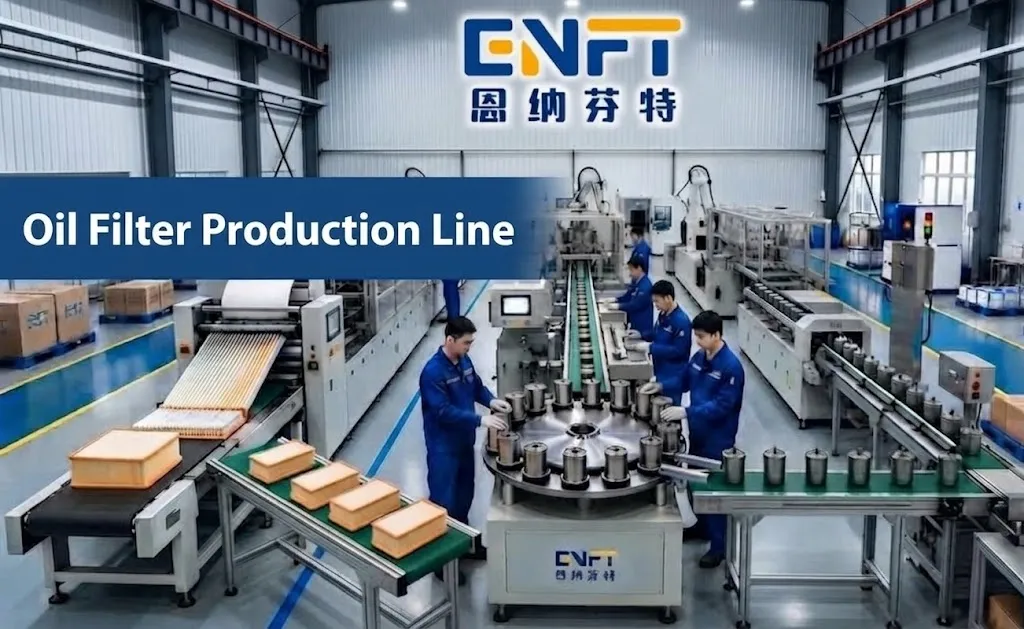
An oil filter production line is one of the most important industrial solutions for investors seeking to enter the automotive filter manufacturing industry and meet the demand for filtration products in the automotive spare parts market. The line consists of a group of specialized machines that perform different production stages, starting with preparing and pleating the filtration media, continuing through the assembly of metal components and installation of internal parts, and ending with filter testing and packaging.
The success of an automotive oil filter manufacturing project depends on selecting the appropriate machinery, ensuring raw material quality, achieving precise assembly, and conducting effective final inspections. It also requires determining the target filter types, production capacity, automation level, and total factory investment before purchasing equipment.
What Is an Oil Filter Production Line?
An oil filter production line is an industrial system that includes the machinery and equipment required to manufacture and assemble engine oil filters according to specific technical specifications. The line's configuration varies depending on the filter design, production volume, automation level, and materials used.
The primary function of the line is to transform raw materials into a finished oil filter capable of removing particles and contaminants from engine oil according to the required filtration level.
A production line typically includes several main stages, such as:
Preparing and cutting the filtration paper.
Pleating the filtration paper and forming the filter element.
Preparing the end covers and metal components.
Securing the filtration element using suitable materials.
Assembling the filter housing and internal components.
Installing gaskets and valves according to the design.
Conducting quality and leak tests when required.
Packaging the filters and preparing them for distribution.
Not all machines have to be installed in a single unit. An integrated production line can be built from interconnected equipment, or machines can be purchased in stages according to the factory's requirements.
What Types of Oil Filters Can Be Manufactured?
Automotive oil filters vary in design, installation method, and replacement procedure. Therefore, the target filter type must be identified before designing the production line.
1. Spin-On Metal Oil Filter
This filter comes as a sealed unit containing a metal housing, a filtration element, and internal components. It is generally replaced as a complete unit.
Manufacturing it requires processes for forming the housing, preparing the filtration element, assembling the components, installing the gasket, and testing the finished product.
2. Cartridge Oil Filter
This design uses a replaceable filtration element installed inside a filter housing already present in the engine. Manufacturing the element may require equipment different from that used to manufacture enclosed metal oil filters.
3. High-Efficiency Oil Filters
Some filters are designed to capture fine particles according to specific requirements while maintaining oil flow within the required limits. Their manufacturing process depends on the filtration media, design, and necessary performance tests.
Comparison of Oil Filter Types
Type | Replacement Method | Manufacturing Requirements |
|---|---|---|
Spin-On | The complete unit is replaced | Housing forming and assembly of internal components |
Cartridge | Usually, only the filtration element is replaced | Manufacturing and preparing the filtration element and its components |
High-Efficiency Filters | Depends on the design | Suitable filtration media and specific performance testing |
What About Mitsubishi Oil Filters?
If you intend to manufacture a Mitsubishi oil filter or filters for other automotive brands, you must identify the part number, dimensions, engine specifications, and oil flow and filtration requirements.
A similar external appearance is not sufficient. The filter's technical specifications must match the intended application.
Likewise, when examining the difference between an original Toyota oil filter and a counterfeit one, you should verify the part number, product source, material quality, and technical compatibility rather than relying solely on color, packaging, or price.
Oil Filter Components and the Function of Each Part
An oil filter consists of several components that work together to ensure filtration, oil flow, and sealing during operation.
Component | Function |
|---|---|
Filtration Media | Captures particles and contaminants |
Outer Housing | Protects the internal components |
End Caps | Secure the filtration element |
Center Tube | Supports the element and provides an oil flow path |
Bypass Valve | Provides an alternative oil flow path under specific conditions, depending on the design |
Anti-Drainback Valve | Reduces oil drainback in designs that use this component |
Gasket | Seals the connection between the filter and its mounting point |
Spring | Secures certain components and maintains their position |
Adhesives | Secure specific parts of the filtration element |
Mounting Base | Connects the filter to the engine system |
These components may vary from one filter to another. Not every design contains the same valves or uses the same internal arrangement.
For this reason, an oil filter production line must be designed to match the actual construction of the target product.
What Machines Are Used in an Oil Filter Production Line?
Machine selection depends on the filter type, production capacity, and automation level. A production line may include several specialized machines that perform successive operations.
1. Filter Paper Cutting Machine
This machine cuts the filtration media to the required dimensions, preparing it for pleating and forming.
2. Filter Paper Pleating Machine
It forms the paper into regular pleats to provide an appropriate filtration area within the filter's specified dimensions.
3. Filter Element Forming Machine
This machine helps prepare the pleated element according to the required dimensions and shape, depending on the filter design.
4. End Cap Installation Machine
It secures the end caps to the filtration element using a mechanism suitable for the adhesive and the product's characteristics.
5. Metal Component Forming Equipment
This equipment is used to manufacture the outer housing or other metal components if the factory intends to produce these parts in-house rather than purchase them ready-made.
6. Filter Assembly Equipment
It assembles the filtration element with the center tube, valves, springs, and other components according to the design.
7. Gasket Installation and Closing Equipment
This equipment installs the gasket and closes the filter or completes its final preparation, depending on the filter type.
8. Testing Equipment
Testing equipment may include systems for inspecting leaks, dimensions, assembly strength, and required performance characteristics.
9. Packaging Equipment
This equipment prepares finished filters for storage, transportation, and distribution.
Equipment and Its Function
Machine | Production Stage | Importance |
|---|---|---|
Cutting Machine | Material Preparation | Dimensional accuracy and waste reduction |
Pleating Machine | Filtration Forming | Consistent pleats |
End Cap Installation Machine | Element Assembly | Securing filtration components |
Metal Forming Equipment | Housing Preparation | Producing the required shape |
Assembly Equipment | Component Assembly | Creating the finished filter |
Testing Equipment | Quality Control | Detecting defects according to inspection criteria |
Packaging Equipment | Packaging | Protecting the product and preparing it for shipment |
Raw Materials Used in Oil Filter Manufacturing
Raw material quality directly affects the quality of the finished filter and its production cost.
The main materials used in automotive oil filter manufacturing include:
Filter paper designed for engine oil applications.
Metal sheets for manufacturing the housing and internal components.
Plastic materials for certain components, depending on the design.
Rubber used in gaskets and seals.
Metal springs.
Adhesives suitable for operating temperatures and conditions.
Packaging materials.
How Do You Choose the Right Raw Materials?
Several factors should be considered:
Compatibility with the engine type and intended application.
Particle retention efficiency.
Ability to maintain the required oil flow.
Resistance to heat and oil.
Quality of metal and rubber components.
Consistency of material properties between production batches.
Reliable and continuous availability of raw materials.
It is important to conduct appropriate tests on the materials and finished product before beginning large-scale commercial production.
Types of Oil Filter Production Lines
Production lines can be classified according to their automation level and the way their equipment is organized.
Manual or Low-Automation Production Line
This type relies on operator involvement in many operating and assembly stages.
Suitable for: Limited production, initial trials, or certain specialized manufacturing operations.
Its challenges include greater dependence on operator skill and a higher possibility of variation between finished products.
Semi-Automatic Production Line
This type combines automated machinery with some manual operations.
Suitable for: Factories that need consistent production while maintaining flexibility in handling different models.
Automatic Production Line
This type uses automated equipment and control systems to reduce manual intervention in repetitive production stages.
Suitable for: High-volume production when the product characteristics, expected demand, and budget justify this level of investment.
Comparison of Automation Levels
Criterion | Manual | Semi-Automatic | Automatic |
|---|---|---|---|
Initial Investment | Usually lower | Medium | Usually higher |
Labor Requirements | Higher | Medium | Relatively lower |
Production Speed | Limited | Medium | Potentially high |
Model Changeover | Depends on organization | Relatively flexible | Depends on line design |
Production Consistency | Operator-dependent | Good when the process is properly controlled | Can be high |
Maintenance | Simpler in some cases | Medium | May require greater technical expertise |
Choosing an automatic production line does not mean it is the best option for every project. The decision depends on expected demand, investment costs, and the target products.
Production Capacity of an Oil Filter Production Line
Production capacity is determined by machine speed, filter design, working hours, model changeover time, downtime, and the percentage of products that pass inspection.
Therefore, it is important to distinguish between a machine's nominal speed and the actual production capacity of the entire line.
Illustrative Calculation Example
Suppose a production line is designed to manufacture 400 filters per hour and operates eight hours per day for 26 days per month.
The theoretical calculation is:
400 × 8 × 26 = 83,200 filters per month.
However, this figure assumes continuous operation at the specified speed. It does not account for maintenance downtime, model changeovers, restarts, or rejected products.
Actual production should therefore be estimated using expected operating data rather than relying solely on the theoretical calculation.
How Do You Calculate the Required Production Capacity?
Determine the expected monthly demand.
Determine the number of operating hours per day.
Determine the number of operating days.
Calculate the required production line speed.
Allow an appropriate margin for downtime.
Check whether all machines can operate at compatible speeds.
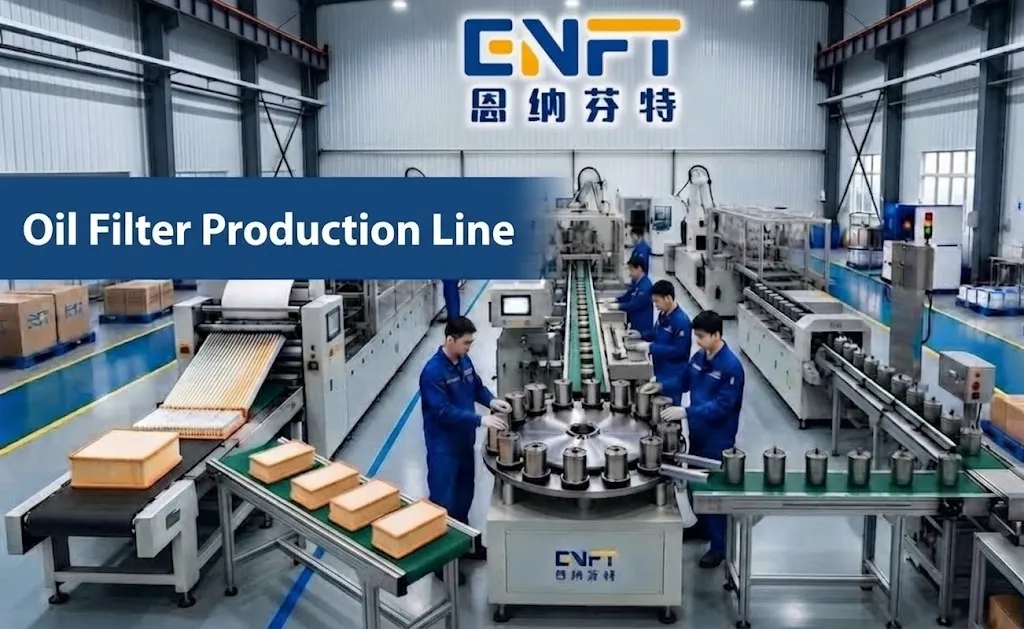
If one production stage is slower than the others, it may become the bottleneck that limits the output of the entire line.
Difference Between an Integrated Oil Filter Production Line and Buying Machines Separately
A factory can purchase an integrated production line from a specialized supplier or buy individual machines from different suppliers.
Each option has advantages and challenges.
Comparison | Integrated Production Line | Purchasing Machines Separately |
|---|---|---|
Production Stage Planning | Can be coordinated as one system | Requires coordination between suppliers |
Equipment Compatibility | Easier to plan when specifications are unified | Requires careful compatibility checks |
Equipment Selection Flexibility | Depends on the proposed solution | Greater flexibility in selecting each machine |
Installation Management | May be simpler with one supplier | May require coordination between multiple parties |
Expansion | Depends on the line design | Equipment can be added gradually |
Cost | Depends on the supply scope | May appear cheaper initially, but total cost must be calculated |
Which Option Is Better?
If you are establishing a new factory and need to coordinate the manufacturing stages, an integrated production line may be a suitable option.
However, if you already operate a factory and want to replace one machine or increase the capacity of a specific stage, purchasing an individual machine may be more appropriate.
In either case, you must ensure that the equipment is compatible with the target product, material specifications, and required production capacity.
Requirements for Establishing an Oil Filter Manufacturing Factory
Establishing an oil filter factory requires planning beyond purchasing machinery. The location, facilities, workforce, quality systems, and raw material supply must also be evaluated.
1. Market Research
Identify the types of filters in demand, target customers, competitors, prices, and distribution channels.
2. Product Selection
Decide whether the factory will manufacture Spin-On filters, Cartridge filters, or more than one type.
3. Selecting the Location and Factory Space
The available space must accommodate machinery installation, raw material storage, finished product storage, and safe movement routes.
4. Preparing Utilities
Electricity, compressed air, and ventilation requirements vary according to the machinery used.
5. Securing Raw Materials
Reliable suppliers must be identified for filter paper, metal and rubber components, and adhesives.
6. Providing Technical Personnel
Depending on production volume, the factory will need machine operators, maintenance technicians, and quality control personnel.
7. Establishing a Quality System
Procedures must be developed for inspecting raw materials, monitoring manufacturing stages, and testing finished products.
8. Planning Maintenance
Preventive maintenance helps reduce breakdowns and unplanned downtime.
Tip: Do not determine the factory space, workforce size, or investment level before understanding the production line configuration and the actual equipment requirements.
Cost of an Oil Filter Production Line
There is no fixed cost that applies to every production line. Prices vary according to the number and specifications of machines, their origin, production capacity, automation level, and overall supply scope.
The main factors affecting the cost of an oil filter production line include:
The types of filters to be manufactured.
The number of machines.
The automation level.
Production capacity.
Whether metal components need to be manufactured in-house.
Testing and quality control systems.
Molds and tooling for different models.
Installation and training.
Shipping, insurance, and customs charges where applicable.
Spare parts and maintenance.
Factory preparation and utilities.
Costs to Calculate Before Purchasing
Cost Item | What to Evaluate |
|---|---|
Machinery | Equipment prices and supply scope |
Molds and Tooling | Cost for each model or design |
Raw Materials | Cost per filter |
Labor | Operation, maintenance, and quality control |
Energy and Utilities | Electricity and compressed air consumption |
Maintenance | Spare parts and technical service |
Quality | Testing and inspection equipment |
Transportation and Installation | Depending on the location and supply terms |
Initial Operation | Trials, training, and initial production waste |
How Do You Compare Quotations?
Do not compare only the total price. Ask each supplier to specify the included machines, production capacity, technical specifications, molds, testing systems, spare parts, training, warranty terms, and installation arrangements.
This allows you to compare quotations on an equivalent basis and estimate the project's total cost more accurately.
How Do You Choose the Best Oil Filter Production Line for Your Factory?
Selecting the right line depends on the project's objectives, investment capacity, and the products it will offer to the market.
Follow these steps:
Step One: Determine the Filter Type.
Document the specifications, dimensions, part number, and intended design.
Step Two: Determine Production Capacity.
Estimate expected demand, then determine the number of units required per hour and per month.
Step Three: Choose the Automation Level.
Balance initial investment against labor costs, productivity, and flexibility.
Step Four: Review Machine Compatibility.
Ensure that the cutting, pleating, assembly, and closing stages operate in a suitable sequence.
Step Five: Verify Quality Requirements.
Determine the required filtration, leakage, sealing, and dimensional tests according to the product specifications.
Step Six: Evaluate the Supplier.
Review the supplier's technical experience, equipment specifications, after-sales service, and spare parts availability.
Step Seven: Calculate the Total Cost.
Include operating expenses, raw materials, and maintenance—not just the machinery purchase price.
Step Eight: Plan for Expansion.
If you intend to introduce new models, discuss the possibility of changing dimensions or adding equipment in the future.
Checklist Before Purchasing a Production Line
Identify the target filter types.
Prepare a list of dimensions and specifications.
Determine production capacity.
Determine the automation level.
Review the required machinery.
Identify the necessary tests.
Estimate the total cost.
Confirm raw material availability.
Review technical support and spare parts availability.
Prepare an operating and maintenance plan.
Advantages of Buying an Oil Filter Production Line from ENFT
ENFT operates in the field of air filter, oil filter, and automotive filter manufacturing machinery. This specialization helps support equipment planning according to the requirements of the filter manufacturing process.
When planning to purchase a production line, it is important to focus on several technical and operational factors.
Selecting Equipment According to Filter Type
The manufacturing requirements for a Spin-On oil filter differ from those for a Cartridge oil filter. Therefore, the production line configuration should match the intended design.
Coordinating Production Stages
Planning the machines as one integrated system helps reduce the likelihood of bottlenecks between filtration media preparation, assembly, and testing.
Defining Target Production Capacity
Each stage needs sufficient capacity so that one machine does not reduce the output of the entire line.
Considering Finished Product Quality
Inspection and testing processes should be incorporated into the manufacturing plan rather than focusing on production speed alone.
Evaluating Factory Requirements
Planning may cover filter types, dimensions, raw materials, automation levels, and future expansion requirements.
Planning Maintenance and Operation
Before purchasing, it is important to ask about maintenance requirements, spare parts, training, and the technical support included in the supply quotation.
The final specifications, cost, and production capacity depend on the required line configuration. Therefore, requesting a customized technical quotation is preferable to relying on general estimates.
Start Your Oil Filter Manufacturing Project with ENFT
Are you planning to establish a new factory or upgrade an existing production line for automotive oil filter manufacturing?
Evaluating your project's requirements before purchasing equipment can help you select suitable machinery, determine production capacity, and avoid unnecessary costs.
Contact ENFT to discuss the requirements of your oil filter production line.
Provide the type of filter you want to manufacture, the required dimensions, your target production capacity, and the automation level that suits your project. This will help establish a technical proposal aligned with your industrial requirements.
Start planning your factory with ENFT and select oil filter manufacturing equipment based on clear specifications and measurable production objectives.