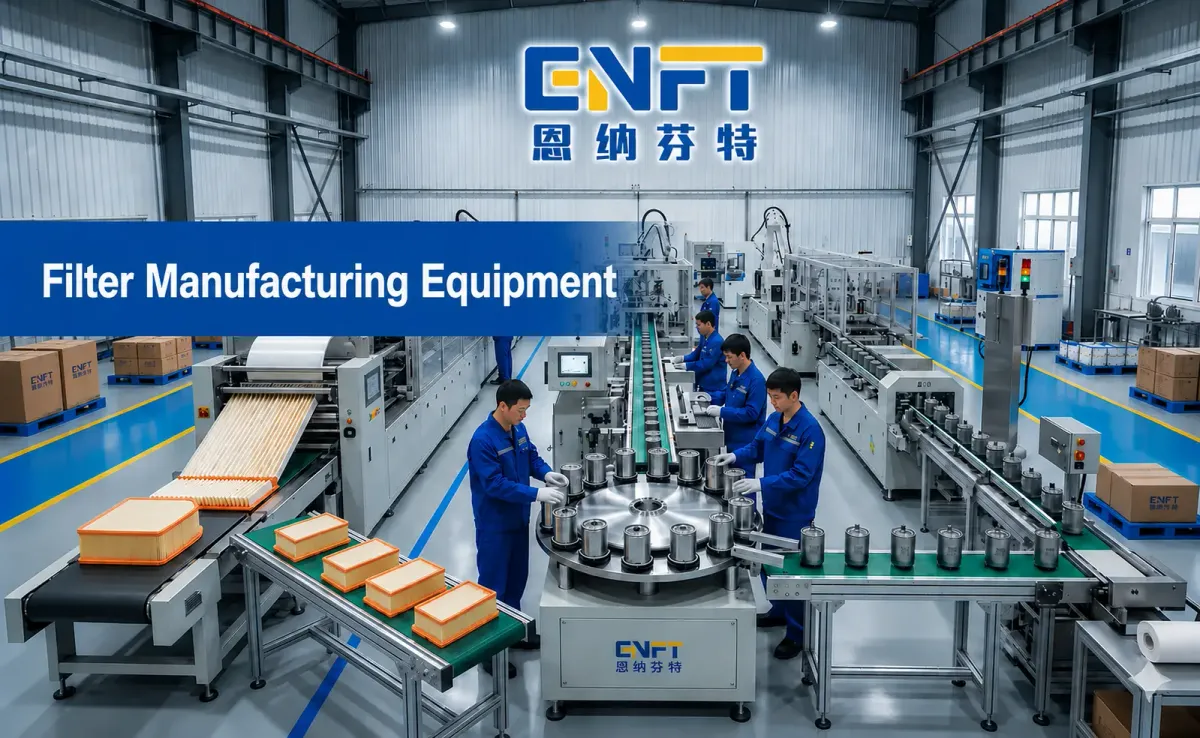
Filter Manufacturing Equipment: The Complete Guide to Choosing the Best Equipment for a Successful Filter Factory

Filter manufacturing equipment is the foundation of every modern filter production facility. Whether you are planning to establish a new air filter factory, expand your existing production capacity, or invest in a complete manufacturing solution, selecting the right filter manufacturing equipment directly affects product quality, production efficiency, operating costs, and long-term profitability.
Today, the global filtration industry continues to grow rapidly due to increasing demand for automotive, industrial, and HVAC filtration systems. Modern factories manufacture products ranging from automotive oil filters and air filters to fuel filters, industrial filtration elements, and advanced vacuum filtration systems. Choosing reliable filter manufacturing equipment ensures higher productivity, lower production costs, and consistent product quality.
What Is Filter Manufacturing Equipment?
Filter manufacturing equipment refers to the complete range of industrial machines used to manufacture different types of filtration products. These machines automate every production stage, from processing raw materials to assembling, testing, printing, and packaging finished filters.
Unlike manual production, modern equipment provides high precision, repeatability, and production efficiency while reducing labor costs and minimizing material waste.
Modern filter manufacturing equipment is commonly used to produce:
Automotive air filters
Oil filters
Fuel filters
Cabin air filters
Hydraulic filters
Industrial filters
HVAC filtration products
Components used in vacuum filtration systems
For manufacturers planning to build an air filter factory, investing in advanced equipment is essential for maintaining international quality standards and achieving competitive production costs.
Why Invest in Modern Filter Manufacturing Equipment?
Investing in advanced filter manufacturing equipment offers significant long-term advantages for manufacturers.
Key Benefits
Higher production capacity
Consistent product quality
Lower labor costs
Reduced material waste
Improved manufacturing accuracy
Faster production cycles
Easier factory management
Better return on investment
Practical Example
A factory producing automotive air filters manually may manufacture only a limited number of filters per day with varying quality. By installing a complete automated production line from an experienced Air Filter Production Line Manufacturer, production output can increase dramatically while maintaining consistent product specifications.
Types of Filters Manufactured Using Modern Equipment
Modern filter manufacturing equipment is designed to produce a wide variety of filtration products for different industries.
Filter Type | Main Application |
Oil Filters | Automotive engines |
Air Filters | Vehicle air intake systems |
Fuel Filters | Fuel purification |
Cabin Air Filters | Vehicle HVAC systems |
Hydraulic Filters | Hydraulic equipment |
Industrial Filters | Manufacturing plants |
Vacuum Filtration Elements | Industrial processing |
Heavy-Duty Filters | Trucks & construction equipment |
Many manufacturers combine several production lines within the same factory to maximize profitability and serve multiple market sectors.
Which Filter Products Offer the Highest Market Demand?
For investors entering the filtration industry, choosing the right product category is critical.
Product | Market Demand | Investment Potential |
Oil Filters | Very High | Excellent |
Air Filters | Very High | Excellent |
Fuel Filters | High | Very Good |
Cabin Filters | High | Very Good |
Industrial Filters | Growing | Excellent |
Vacuum Filtration Products | Specialized | High Margin |
A diversified production strategy allows manufacturers to serve automotive, industrial, and commercial customers simultaneously.
Types of Filter Manufacturing Equipment
Different filters require different manufacturing machines. A complete production facility typically includes specialized equipment for each manufacturing stage.
Machine | Primary Function |
Filter Paper Pleating Machine | Forms filtration media |
Mesh Expanding Machine | Produces support mesh |
Center Tube Machine | Manufactures perforated tubes |
End Cap Assembly Machine | Installs end caps |
PU Dispensing Machine | Produces polyurethane seals |
Gluing Machine | Bonds filter media |
Assembly Machine | Combines filter components |
Leak Testing Machine | Quality inspection |
Printing Machine | Product marking |
Packaging Machine | Final packaging |
Some factories also integrate dedicated oil filter manufacturing machine units alongside air filter production equipment to manufacture multiple product categories.

Complete Filter Manufacturing Production Line
Instead of purchasing standalone machines, many manufacturers choose a complete filter manufacturing equipment solution.
A modern production line typically includes:
Raw material feeding system
Filter paper pleating machine
Cutting machine
Adhesive application system
Assembly machine
End cap installation
Leak testing system
Automatic inspection
Product printing
Packaging machine
Production Workflow
Raw Materials
↓
Paper Pleating
↓
Cutting
↓
Assembly
↓
Sealing
↓
Quality Inspection
↓
Printing
↓
Packaging
↓
Finished Products
This integrated process minimizes production time while maximizing manufacturing consistency.
Main Machines Used in Filter Manufacturing
Every successful filter manufacturing equipment system relies on several specialized production machines.
Machine | Function |
Pleating Machine | Creates filter folds |
Cutting Machine | Cuts filter media |
PU Injection Machine | Produces polyurethane frames |
Assembly Machine | Combines components |
Leak Testing Machine | Detects defects |
Laser Printing Machine | Prints specifications |
Packing Machine | Automatic packaging |
Each machine plays a critical role in ensuring production quality and efficiency.
Filter Manufacturing Process
Modern filter manufacturing equipment follows a carefully controlled production process.
Step 1 — Raw Material Inspection
Incoming materials such as filter paper, steel components, adhesives, and polyurethane are inspected before production begins.
Step 2 — Filter Media Pleating
Specialized pleating machines fold the filtration media into uniform patterns that maximize filtration efficiency.
Step 3 — Cutting
Automatic cutting machines trim the filter media according to product specifications.
Step 4 — Frame or End Cap Assembly
Depending on the product type, the filter element is assembled with:
Plastic frame
Metal housing
Polyurethane seal
End caps
Step 5 — Adhesive Bonding
Industrial adhesive systems permanently secure the filtration media.
Step 6 — Final Assembly
All components are assembled into the finished filter.
Step 7 — Quality Testing
Every filter undergoes leak testing, dimensional inspection, and visual quality checks before packaging.
Step 8 — Printing & Packaging
Finished filters receive branding, technical information, and automatic packaging before shipment.
Raw Materials Used in Filter Manufacturing
The quality of raw materials directly determines the performance and service life of the finished filter.
Material | Purpose |
Filter Paper | Filtration media |
Synthetic Fiber | High-efficiency filtration |
Expanded Metal Mesh | Structural support |
Polyurethane | Air filter sealing |
Steel Sheet | Oil filter housing |
Rubber Gaskets | Sealing |
Adhesives | Bonding |
End Caps | Structural reinforcement |
Protective Coatings | Corrosion resistance |
Premium raw materials improve durability, filtration efficiency, and product reliability.
Technical Specifications of Filter Manufacturing Equipment
Before purchasing filter manufacturing equipment, manufacturers should carefully evaluate machine specifications.
Specification | Importance |
Production Capacity | Determines daily output |
Product Size Range | Manufacturing flexibility |
Automation Level | Labor efficiency |
PLC Control System | Precision operation |
HMI Touch Screen | Easy operation |
Power Consumption | Operating cost |
Air Pressure | Pneumatic system compatibility |
Machine Speed | Production efficiency |
Safety Protection | Operator safety |
Maintenance Requirements | Long-term reliability |
Pre-Purchase Checklist
✔ Does the equipment support multiple filter sizes?
✔ Can production capacity meet future demand?
✔ Is technical training included?
✔ Are spare parts readily available?
✔ Does the supplier provide after-sales service?
✔ Does the equipment comply with international safety standards?
✔ Can the production line be expanded in the future?
Which Production Line Fits Your Factory?
Factory Size | Recommended Equipment |
Startup Factory | Semi-Automatic Filter Manufacturing Line |
Medium Factory | Automatic Production Line |
Large Industrial Plant | Fully Automated Smart Manufacturing Line |
Practical Example
A company establishing a new air filter factory may begin with a semi-automatic production line to control initial investment. As customer demand grows, additional automated stations can be integrated into the existing production line, increasing output without replacing the entire system.
Automation Levels in Filter Manufacturing Equipment
Automation is one of the most important factors affecting the efficiency, productivity, and profitability of filter manufacturing equipment. The appropriate automation level depends on your production capacity, investment budget, labor availability, and long-term business goals.
1. Manual Production Equipment
Manual production relies heavily on operators to complete most manufacturing tasks.
Advantages
Low initial investment
Easy to operate
Suitable for small workshops
Simple maintenance
Disadvantages
Limited production capacity
Higher labor costs
Inconsistent product quality
Increased material waste
Manual systems are generally recommended only for small-scale production or prototype manufacturing.
2. Semi-Automatic Filter Manufacturing Equipment
Semi-automatic production lines combine automated machinery with manual operations.
Advantages
Moderate investment cost
Improved production efficiency
Better product consistency
Flexible production
Easier maintenance
This option is ideal for manufacturers planning to expand gradually while maintaining reasonable operating costs.
3. Fully Automatic Filter Manufacturing Equipment
Fully automated production lines perform almost every manufacturing process without manual intervention.
Advantages
Maximum productivity
Stable product quality
Lower operating costs
Reduced labor requirements
Continuous production
Real-time monitoring
Easy production planning
Factories targeting international markets often choose fully automated systems to ensure consistent quality and maximize return on investment.
Automation Comparison
Feature | Manual | Semi-Automatic | Fully Automatic |
Production Speed | Low | Medium | High |
Product Quality | Variable | Good | Excellent |
Labor Requirement | High | Medium | Low |
Material Waste | High | Medium | Very Low |
Operating Cost | High | Medium | Low |
Initial Investment | Low | Medium | High |
Factory Setup Requirements
Proper factory planning is essential before installing filter manufacturing equipment.
Factory Layout
A modern factory should include:
Raw material warehouse
Production workshop
Quality control laboratory
Finished goods warehouse
Packaging section
Maintenance room
Technical office
Loading area
Utilities Required
A professional manufacturing facility should provide:
Stable electrical power
Compressed air system
Industrial ventilation
Fire protection system
Temperature control
Material handling equipment
Quality inspection area
Workforce Requirements
Typical staffing includes:
Position | Responsibility |
Production Manager | Production supervision |
Machine Operators | Equipment operation |
Maintenance Engineers | Machine servicing |
Quality Inspectors | Product inspection |
Packaging Staff | Final packaging |
Warehouse Personnel | Inventory management |
Practical Example
A medium-sized air filter factory equipped with modern production lines can operate efficiently with a relatively small team because most manufacturing stages are automated, reducing labor costs while increasing production consistency.
How to Choose the Best Filter Manufacturing Equipment
Selecting the right filter manufacturing equipment is one of the most important decisions for any filtration manufacturer.
Step 1 — Define Your Products
Determine exactly which filters you intend to manufacture.
Examples include:
Automotive air filters
Oil filters
Fuel filters
Cabin filters
Industrial filters
HVAC filters
Vacuum filtration elements
Step 2 — Estimate Production Capacity
Before purchasing equipment, determine:
Daily production target
Monthly sales forecast
Future expansion plans
Available factory space
Choosing equipment with scalable production capacity helps support future business growth.
Step 3 — Evaluate the Equipment Supplier
A reliable supplier should provide:
Installation services
Machine commissioning
Technical training
Spare parts
Warranty
Long-term after-sales support
Working with an experienced Air Filter Production Line Manufacturer significantly reduces operational risks.
Step 4 — Compare Technical Specifications
Important evaluation criteria include:
Production speed
Machine accuracy
Automation level
Power consumption
Maintenance requirements
Safety systems
Production flexibility
Practical Example
A manufacturer planning to produce both automotive air filters and oil filters may benefit from selecting modular filter manufacturing equipment that allows additional machines to be integrated as production expands.
Common Problems in Filter Manufacturing Equipment
Even the most advanced filter manufacturing equipment requires proper operation and maintenance to ensure reliable performance.
Problem | Possible Cause | Recommended Solution |
Uneven pleating | Incorrect machine calibration | Adjust pleating system |
Adhesive failure | Improper glue application | Optimize adhesive settings |
Poor sealing | Assembly inaccuracy | Improve assembly process |
High material waste | Machine misalignment | Regular calibration |
Production downtime | Lack of preventive maintenance | Implement maintenance schedule |
Inconsistent dimensions | Incorrect tooling | Replace worn components |
Example
If an oil filter manufacturing machine repeatedly produces leaking filters, technicians should inspect the adhesive application system, gasket installation, and sealing pressure before resuming production.

Preventive Maintenance Tips
Following a preventive maintenance schedule helps maximize equipment life and reduce unexpected downtime.
Maintenance Interval | Recommended Tasks |
Daily | Cleaning and visual inspection |
Weekly | Lubrication of moving parts |
Monthly | Inspection of sensors and pneumatic systems |
Quarterly | Machine calibration |
Every 6 Months | Comprehensive preventive maintenance |
Consistent maintenance improves machine reliability and lowers long-term operating costs.
How to Start a Filter Manufacturing Business
Starting a filter manufacturing business is an excellent investment opportunity driven by the growing global demand for automotive, industrial, and HVAC filtration products. Whether you plan to manufacture air filters, oil filters, fuel filters, or specialized industrial filtration systems, success depends on careful planning, selecting the right filter manufacturing equipment, and partnering with an experienced equipment supplier.
Before investing, it is essential to conduct comprehensive market research to identify your target customers, analyze competitors, and determine which filter products offer the greatest business potential. For many investors, beginning with high-demand products such as automotive air and oil filters provides a solid foundation for long-term growth.
The next step is choosing the appropriate production line based on your expected production capacity, available factory space, and investment budget. Modern, scalable filter manufacturing equipment allows manufacturers to increase production over time without replacing the entire production line, making future expansion more cost-effective.
Equally important is preparing your factory with the necessary infrastructure, including reliable power, compressed air systems, quality control facilities, and efficient material handling. Using premium raw materials, implementing strict quality control procedures, and training operators to use the equipment correctly are all critical factors in producing reliable filtration products that meet international standards.
Roadmap to Launch Your Filter Manufacturing Business
Step | Description |
1. Market Research | Analyze demand, competitors, and target industries. |
2. Select Filter Types | Decide whether to produce air filters, oil filters, fuel filters, cabin filters, or industrial filters. |
3. Choose the Right Equipment | Invest in reliable filter manufacturing equipment that matches your production goals. |
4. Prepare the Factory | Set up production areas, utilities, and quality control facilities. |
5. Source High-Quality Raw Materials | Use premium filter media, steel components, adhesives, and sealing materials. |
6. Install & Test the Production Line | Complete installation, calibration, and trial production before commercial operation. |
7. Train Your Team | Ensure operators understand machine operation, maintenance, and quality procedures. |
8. Start Commercial Production | Launch manufacturing with consistent quality control and continuous process improvement. |
By combining advanced filter manufacturing equipment, efficient factory management, and a commitment to product quality, manufacturers can build a competitive and profitable filter production business capable of serving both domestic and international markets. For companies seeking a complete turnkey solution, ENFT provides the expertise, equipment, and technical support needed to transform a manufacturing idea into a successful and sustainable business.
Benefits of Investing in Modern Filter Manufacturing Equipment from ENFT
Choosing the right manufacturing partner is just as important as choosing the right machinery.
ENFT provides complete filter manufacturing equipment solutions designed for manufacturers seeking high productivity, outstanding product quality, and sustainable business growth.
Why Choose ENFT?
Complete production lines for air, oil, and fuel filters
Advanced oil filter manufacturing machine solutions
Professional Air Filter Production Line Manufacturer
Customized production line design
High-speed automated equipment
Reliable filtration machine technology
Engineering consultation before purchase
Installation and commissioning support
Operator training
Fast spare parts supply
Comprehensive after-sales service
Future production line upgrade solutions
Whether you are building a new air filter factory or expanding an existing facility, ENFT provides reliable manufacturing solutions tailored to your production goals.
Build Your Filter Manufacturing Business with ENFT
Looking for high-performance filter manufacturing equipment that delivers exceptional productivity, precision, and long-term profitability?
ENFT offers complete turnkey manufacturing solutions—from factory planning and machine selection to installation, training, technical support, and production optimization.
Contact ENFT today for a free consultation and customized quotation. Our engineering experts will help you select the ideal filter manufacturing equipment to build a modern, efficient, and profitable filter production facility.