
Air Filter Production Line: The Complete Guide to Machinery, Manufacturing, and Factory Setup
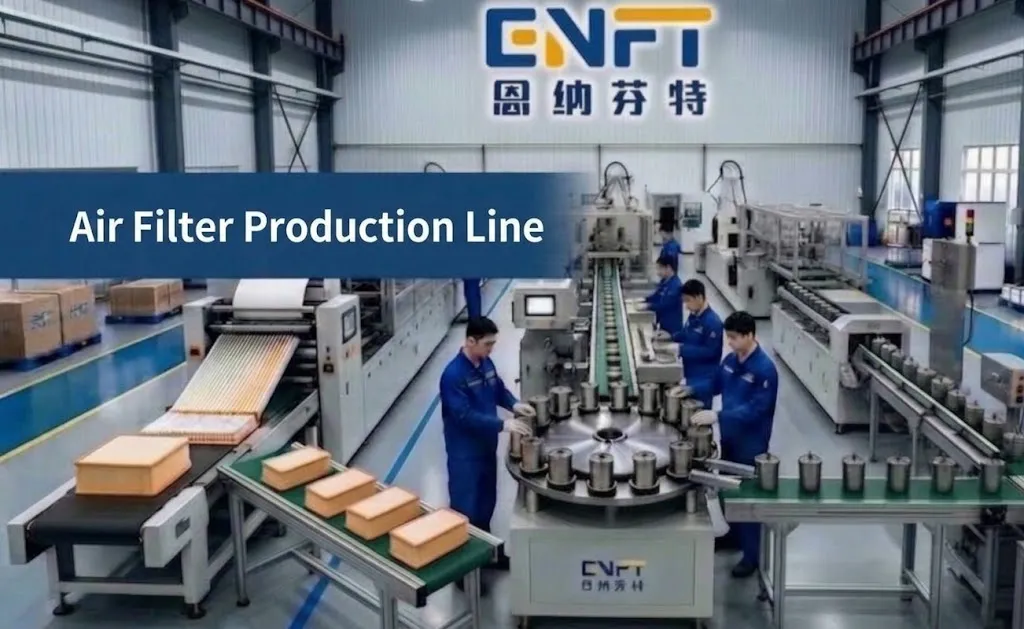
An air filter production line is one of the most important industrial investments for businesses aiming to manufacture automotive air filters or industrial air filters. It consists of a range of machines and equipment that transform raw materials into finished products, starting with preparing and pleating the filter media, continuing through component assembly and fastening, and ending with filter quality inspection and packaging.
The success of an air filter manufacturing project depends on selecting a production line that matches the target filter types, required production capacity, level of automation, and raw material quality. Understanding the manufacturing stages, operating costs, and quality requirements also helps investors make informed decisions, reduce waste, and improve production efficiency.
In this guide, we explore the types of air filters that can be manufactured, the machinery used in production lines, the raw materials required, operating procedures, factory setup requirements, and how to select the right production line for your project. We also explain the role of ENFT, a company specializing in machinery for manufacturing air filters, oil filters, and automotive filters.
What Is an Air Filter Production Line?
An air filter production line is an industrial system that includes the machinery and equipment required to manufacture, assemble, and test filters according to the product type and required specifications. A production line may be dedicated to a specific stage, such as filter paper pleating, or it may be a complete line covering several stages, from raw material preparation to the production of the finished filter.
The components of a production line vary depending on the type of filter. An automotive air filter production line requires equipment suitable for the shapes and dimensions used in vehicles, while industrial filter manufacturing may require additional machinery to handle larger sizes or specialized filtration media.
The main functions of an air filter production line include:
Preparing and cutting filtration media to the required dimensions.
Forming filter paper pleats according to the specified design.
Manufacturing or preparing frames, end caps, and supporting components.
Assembling parts using suitable fastening methods or adhesives.
Inspecting dimensions, assembly quality, and filtration performance.
Packaging finished products for storage or distribution.
What Is the Difference Between a Single Filter Manufacturing Machine and a Complete Production Line?
Comparison Factor | Single Machine | Complete Production Line |
|---|---|---|
Function | Performs a specific manufacturing process | Connects multiple manufacturing stages within one integrated or interconnected system |
Initial Investment | Usually lower when purchasing a single machine | Generally higher, depending on the number of machines and the level of automation |
Production Capacity | Depends on the operation performed by the machine | Depends on the performance and balance of all production stages |
Labor Requirements | May require manual intervention between stages | Can reduce manual intervention when automation is integrated |
Flexibility | Suitable for upgrading a specific manufacturing stage | Suitable for projects that require an organized production workflow |
Applications | Gradual expansion or completion of an existing production line | Establishing a factory or developing a broader manufacturing system |
Practical example: If your factory already has a filter paper pleating machine but experiences delays during assembly, purchasing additional assembly equipment may be more cost-effective than replacing the entire production line. However, if you are starting a new project, it is better to evaluate the complete sequence of manufacturing operations before selecting the equipment.
What Types of Air Filters Can Be Manufactured?
Different production lines can be used to manufacture various types of air filters, but a single production line does not necessarily suit every filter type. Equipment selection depends on the filter shape, filtration media, assembly method, and performance requirements.
The main types of air filters that an air filter manufacturing project can target include:
Filter Type | Application | Key Manufacturing Requirements |
|---|---|---|
Automotive air filters | Purifying the air entering the engine | Precise pleating, compatible dimensions, and secure assembly |
Cabin air filters | Purifying the air entering the vehicle cabin | Suitable filtration media, a compatible frame, and high assembly quality |
Air conditioning filters | HVAC and ventilation systems | Appropriate dimensions, suitable airflow resistance, and secure installation |
Industrial air filters | Factories, equipment, and ventilation systems | A design suited to operating conditions and airflow requirements |
Flat panel filters | Certain ventilation and air purification applications | Accurate cutting and a suitable frame |
Pleated air filters | Automotive, industrial, and HVAC applications | Stable pleats arranged according to the specified design |
What Is the Difference Between Automotive Filter Manufacturing and Industrial Filter Manufacturing?
Automotive filter manufacturing differs from industrial filter manufacturing in product shape, dimensions, materials, and testing requirements.
Automotive filters: Require precise compatibility with the installation location, with particular attention to sealing, vibration resistance, and operating conditions.
Industrial filters: Requirements vary by application and may include larger filtration areas, stronger structures, or specialized filtration media.
Air conditioning filters: Manufacturing requirements depend on the HVAC system, airflow rate, and required filtration level.
If your goal is to manufacture automotive air filters, it is important to identify the vehicle types, shapes, and dimensions you intend to serve before purchasing machinery. If you are targeting the industrial market, you should identify the filter types, the industries that will use them, and the performance requirements for each application.
What Machines Are Used in an Air Filter Production Line?
The machinery used in an air filter production line varies according to the target product, the level of automation, and whether the factory will manufacture components internally or purchase some of them ready-made.
The equipment may include filter media preparation and pleating machines, cutting equipment, filter assembly machines, adhesive dispensing systems, and inspection and packaging equipment.
Main Air Filter Manufacturing Machines
Machine | Function | Importance in the Production Line |
|---|---|---|
Filter paper cutting machine | Cuts paper to the required dimensions | Prepares the raw material for subsequent stages |
Filter paper pleating machine | Forms uniform pleats | Determines the filtration area and the shape of the media |
Frame or end cap forming machine | Produces certain components according to the design | Used when components are manufactured in-house |
Adhesive dispensing machine | Applies adhesive to specified locations | Improves assembly consistency |
Filter assembly equipment | Joins the filtration media and other components | Converts individual parts into a finished product |
Trimming equipment | Removes excess material and adjusts the shape | Improves appearance and dimensional accuracy |
Inspection and testing equipment | Checks product quality and performance | Reduces the number of nonconforming products |
Packaging equipment | Prepares products for storage and distribution | Protects filters after manufacturing |
Not all this equipment is necessary for every factory. A manufacturer may purchase frames, end caps, and gaskets from external suppliers and focus on cutting, pleating, and assembling the filtration media. In contrast, a fully integrated factory may require additional equipment to manufacture components in-house.
How Do You Choose the Right Machines?
Before purchasing any machine, evaluate the following criteria:
Product type: Will you manufacture automotive filters, industrial filters, or both?
Dimensions: What range of filtration media lengths and widths can the machine handle?
Production speed: Does the actual production capacity match expected demand?
Automation level: Do you need manual, semi-automatic, or fully automatic operation?
Product changeover flexibility: How much time and cost are required to change dimensions or molds?
Technical support: Are maintenance, spare parts, and necessary training available?
Equipment integration: Can the machine be connected to the other stages of the production line?
It is best to evaluate the production line as an interconnected sequence. A fast pleating machine may create a backlog of semi-finished products if the assembly stage operates more slowly.
How Does an Air Filter Production Line Work Step by Step?
Air filter manufacturing involves several stages, and the sequence may vary depending on the product design and the equipment used. In automotive air filter production lines, pleating precision, assembly quality, and sealing integrity are important factors in ensuring that the product meets the target specifications.
Step 1: Raw Material Preparation
Raw materials are received and inspected to ensure that they meet the required specifications, including the type, thickness, width, and properties of the filter paper. Frames, end caps, adhesives, and gaskets are also inspected if they are part of the product.
Incoming material inspection helps identify defects before the materials enter the production line rather than discovering them after assembly is complete.
Step 2: Filter Paper Cutting
Filter paper is cut to the required dimensions according to the filter design. The dimensions must be accurately controlled to minimize waste and ensure compatibility with the pleating machine, mold, or final frame.
Step 3: Filter Paper Pleating
A filter paper pleating machine is used to form closely spaced, uniform pleats. The design specifications determine the pleat height and spacing, which affect the filtration area, product shape, and airflow resistance.
Increasing the number of pleats does not always improve performance. The pleat design must be compatible with the properties of the filtration media, the airflow rate, and the filter's performance requirements.
Step 4: Frame and Component Preparation
The frame, end cap, or supporting components are prepared according to the filter type. These components can be manufactured in-house or purchased from specialized suppliers, depending on the business model, production capacity, and budget.
Step 5: Assembly and Bonding
The filtration media is installed inside the frame, and the other components are secured using a method appropriate to the design, such as adhesives or mechanical fastening methods.
The adhesive must be applied evenly. Care should be taken to avoid blocking parts of the filtration media or leaving gaps that could allow unfiltered air to pass through.
Step 6: Curing and Trimming
When adhesives that require curing are used, the product is allowed to cure for the period and under the conditions specified in the technical instructions. Excess material is then removed when necessary, and the edges and overall shape are inspected.
Step 7: Quality Inspection
Depending on the product type and specifications, appropriate inspections may include:
Measuring dimensions and checking pleat geometry.
Inspecting component stability and bonding quality.
Verifying sealing integrity.
Testing airflow resistance and filtration efficiency according to the specified requirements.
Inspecting the finished appearance and checking for defects that could affect performance.
Step 8: Packaging and Storage
Filters are packaged in a way that protects them from dust, damage, and deformation during transportation and storage. Inventory should ideally be organized by product type, part number, dimensions, and production date to facilitate traceability.
Practical Example: Calculating Production Capacity
Suppose a factory aims to produce 300 filters per hour and operates one eight-hour shift per day for 26 days per month.
The theoretical production output would be:
300 × 8 × 26 = 62,400 filters per month.
However, this figure does not necessarily represent actual output. Downtime, maintenance, product changeovers, material waste, and rejected products must be taken into account. Therefore, when selecting a production line, request actual production capacity data under operating conditions similar to those of your product rather than relying solely on the machine's nominal speed.
Raw Materials Used in Air Filter Manufacturing
The quality of air filter manufacturing depends on selecting suitable raw materials for each component. A material's general quality alone is not enough; it must also be compatible with the filter design, operating conditions, and performance requirements.
Main Raw Materials
Raw Material | Application | Selection Criteria |
|---|---|---|
Filter paper | Filtration media in various filter types | Filtration efficiency, airflow resistance, and durability |
Synthetic fibers | Filtration media for certain applications | Fiber structure, separation efficiency, and moisture resistance when required |
Plastic | Frames, end caps, and certain components | Rigidity, dimensional stability, and thermal compatibility |
Metal sheets | Structures or end caps in specific designs | Formability and corrosion resistance |
Rubber | Gaskets and sealing components | Flexibility and resistance to operating conditions |
Adhesives | Bonding filter components | Bonding strength, compatibility, and curing time |
Support mesh | Supports the filtration media when required | Strength and minimal adverse impact on airflow |
How Do You Choose the Right Filter Paper?
When selecting filter paper, review the required filtration efficiency, airflow resistance, mechanical properties, and compatibility with cutting, pleating, and assembly processes.
The paper dimensions must also suit the machine, and its properties must match the intended filter type. Testing a sample of the raw material on the actual equipment before purchasing large quantities is recommended.
The Role of Adhesives in Air Filter Manufacturing
Adhesives are used to secure specific filter components or seal certain joints. The adhesive must be selected according to the type of filtration media, frame material, operating conditions, and dispensing method used on the production line.
For example, some applications may require an adhesive with a curing time suited to the line speed, while others may require different properties depending on temperature, humidity, or the materials with which the adhesive comes into contact. Always follow the supplier's technical instructions rather than assuming that one adhesive is suitable for every filter design.
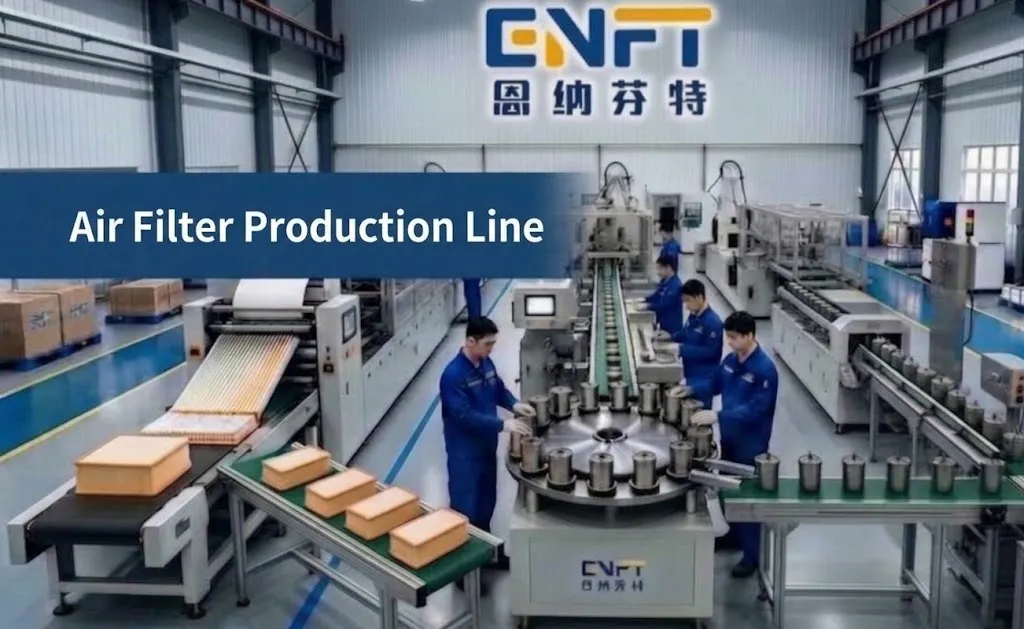
Automotive Air Filter Production Line
An automotive air filter production line is designed to manufacture filters that meet vehicle design requirements and the specifications of engine air intake or cabin ventilation systems. Automotive filter manufacturing requires careful attention to dimensional accuracy, filtration media quality, frame stability, and assembly integrity.
An automotive air filter production line may include the following equipment:
Filter paper cutting machine.
Filter paper pleating machine.
Equipment for manufacturing frames and end caps, or systems for receiving them from suppliers.
Adhesive dispensing equipment.
Filter assembly and trimming equipment.
Measuring and quality inspection tools.
Packaging equipment.
The final production line configuration depends on the filter type. Manufacturing an engine air filter may differ from manufacturing a cabin air filter in terms of materials, design, and assembly requirements.
Key Factors for Successful Automotive Filter Manufacturing
Dimensional accuracy: The filter dimensions must match the installation location. Unacceptable dimensional variations may cause installation difficulties or poor sealing.
Pleat uniformity: Controlling pleat shape and distribution helps maintain the required filtration media design.
Assembly quality: The frame and filtration media must be securely joined, with no significant gaps.
Finished product testing: Appropriate inspections should be defined for the filter type, including dimensional checks, sealing integrity, airflow resistance, and filtration efficiency.
Product variety: If the factory targets multiple sizes or designs, the equipment must be capable of changing settings or molds efficiently.
Is It Better to Manufacture All Components In-House?
Not necessarily. A factory can purchase ready-made frames, end caps, and gaskets and focus on preparing the filtration media and assembling the filter. This approach may be suitable for new projects or businesses testing the market.
In-house component manufacturing may provide greater control over the production chain, but it requires additional machinery, molds, and expertise. The total cost, quality, flexibility, and availability of suppliers should therefore be compared before making a decision.
Industrial Air Filter Production Line
Industrial air filter production lines vary according to the filter type and the industry in which the filter will be used. Products may be designed for HVAC systems, factory equipment, or air purification applications that require specific filtration characteristics.
Some industrial filters require larger filtration areas, supporting structures, or specialized media. These requirements affect machine design, assembly stages, and testing procedures.
What Equipment May an Industrial Filter Production Line Require?
Process | Potential Equipment | Purpose |
|---|---|---|
Filtration media preparation | Cutting and pleating equipment | Produces the media according to the specified design |
Frame forming | Metal or plastic forming equipment, depending on the material | Prepares the frame or structure |
Assembly | Fastening and adhesive dispensing equipment | Bonds the filtration media to the structure |
Finishing | Cutting and trimming equipment | Adjusts dimensions and appearance |
Inspection | Measuring tools and suitable testing equipment | Verifies product compliance |
Packaging | Packaging equipment suitable for the product size | Protects filters during transportation and storage |
What Are the Main Differences Between Industrial Filter Lines and Automotive Filter Lines?
Industrial filters may vary considerably in dimensions depending on the systems they serve.
Some industrial applications require specialized structures or filtration media.
Quality testing requirements may vary according to the final application.
Larger products may require different workspace and handling arrangements than smaller products.
Target production rates may differ depending on the filter type and manufacturing complexity.
Before investing in an industrial production line, identify the products you intend to manufacture, customer requirements, and required testing specifications. Then select the equipment based on these details.
Requirements for Setting Up an Air Filter Factory
Setting up an air filter factory requires technical, operational, and financial planning—not simply purchasing machinery. Project success depends on aligning equipment, raw materials, labor, quality control, and market demand.
1. Conduct Market Research and Define Your Products
Start by identifying your target customers, such as spare parts distributors, assembly plants, HVAC suppliers, or industrial companies. Then determine the filter types you can manufacture competitively, the most in-demand dimensions, and the required specifications.
2. Select the Location and Facility Size
The facility must provide sufficient space for installing equipment, storing raw materials and finished products, and allowing workers and materials to move safely. Appropriate space must also be allocated for maintenance. Local safety, ventilation, electrical, and other regulatory requirements should be considered.
3. Determine the Equipment and Production Capacity
Select machinery based on the number of products targeted and the manufacturing stages that will be carried out in-house. Ensure that the production capacities of the different stages are balanced to prevent work-in-progress from accumulating between operations.
4. Secure Raw Materials and Suppliers
The factory needs reliable suppliers for filter paper, frames, end caps, gaskets, adhesives, and other materials required by the product. Evaluate material quality, supply consistency, delivery times, and purchasing terms.
5. Provide Labor and Training
Labor requirements vary according to the level of automation and product complexity. Potential roles include machine operators, maintenance technicians, quality control personnel, assembly workers, and packaging staff.
6. Implement a Quality Control System
Define clear specifications for raw materials and finished products, and establish inspection procedures for dimensions, sealing integrity, and performance according to the filter type. Documenting inspection results helps identify the causes of defects and supports continuous process improvement.
7. Plan Costs and Working Capital
The financial plan should include machinery, facility preparation, raw materials, labor, energy, maintenance, packaging, transportation, and marketing costs. Working capital should also be available to cover operating expenses during the initial business period while the customer base is being established.
Air Filter Factory Setup Checklist
Identify target filter types and dimensions.
Conduct market, customer, and competitor research.
Determine which manufacturing stages will be performed in-house.
Define the required actual production capacity.
Compare machine quotations and technical specifications.
Secure raw materials and component suppliers.
Prepare the facility and meet safety requirements.
Establish an inspection and quality control plan.
Prepare a budget for equipment, operations, and working capital.
How Do You Choose the Right Air Filter Production Line?
Choosing the right air filter production line depends on the target products, expected demand, budget, automation level, and quality requirements. The line should not be selected based on purchase price or nominal speed alone.
First: Define Your Production Scope
Decide whether you will manufacture only automotive air filters, industrial filters, or a range of different products. A wider product range may require greater machine flexibility and easier changeovers.
Second: Compare Automation Levels
Comparison Factor | Manual or Semi-Automatic Line | More Highly Automated Line |
|---|---|---|
Initial Investment | Usually lower | Usually higher |
Human Intervention | Greater | Lower for automated operations |
Flexibility for Certain Products | May be suitable for varied production | Depends on the line design and ease of changing settings |
Process Consistency | Depends on procedures and operator skills | May improve with proper adjustment and control |
Maintenance | May be simpler for some equipment | May require specialized technical expertise and spare parts |
Best Suited For | Startups or limited production, depending on the design | Stable or higher-volume production when the investment is justified |
Choosing an automated line does not necessarily guarantee the best return on investment. Returns depend on demand, operating costs, and equipment utilization. A semi-automatic line may be suitable for a factory producing a variety of filters in moderate quantities.
Third: Verify Actual Production Capacity
Ask the supplier to specify production capacity for your product type and operating conditions. Inquire about changeover times, expected downtime, maintenance requirements, material waste, and staffing needs.
Fourth: Verify Finished Product Quality
Make sure the line can manufacture filters that meet your specifications, rather than simply operating machinery at a high speed. Clear acceptance criteria should be established for dimensions, assembly, sealing, and performance.
Fifth: Calculate the Total Cost
The total cost extends beyond the purchase price. Include installation, training, energy, labor, maintenance, spare parts, molds, raw materials, and expected downtime.
Sixth: Confirm Future Expansion Options
If you expect to add products or increase production in the future, verify whether the line can be expanded or additional machines integrated without rebuilding the entire system.
Illustrative example: If you are starting a small automotive air filter factory, it may be practical to purchase ready-made components and focus on cutting, pleating, and assembling the filter media. Once demand stabilizes, you can evaluate in-house component manufacturing if the calculations show that it would reduce unit costs or improve supply reliability.
How Do You Choose a Reliable Air Filter Production Line Supplier?
Choosing the supplier is just as important as choosing the machinery. The right supplier can help you identify equipment that matches your target products, understand operating requirements, and evaluate technical specifications before investing.
Before signing a contract, review the following criteria.
1. Experience in Filter Manufacturing Equipment
Verify the company's experience with the types of machines you need, such as filter paper pleating machines, filter assembly equipment, or machinery for manufacturing specific filter types.
2. Clear Technical Specifications
Request documentation that specifies the range of materials and dimensions supported by the machines, production capacity, power and facility requirements, automation level, and any known operating limitations.
3. Machine Testing Availability
Ask whether you can observe the equipment in operation or test a sample of your product when this option is available. This helps verify whether the machine meets your actual requirements before purchase.
4. Technical Support and Spare Parts
Check warranty terms, maintenance services, training, spare parts availability, and procedures for handling equipment failures. The responsibilities of both the supplier and buyer should also be clearly defined in the contract.
5. Cost Transparency
The quotation should clearly state the scope of supply and the included equipment. It should also specify whether molds, installation, training, and transportation are included in the price or charged separately.
6. A Solution That Fits Your Budget
A good supplier does more than offer a high-specification machine. The supplier should help you understand the available options and compare your actual requirements with your investment capacity.
Questions to Ask the Supplier Before Purchasing
What types of filters can the machine produce?
What range of product dimensions does it support?
What actual production capacity can be expected?
Which raw materials are compatible with the machine?
How long does it take to change dimensions or settings?
What are the installation, power, and operating requirements?
Does the quotation include training, warranty, and technical support?
Which spare parts should be available when production begins?
Clear answers to these questions help you compare suppliers on technical and financial grounds rather than relying on price alone.
How Can ENFT Help You Source the Right Air Filter Production Line?
ENFT operates in the field of machinery for manufacturing air filters, oil filters, and automotive filters. You can contact the company to discuss your project requirements and identify the equipment you need based on your target products.
The selection process begins by defining the type of filter you intend to manufacture, the required dimensions, target production capacity, and the range of operations that will be performed in-house. A project focused on automotive air filters has different requirements from a factory targeting industrial filters or a diverse range of products.
What Information Can Help ENFT Understand Your Project?
To obtain a more accurate technical assessment, prepare the following information:
Filter type: Automotive air filters, industrial filters, or other types.
Product specifications: Dimensions, filter shape, and filtration media type.
Production capacity: The number of units required per hour or shift.
Manufacturing scope: Whether you need a single machine or several interconnected machines.
Automation level: Manual, semi-automatic, or fully automatic.
Facility space and budget: To evaluate installation and investment requirements.
Expansion plans: Whether you intend to add other filter sizes or types in the future.
How Can This Information Help You Choose Equipment?
These details help determine the essential machinery, the operations that can be performed in-house, and the components that may be more suitable to purchase ready-made. They also make equipment quotations easier to compare, particularly when evaluating production capacity, operating requirements, and total cost.
Before approving any quotation, request detailed technical specifications and verify the range of products supported by the equipment, expected production capacity, and the terms for installation, training, warranty, and technical support. Any service or feature should be confirmed in the actual offer before it is included in the purchasing decision.
Start Your Air Filter Manufacturing Project with ENFT
Are you planning to establish a new factory or upgrade your existing production line? Choosing an air filter production line that matches your products and budget is an essential step toward building a stable, scalable manufacturing operation.
Contact ENFT to discuss your requirements for air filter, oil filter, and automotive filter manufacturing machinery. Define your target filter types and production capacity to develop a suitable understanding of the equipment your project requires.
Start by defining your project specifications, carefully comparing the available technical options, and selecting equipment that supports product quality and aligns with your manufacturing plan.