
Air Filter Manufacturing Machines: A Comprehensive Guide to Setting Up a Professional Production Line with ENFT
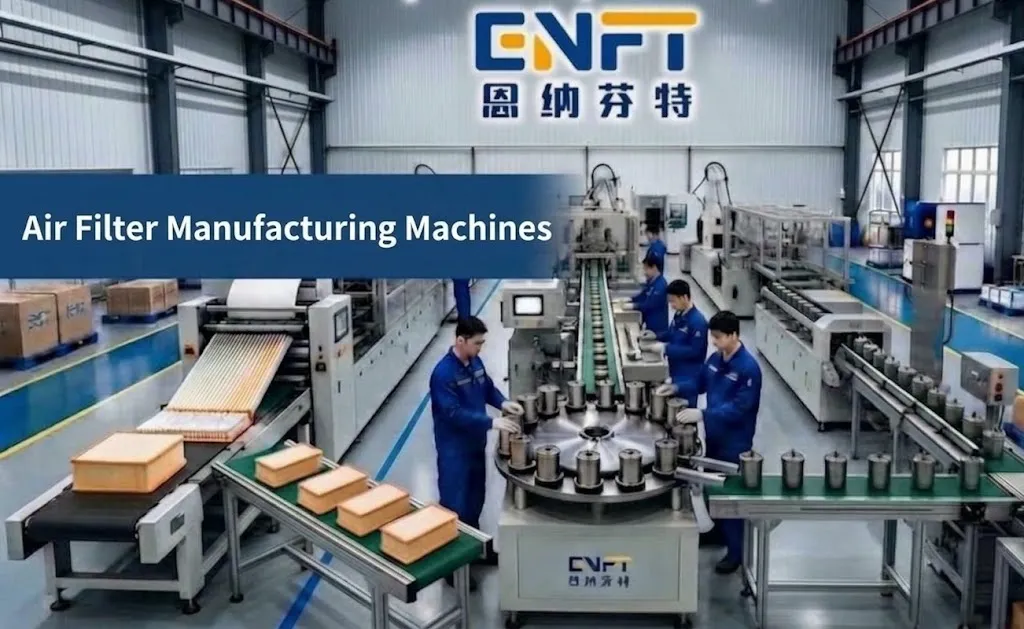
Investing in air filter manufacturing machines is an important step for investors looking to enter the automotive filter market or expand existing factories and increase their production capacity. As demand continues for air filters used in vehicle engines and industrial equipment, choosing the right machinery has become essential for improving product quality, reducing waste, and increasing operational efficiency.
However, a successful air filter manufacturing project requires more than purchasing a single machine. It involves understanding the types of filters in demand, the manufacturing stages, the equipment required for each stage, the target production capacity, and the appropriate level of automation.
What Are Air Filter Manufacturing Machines?
Air filter manufacturing machines are a group of industrial machines and equipment used to transform raw materials, such as filter paper, synthetic fabrics, plastics, polyurethane, and metals, into finished air filters for automotive and various industrial applications.
The specifications of these machines vary according to the filter design, dimensions, filtration media, and required production rate. Some machines are designed for pleating filter paper, while others form plastic or metal frames. Additional equipment may include polyurethane dispensing or injection machines, as well as assembly, testing, and packaging equipment.
The term automotive filter manufacturing machine does not necessarily refer to a single machine that performs every manufacturing operation. A factory typically relies on several integrated machines working together to create a production line tailored to its target filter products.
What Is the Difference Between a Single Machine and a Complete Production Line?
Standalone machine: Performs a specific operation, such as pleating filter paper, forming a frame, or dispensing polyurethane.
Semi-automatic production line: Combines several machines while leaving some material handling, assembly, and inspection tasks to operators.
Fully automatic production line: Uses automated control and operating systems across more manufacturing stages, reducing manual intervention when properly configured and operated.
Equipment Type | Suitable Application | Main Advantage |
|---|---|---|
Standalone machine | Starting with a specific manufacturing operation or expanding an existing factory | Relatively lower initial investment |
Semi-automatic production line | Small and medium-sized factories | Balances investment and flexibility |
Fully automatic production line | High-volume, repetitive production | Reduces manual work and improves production consistency |
Expandable production line | Projects planning to add products in the future | Allows production capacity to be expanded gradually |
For example, if you plan to manufacture rectangular paper automotive air filters, you may need a paper pleating machine, frame-forming equipment, a sealing or polyurethane dispensing station, and assembly and inspection tools. If your objective is to manufacture air filters for truck engines or heavy equipment, the dimensions, filtration media, and testing requirements may differ, meaning that different machinery may be necessary.
The fundamental rule is that choosing air filter manufacturing machines should begin with the specifications of the finished product, not simply the price of the machine.
What Types of Air Filters Can Be Manufactured Using These Machines?
Air filter manufacturing machines can produce several types of filters. However, the products a factory can manufacture depend on the machine design, technical specifications, and compatibility with the filtration media being used.
It is important to distinguish between engine air filters, cabin air filters, and industrial air filters because each category has different designs, functions, and manufacturing requirements.
1. Paper Engine Air Filters
These filters remove dust and other particles from the air entering a vehicle's engine. Their manufacture typically involves pleated filter paper and a frame or gasket that secures the filter and prevents unfiltered air from bypassing the filtration media.
Main equipment: Paper pleating machines, frame-forming equipment, and assembly and sealing stations.
2. Cylindrical and Round Air Filters
These filters are used in certain cars, trucks, and equipment that require cylindrical designs. Manufacturing them involves shaping the filtration media and assembling it with the appropriate cover or frame to achieve the required dimensions and sealing performance.
Main equipment: Filtration media forming or pleating machines, along with suitable assembly and fastening equipment.
3. Cabin Air Filters
Cabin air filters clean the air entering the passenger compartment by removing dust and particles. Some designs incorporate additional layers of filtration media. The machinery must be selected according to the filter's construction, layer thickness, and dimensions.
Main equipment: Media pleating and cutting equipment, assembly machinery, fastening equipment, and inspection systems.
4. Truck and Heavy-Duty Equipment Air Filters
These filters often require larger dimensions and specialized designs suitable for different operating conditions. Depending on the engine specifications, they may incorporate cylindrical elements or multiple filtration layers.
Main equipment: Machines with suitable capacity and dimensional capabilities, along with forming, assembly, and testing equipment compatible with the target product.
Comparison of Air Filter Types and Their Manufacturing Requirements
Filter Type | Common Filtration Media | Key Manufacturing Requirements |
|---|---|---|
Engine air filter | Specialized filter paper | Pleat accuracy, dimensional precision, and sealing |
Cabin air filter | Fabrics or multilayer filtration media | Material compatibility, precise cutting, and assembly |
Cylindrical air filter | Filter paper or media suitable for the design | Cylindrical forming and structural stability |
Truck and heavy-duty equipment air filter | Filter paper or application-specific filtration media | Structural durability, dimensional accuracy, and filtration efficiency |
These filter types cannot necessarily all be manufactured using the same equipment configuration without modifications. Therefore, the target products must be identified before purchasing air filter manufacturing equipment.
What Is the Most Important Machine in an Air Filter Production Line?
For a factory manufacturing pleated paper engine air filters, the filter paper pleating machine is one of the most important machines in the production line because it largely determines the shape of the filtration media, the number of pleats, and their uniformity.
However, no single machine is the most important for every type of filter. For certain products, a polyurethane dispensing machine or a frame-forming and assembly station may be the critical factor influencing the quality of the finished product.
The Most Important Machines in the Production Line
Machine | Function | Impact on Product Quality |
|---|---|---|
Filter paper pleating machine | Forms pleats to the required height and spacing | Pleat uniformity and effective use of filtration area |
Cutting machine | Cuts the filtration media to the required dimensions | Dimensional accuracy and reduced material waste |
Polyurethane dispensing machine | Forms seals or secures the filtration media, depending on the design | Sealing quality and component integrity |
Frame-forming machine | Forms plastic or metal frames | Structural stability and dimensional accuracy |
Assembly equipment | Joins and secures filter components | Product consistency and assembly integrity |
Inspection equipment | Checks dimensions, sealing, and required performance | Detects defects before delivery |
Practical example: If the paper pleats are irregular, the effective filtration area may be affected, or the filter may deform during assembly. If the frame or sealing material is not properly secured, air may bypass the filtration media through unwanted gaps. Therefore, the accuracy of the pleating machine alone cannot guarantee the quality of the finished filter.
When purchasing an air filter manufacturing machine, evaluate its precision, ease of adjustment, compatibility with the materials being used, changeover time between product sizes, spare parts availability, and technical support.
How Do Air Filter Manufacturing Machines Work?
Air filter manufacturing machines operate through a series of processes that transform raw materials into finished products that meet specified dimensions and technical requirements.
The process begins with preparing the filtration media, followed by forming or pleating, cutting, and assembling it with the frame or gasket. The finished filter is then inspected before packaging.
The Basic Air Filter Manufacturing Process
1. Raw Material Feeding
Filter paper or other filtration media is fed into the appropriate machine.
2. Pleating and Forming
The media is shaped into the required pleats or geometric configuration according to the filter design.
3. Cutting and Dimensional Adjustment
The filtration media is prepared to the specified dimensions.
4. Assembly and Sealing
The filtration media is joined to the frame or gasket using the appropriate manufacturing method.
5. Final Inspection
The filter is checked for dimensional accuracy, assembly integrity, and required performance.
6. Packaging and Storage
The finished filters are protected from damage and contamination before shipment.
What Role Do Machine Control Systems Play?
Modern machines use control systems to regulate operating parameters such as feed speed, cutting dimensions, process timing, and, where applicable, temperatures or dispensing quantities.
These systems help maintain more consistent manufacturing conditions. However, they do not eliminate the need for correct machine settings, routine maintenance, and product inspection.
Is There a Difference Between Automatic and Semi-Automatic Machines?
Yes. In semi-automatic systems, operators typically perform more tasks involving material loading, component transfer, and assembly. Automatic systems perform a larger number of these operations without manual intervention.
However, a higher level of automation does not necessarily mean that a machine is suitable for every factory. Semi-automatic equipment may be more appropriate for a workshop producing multiple sizes in limited quantities, while a fully automatic line may be better suited to high-volume, repetitive production.
Therefore, selecting an air filter making machine should be based on the intended operating method, quality requirements, expected demand, and production targets—not simply on whether the machine is described as automatic.
Stages of Air Filter Manufacturing: From Raw Materials to the Finished Product
Air filter manufacturing consists of interconnected stages, and the success of each stage affects the quality of the finished filter and the efficiency of the production line. The exact process varies by filter type, but the manufacture of a paper engine air filter can generally be divided into the following stages.
Stage 1: Selecting and Preparing Raw Materials
The process begins by selecting materials that meet the filter's specifications. These may include:
Specialized air filter paper.
Plastic or metal frames, depending on the product design.
Polyurethane or suitable sealing materials, where required.
Adhesives and fastening components compatible with manufacturing requirements.
Packaging materials.
The raw materials must be compatible with the intended operating conditions and provide the required filtration efficiency, airflow resistance, and durability.
Stage 2: Pleating the Filter Paper
The filter paper is fed into the pleating machine and formed into uniform pleats with the height and spacing specified in the filter design.
The number, distribution, and dimensions of the pleats must be controlled to achieve the required filtration area without unnecessarily restricting airflow or weakening the filtration media.
Stage 3: Cutting and Shaping the Filtration Media
After pleating, the filtration media is cut to the required dimensions. Additional forming operations may be necessary to create rectangular, circular, or cylindrical filter elements.
Accurate cutting helps reduce raw material waste and improves the fit between the filtration media and the frame.
Stage 4: Forming the Frame and Preparing the Seals
Frames and covers made of plastic or metal are prepared according to the filter design. Some production lines use specialized molds and equipment to dispense polyurethane or form sealing gaskets.
The dispensing quantity, material distribution, and curing time must be controlled according to the material type and operating instructions. This helps prevent defects that could affect media retention or filter sealing.
Stage 5: Assembly and Bonding
The filtration media is assembled with the frame or covers using the method appropriate to the design, such as dispensing, adhesive bonding, or mechanical fastening.
This stage requires careful control to prevent damage to the pleats, gaps between components, or dimensional deviations from the required specifications.
Stage 6: Quality Testing
A filter should not be considered ready for sale simply because assembly is complete. It must undergo inspections appropriate to the product type and customer requirements. These may include:
Dimensional and, where necessary, weight measurements.
Inspection of pleat uniformity and material integrity.
Verification of component retention strength.
Leakage testing to identify potential air bypass.
Measurement of filtration efficiency and airflow resistance using the specified test method.
Documentation of inspection results and tracking of nonconforming products.
Stage 7: Packaging and Storage
After passing the required inspections, the filters are packaged with relevant product information, including the batch number, dimensions, and traceability details.
They should be stored in an environment that protects them from moisture, contamination, and deformation.
Practical Example: Improving the Manufacturing Process
Suppose a factory notices an increase in rejected filters due to poor sealing around the frame. Instead of immediately increasing production or purchasing a new machine, the factory could follow these steps:
Classify the defects and identify the manufacturing stage where they occur.
Inspect the frame dimensions and their compatibility with the filtration media.
Review the dispensing, bonding, or fastening settings.
Produce a trial sample and adjust the settings.
Repeat the sealing test and compare the results before and after the adjustment.
Approve the appropriate settings and monitor them during production.
This is an illustrative example of industrial problem-solving, not a documented case study from a specific factory. It demonstrates how improving machine settings and quality control may be more effective than increasing output without addressing the cause of defects.
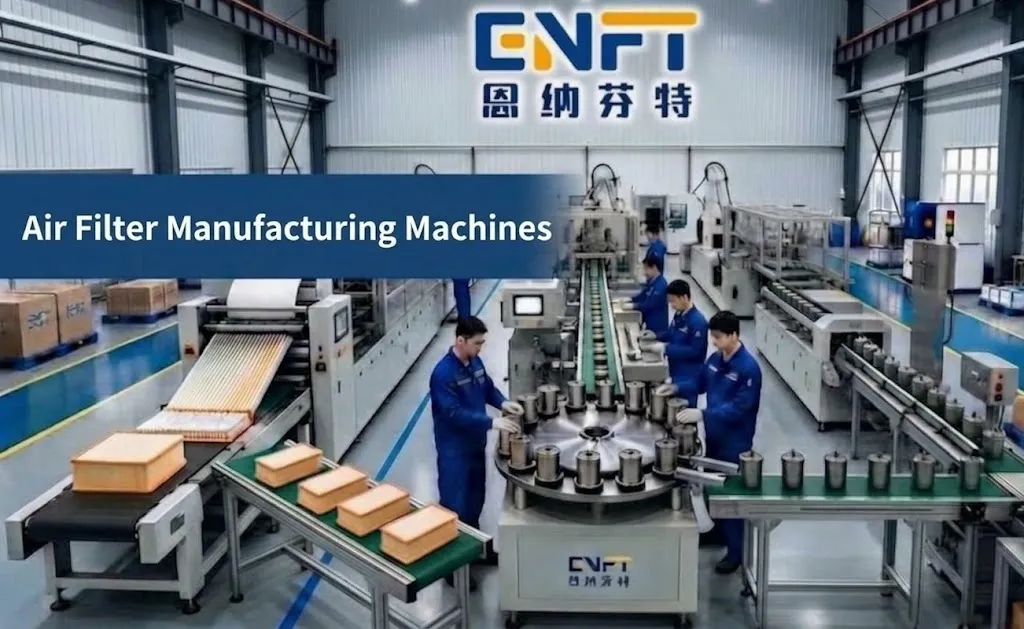
How to Establish an Air Filter Manufacturing Factory
Establishing an air filter manufacturing factory requires planning that combines market research, product selection, production capacity planning, facility preparation, equipment purchasing, raw material sourcing, and the development of quality and operating procedures.
The best approach is to implement the project in clear stages rather than purchasing all the machinery before identifying market requirements.
Step 1: Conduct Market Research and Select Products
Identify your target customers, such as auto parts retailers, filter distributors, and automotive assembly manufacturers. Then select filter types and sizes based on expected demand and market competition.
Step 2: Prepare an Equipment List
Identify the machines required for each manufacturing stage, including their production capacities, labor requirements, raw material needs, utility requirements, and maintenance needs.
Step 3: Prepare the Factory
Choose a facility that allows materials to move from receiving and storage through production, inspection, and packaging without unnecessary interference. Provide electricity, ventilation, and industrial safety provisions appropriate to the equipment.
Step 4: Install the Equipment and Conduct Trial Runs
Verify that the machines are installed and adjusted correctly. Train operators and produce trial batches to evaluate actual product quality and production rates before beginning commercial operations.
Step 5: Start Production and Marketing
Begin with a manageable product range, then expand production according to actual demand, quality results, and unit costs. Develop distribution channels and after-sales service capabilities.
What Is the Appropriate Factory Size for Air Filter Manufacturing?
There is no single factory size suitable for every project. The required space depends on the number of machines, inventory volume, material handling methods, inspection and packaging areas, and utility requirements.
For practical space planning, divide the facility into the following areas:
Raw material receiving and storage.
Production and machinery area.
Assembly and inspection area.
Packaging area.
Finished goods storage.
Offices, utilities, and technical service areas.
It is advisable to request a preliminary machinery layout from the equipment supplier, including machine positioning and material flow paths, rather than estimating space based only on the dimensions of individual machines.
How Do You Calculate the Required Production Capacity?
Start with expected demand and convert it into daily and hourly production targets.
For example, suppose a factory aims to produce 10,000 saleable filters per month and operates 22 days per month, with eight working hours per day. Its theoretical production target would be:
Approximately 455 filters per day.
Approximately 57 filters per hour.
These figures represent calculated targets, not a guarantee that any machine can achieve them. Allowances must be made for downtime, maintenance, product changeovers, and rejected units. The actual capacity of every production stage must then be verified.
If one machine operates more slowly than the others, it may become a bottleneck that limits the output of the entire factory. For this reason, equipment capacities should be evaluated across the integrated production line, not just individually.
What Costs Should Be Included in the Project Feasibility Study?
The factory budget should cover more than machinery purchases. It should also include facility preparation, raw materials, labor, maintenance, testing, operating expenses, and marketing.
Cost Category | Examples of Included Expenses |
|---|---|
Equipment | Pleating, cutting, forming, and assembly machines |
Facility preparation | Electrical systems, utilities, and production area layout |
Raw materials | Filter paper, frames, and sealing materials |
Installation and training | Shipping, installation, commissioning, and training, depending on the quotation |
Quality control | Measuring instruments and required testing equipment |
Operating expenses | Wages, energy, maintenance, and spare parts |
Working capital | Raw material inventory, finished goods, and ongoing expenses |
Prepare a separate budget for each category to avoid focusing on machinery prices at the expense of the working capital needed to operate the factory after setup.
How to Choose the Right Air Filter Manufacturing Machines for Your Factory
Choosing the right air filter manufacturing machines depends on compatibility with the target product, production capacity, manufacturing quality, budget, and the possibility of expanding the production line in the future.
Because differences in machine specifications can significantly affect factory efficiency, it is advisable to prepare written technical requirements before requesting quotations.
1. Identify the Filter Type and Specifications
Determine whether you will manufacture engine air filters, cabin air filters, truck filters, or industrial filters. Prepare drawings or product samples showing the dimensions, frame design, filtration media, and sealing method.
For example, a machine designed for paper pleating is not necessarily suitable for every paper grade, pleat height, or cylindrical design.
2. Compare Actual Production Capacity
Ask the supplier to specify the expected production rate for a particular product under clearly defined operating conditions. Distinguish between the machine's rated speed and the actual output of products that meet the required specifications.
It is also important to establish whether the advertised production rate applies to a single product size or includes normal changeovers and operating interruptions.
3. Evaluate the Level of Automation
Choose between manual, semi-automatic, and fully automatic operation based on your budget, labor costs, and expected demand.
A semi-automatic line may be suitable for a new factory that needs production flexibility. A factory with high and consistent demand may benefit from automation if the operating savings justify the additional investment.
4. Assess Build Quality and Maintenance Requirements
Check spare parts availability, access to components requiring routine maintenance, the clarity of operating instructions, and the availability of technical support and training.
You should also verify that the control systems and safety features are appropriate for the intended application and that the supplier can provide the necessary technical documentation.
5. Request a Practical Machine Test Before Purchasing
Where possible, ask the supplier to operate the machine using raw materials and product dimensions similar to your actual requirements. Inspect pleat quality, dimensional accuracy, operating stability, and ease of adjustment, and request documented results.
This is more useful than relying solely on general photographs or demonstration videos.
Comparison of Air Filter Manufacturing Equipment Options
Comparison Criteria | Standalone Machine | Semi-Automatic Line | Fully Automatic Line |
|---|---|---|---|
Initial investment | Relatively lower | Relatively moderate | Relatively higher |
Labor requirements | Depend on manual operations | Typically moderate | Lower for automated operations |
Flexibility | Suitable for a specific operation | Good for many applications | Depends on line design |
High-volume repetitive production | Limited by the individual operation | Suitable within line capacity | Suitable when machine capacities are properly matched |
Expansion | Add equipment later | Upgrade selected production stages | May require more extensive engineering modifications |
This is a general comparison. Actual results may vary depending on machine specifications, supplier capabilities, production line design, and the country where the factory will operate.
Equipment Purchasing Checklist
Use the following checklist when evaluating machine quotations:
Identify the target filter types and dimensions.
Obtain the technical specifications of each machine.
Compare the actual production capacity of the complete line.
Confirm compatibility between the machines and raw materials.
Review the total price, shipping, installation, and training costs.
Confirm warranty terms, spare parts availability, and technical support.
Clarify acceptance testing procedures and product quality criteria.
Verify facility, electrical, and industrial safety requirements.
Using this checklist when comparing suppliers helps you make a decision based on specifications and total cost rather than relying solely on the initial purchase price.
Air Filter Manufacturing Machine Prices and Factors Affecting Cost
Air filter manufacturing machine prices vary according to machine type, automation level, production capacity, technical specifications, and the number of machines required to build the production line. Therefore, there is no single price that applies to every factory or project.
It is also important to distinguish between the price of an individual machine and the price of a complete production line. One quotation may include pleating, cutting, forming, and assembly equipment, while another may cover only the main machines and exclude inspection or packaging equipment.
What Factors Determine the Price of Air Filter Manufacturing Machines?
Factor | Impact on Cost |
|---|---|
Machine type | A paper pleating machine has different costs from a dispensing or assembly machine |
Automation level | Automated systems may cost more initially while reducing certain manual tasks |
Production capacity | Higher capacities may require different equipment, motors, and control systems |
Product specifications | Dimensions, shapes, and filtration media influence machine design |
Number of machines | Purchasing a single machine differs in cost from equipping a complete production line |
Country of supply and shipping | Transportation, insurance, and applicable customs duties affect the final cost |
Installation and training | These services may be included in the quotation or charged separately |
Warranty and maintenance | Service terms and spare parts availability affect long-term ownership costs |
How Can You Obtain an Accurate Price for an Air Filter Production Line?
To receive a suitable quotation, prepare the following information before contacting the supplier:
The types of air filters you intend to manufacture.
Product dimensions, technical drawings, or physical samples.
Target daily or monthly production capacity.
Required level of automation.
The country where the production line will be installed.
Additional equipment requirements, such as testing and packaging systems.
Installation, training, warranty, and after-sales service requirements.
Once these details have been established, the supplier can prepare a more accurate technical and commercial quotation specifying the required machines, their capacities, costs, and delivery terms.
Important tip: Do not compare quotations based on the total price alone. Also compare the included equipment, actual production capacity, operating and maintenance costs, warranty conditions, and compatibility with the products you intend to sell.
How to Choose a Reliable Supplier Like ENFT for Air Filter Manufacturing Machines
Choosing the right supplier is an important decision for any air filter manufacturing factory. The relationship does not end when the machinery is purchased; it may also involve installation, commissioning, training, maintenance, and spare parts support.
When evaluating a specialized company such as ENFT for air filter manufacturing machines, assess its ability to understand your project requirements and propose equipment that matches your technical needs rather than relying solely on price or marketing claims.
What Are the Criteria for Choosing a Reliable Air Filter Manufacturing Machine Supplier?
1. Specialization in Filter Manufacturing Equipment
Check the types of machines the supplier offers, their compatibility with your target air filters, and whether the supplier can provide equipment for different manufacturing stages.
2. Clear Technical Specifications
Request documented information on production capacity, supported dimensions, operating requirements, energy consumption, main components, and the limitations of each machine.
3. The Ability to Provide a Suitable Solution for Your Project
The proposed equipment should be based on your filter type, budget, and required production capacity. A new factory producing a limited range of products may require different equipment from a factory manufacturing large volumes of a single product.
4. Technical Support and Training
Confirm the arrangements for equipment installation and operation, operator training, technical support, spare parts availability, and consumable supplies.
5. The Ability to Verify Machine Performance
Request documented operating videos or a practical demonstration, where possible, and verify the quality of the resulting products under operating conditions similar to your requirements.
6. Commercial Transparency
The quotation should clearly state the price, included equipment, delivery time, payment terms, warranty, shipping and installation costs, and any additional services.
Why Contact ENFT Before Purchasing the Machinery?
If you are planning to establish a new factory or upgrade an existing production facility, you can contact ENFT to inquire about air filter manufacturing machines and equipment suited to your project.
Start by identifying the types of filters you intend to produce and your target production capacity. Then ask the company's team to clarify the available options, technical specifications, costs, and technical support arrangements.
Before making a purchasing decision, verify the details of each quotation, including equipment compatibility with your products and factory requirements.
Are You Planning to Establish an Air Filter Factory or Upgrade Your Production Line?
Start Choosing the Right Air Filter Manufacturing Machines for Your Project with ENFT
Gain a clearer understanding of the equipment you need, define your production requirements before investing, and compare technical and commercial options according to your factory's objectives.
Identify the machines suitable for your target filter type.
Evaluate your required production capacity and manufacturing stages.
Inquire about technical specifications, prices, and delivery terms.
Discuss installation, training, and technical support requirements.