
Air Filter Accessories: A Comprehensive Guide to Types, Components, and Manufacturing Machines
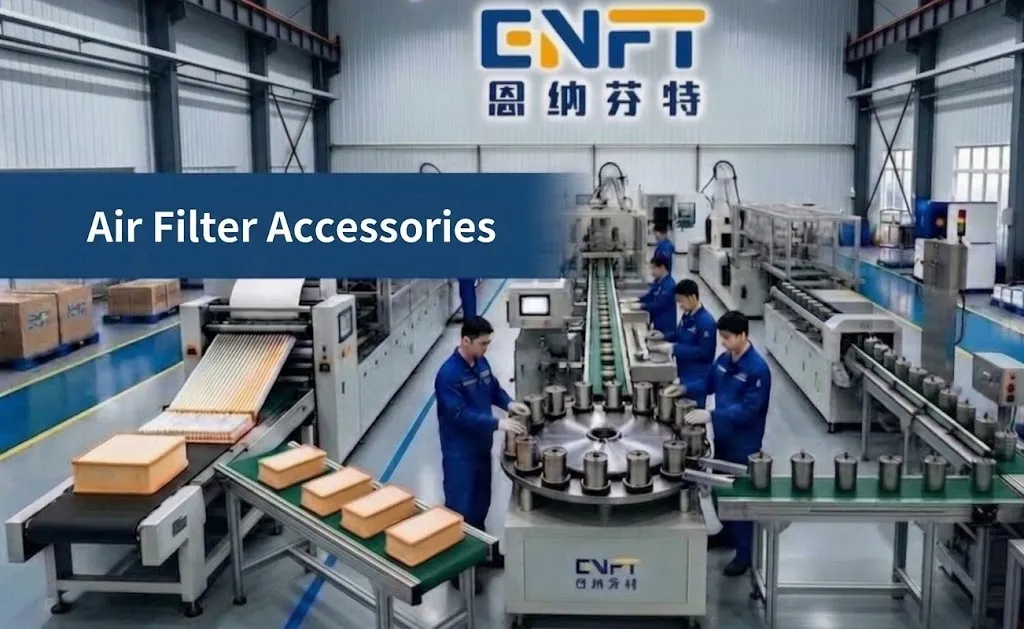
Air filter accessories are essential components in the automotive filter and industrial air purification industries. They help secure filtration media, improve filter sealing, prevent unfiltered air from leaking through, and maintain operational efficiency. These accessories include metal and plastic end caps, rubber gaskets, frames, support meshes, adhesives, and other components that vary according to the filter type and its intended application.
If you are planning to establish a factory specializing in automotive air filters or upgrade an existing production line, selecting the right accessories and the machines needed to manufacture them directly affects product quality, production costs, and waste rates. This guide provides a practical overview of the types of air filter accessories, the materials used to manufacture them, the production stages, and how to select suitable equipment. It also explains ENFT's role in providing filter manufacturing solutions and equipment.
What Are Air Filter Accessories?
Air filter accessories are the auxiliary parts and materials used to manufacture, assemble, and secure filter components so that the filter operates efficiently and maintains its shape and air purification capabilities. These accessories may include mechanical components, such as end caps, meshes, and frames, or consumable materials, such as adhesives and gaskets used for sealing and leak prevention.
Air filter accessories vary according to their application. Filters designed for automotive engines require components that can withstand vibration and temperature changes, while air conditioning, ventilation, and industrial filters may require designs that meet specific airflow rates, operating conditions, and filtration requirements.
The main functions of these accessories include:
Securing the filtration media: Keeping filter paper, fibers, or other filtration media in the correct position.
Preventing air leakage: Sealing the gaps between the filter and the housing in which it is installed.
Supporting the internal structure: Reducing the likelihood of deformation or collapse caused by air pressure or vibration.
Protecting the filtration element: Reducing the risk of mechanical damage during manufacturing, transportation, and operation.
Improving assembly efficiency: Making filter installation easier and helping maintain consistent dimensions and quality.
Extending service life: When materials and designs are appropriately selected for the operating environment.
It is important to distinguish between air filter accessories and the filtration media itself. The filtration media captures dust and particles, while the accessories help secure, seal, and support it. Some accessories may directly contribute to filtration sealing, but they cannot replace the need to select suitable filtration media.
What Are the Main Types of Air Filter Accessories?
Air filter accessories vary according to product design and intended purpose. Not all filters require the same components: an automotive engine air filter differs from an air conditioning filter, and industrial filters have different requirements depending on their size, airflow rate, and operating conditions.
The following table outlines the main types and their functions:
Accessory Type | Primary Function | Common Applications |
|---|---|---|
End Caps | Secure the ends of the filtration media and provide assembly points | Automotive filters and some industrial filters |
Frames and Housings | Maintain the filter's shape and dimensions | Flat and pleated air filters |
Gaskets and Seals | Provide a tight seal and prevent air from bypassing the media | Automotive, HVAC, and industrial filters |
Support Meshes | Support the filtration media and reduce deformation | Filters exposed to significant pressure differences |
Plastic Frames | Secure the media and facilitate installation | Automotive filters and some cabin filters |
Adhesives | Bond components and seal joints | Most filter assembly processes, depending on the design |
Spacers and Supports | Maintain the spacing between pleats | Pleated air filters |
Clips and Fasteners | Secure certain components or facilitate installation | Specific filter designs |
How Do You Choose the Right Type?
The selection depends on five key factors:
Filter type: Is it an engine air filter, cabin filter, air conditioning filter, or industrial filter?
Filtration media: Filter paper, synthetic fibers, or other media.
Operating conditions: Temperature, humidity, vibration, and exposure to oils or chemicals.
Sealing requirements: The mounting surface, gasket type, and method of securing the accessory.
Production volume: Is manufacturing manual, semi-automatic, or fully automatic?
Practical example: If you manufacture an automotive engine air filter, you may need a suitable frame, a support mesh if required, an end cap or base depending on the design, and a gasket that provides a proper seal during installation. A flat air conditioning filter, however, may use a lightweight frame, filtration media, and retaining edges without requiring all the components found in an engine air filter.
Air Filter Components and the Function of Each Component
An air filter generally consists of filtration media and a set of supporting or securing components. The exact structure varies according to the filter type and design, so a single component list cannot be considered suitable for every product.
The following table outlines the main components to understand when studying filter and accessory manufacturing:
Component | Function | Manufacturing Considerations |
|---|---|---|
Filtration Media | Captures dust and particles according to the filter specifications | Filtration efficiency, airflow resistance, and durability |
Frame or Housing | Defines the filter's shape and secures the media | Dimensional accuracy, rigidity, and compatibility with the mounting location |
End Caps | Close the ends or connect filter components | Forming quality and bonding or fastening strength |
Rubber Gasket | Prevents leakage around the mounting area | Flexibility, resistance to operating conditions, and dimensional accuracy |
Support Mesh | Supports the media in designs that require it | Resistance to deformation without obstructing airflow |
Adhesive | Bonds filter components or seals certain joints | Material compatibility, curing time, and bond strength |
Spacers | Maintain the distance between pleats when required | Shape stability and appropriate airflow distribution |
Why Does Component Compatibility Affect Filter Quality?
The filtration media may be of high quality, but the filter may still fail to deliver the required performance if the frame dimensions are incorrect or the gasket does not provide sufficient sealing. Poor adhesive distribution or incomplete curing can weaken the bond or cause leakage.
Therefore, filter manufacturing should be treated as an integrated process that begins with material selection and continues through component forming, assembly, and final inspection. The quality of air filter accessories should not be evaluated separately from the other components of the finished product.
Automotive Air Filter Accessories
Automotive air filters require accessories that match the design of the engine or air conditioning system in which they operate. These components are designed to secure the filtration media and provide an appropriate seal while accounting for vibration, temperature changes, and operating conditions.
The main automotive air filter accessories include:
Plastic or rubber frames: Define the filter's shape and facilitate installation.
End caps and bases: Secure the filtration media and connect it to other filter components.
Rubber gaskets: Reduce air leakage around the filter edges.
Support meshes: Used in some designs to protect the filtration media from deformation.
Adhesives: Assemble components that rely on adhesive bonding.
Internal spacers: Help maintain the shape of the pleats when required by the design.
Difference Between Engine Air Filter Accessories and Cabin Filter Accessories
Although both are automotive air filters, their designs and materials vary according to their functions.
Comparison Factor | Engine Air Filter | Cabin Air Filter |
|---|---|---|
Function | Filters the air entering the engine | Filters the air entering the passenger cabin |
Product Shape | Usually a frame or housing that fits the engine air filter compartment | Usually a flat or pleated design |
Accessories | Frame, gasket, supports, or fasteners depending on the design | Lightweight frame, retaining edges, and sealing components depending on the design |
Key Considerations | Installation sealing and resistance to operating conditions | Filtration efficiency, dimensional compatibility, and ease of replacement |
Practical Example
When developing an engine air filter for a vehicle, first determine the filter dimensions and mounting location. Then select a frame that matches the design, a gasket that provides the required seal, and suitable filtration media. After assembly, check the dimensions and assembly quality, then test the filter against the intended specifications.
When manufacturing a cabin filter, priority may be given to a lightweight frame that fits the available installation space, along with filtration media suited to the application. Accessories should not be selected simply because they are commonly used in automotive filters; their compatibility with the actual product design must be verified.
Industrial Air Filter Accessories
Industrial air filters are used in ventilation and air conditioning systems, production equipment, and certain air purification applications in industrial facilities. Their accessories vary according to filter size, media type, airflow rate, operating conditions, and maintenance and replacement requirements.
Common accessories in this sector include:
Metal frames: Provide mechanical support for large filters or applications requiring greater rigidity.
Plastic frames: Used in specific applications where plastic properties are suitable for operating conditions.
Gaskets and sealing components: Reduce air leakage around the filter.
Support meshes: Reinforce the filtration media when necessary.
Spacers: Maintain uniform pleat spacing and distribution.
Industrial adhesives: Bond components, provided the adhesive is compatible with the media and frame.
Fasteners: Facilitate filter installation and removal during maintenance.
Comparison of Accessories Used in Automotive and Industrial Filters
Comparison Factor | Automotive Air Filters | Industrial Air Filters |
|---|---|---|
Design | Usually associated with a specific vehicle model or mounting space | Varies according to the industrial system and filter size |
Materials | Plastic, rubber, metal, and adhesives, depending on the design | Metals, plastics, rubber, and bonding materials suitable for the application |
Operating Conditions | Vibration, temperature changes, and vehicle environmental conditions | May include continuous airflow or specialized industrial conditions |
Maintenance Requirements | Replacement according to vehicle specifications and operating conditions | Depend on the system, dust loading, and operating requirements |
Manufacturing Considerations | Dimensional accuracy and compatibility with the mounting location | Structural strength, sealing stability, and compatibility with system requirements |
An important point: industrial applications do not necessarily require every component to be made of metal or to be more expensive. Each component should be selected according to actual technical requirements. High-efficiency filters may also require specialized designs that cannot be generalized to all industrial filters.
Materials Used to Manufacture Air Filter Accessories
The materials used to manufacture air filter accessories are selected according to component function, operating conditions, and production costs. An unsuitable material may cause frame deformation, weak bonding, or loss of filter sealing, even when the other components are of good quality.
The main materials include:
Material | Potential Application | Key Considerations |
|---|---|---|
Engineering Plastics | Frames, housings, and some end caps | Rigidity, dimensional stability, and heat resistance |
Metal Sheets | End caps, housings, and some support components | Formability, corrosion resistance, and dimensional accuracy |
Rubber | Gaskets and seals | Flexibility, sealing performance, and resistance to operating conditions |
Filter Paper | Filtration media in various designs | Filtration efficiency, airflow resistance, and durability |
Synthetic Fibers | Filtration media in specific applications | Fiber structure and filtration properties |
Metal or Plastic Meshes | Reinforcement for certain filters | Strength, weight, and ability to avoid obstructing airflow |
Specialized Adhesives | Component assembly and joint sealing | Material compatibility, adhesion, and curing |
The Role of Polyurethane Adhesives in Filter Manufacturing
Polyurethane adhesives are used in various industrial applications and may be suitable for certain filter assembly processes, depending on their formulation and specifications. Their suitability varies according to the filtration media, frame material, temperature, and exposure to moisture and chemicals.
Important considerations when selecting an adhesive include:
Compatibility with the plastic, metal, or filtration media being used.
Ability to form a bond suitable for the application.
Viscosity and suitability for the adhesive dispensing method used on the production line.
Working time and curing time required to achieve the target production rate.
Resistance to expected operating conditions after curing.
Storage, safety, and manufacturer handling requirements.
An adhesive should not be selected simply because it is a polyurethane product. This category includes multiple formulations, so the technical data sheet should be reviewed and compatibility should be tested before the adhesive is approved for commercial production.
How Do You Choose the Right Material?
Start by identifying the function of the component and the conditions to which it will be exposed. Then compare available materials in terms of performance, cost, and ease of manufacturing. For example, plastic may be suitable for a lightweight frame, while metal sheets may be preferred for a design that requires a particular level of rigidity. In both cases, the material's suitability for the finished product must be verified instead of relying on price alone.
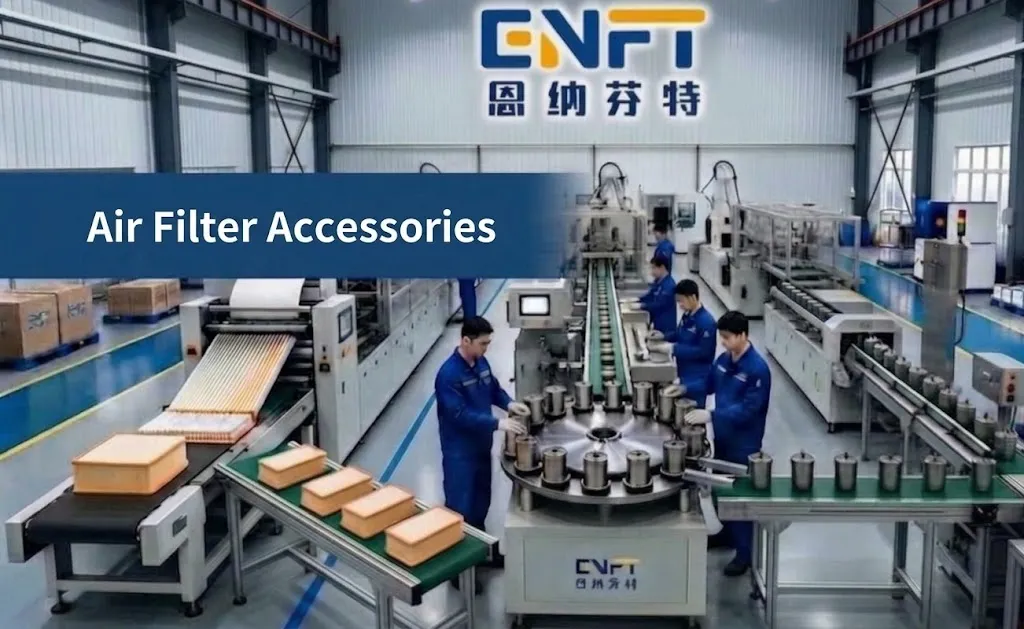
Air Filter Accessory Manufacturing Machines
Air filter accessory manufacturing machines vary according to the parts that need to be produced. Equipment for forming metal end caps is not necessarily the same as that used to produce plastic frames, cut filtration media, or assemble the finished filter.
It is important to distinguish between machines that manufacture the accessories themselves and machines that manufacture and assemble filters using those accessories. A factory may need separate equipment to produce certain components, while purchasing other components ready-made and using specialized equipment to assemble them.
Main Types of Machines and Equipment
Machine or Equipment | Application | When Is It Needed? |
|---|---|---|
Filter Paper Cutting Machines | Cut paper to the required dimensions | When filtration media is manufactured in-house |
Filter Paper Pleating Machines | Form pleats at specified heights and spacing | When producing filters that use pleated media |
Metal Sheet Forming Machines | Form certain metal end caps or components | When metal components are manufactured in-house |
Plastic Injection Molding Equipment | Produce plastic frames and end caps using suitable molds | When plastic component manufacturing is included in the project |
Adhesive Dispensing Machines | Apply adhesive in specified quantities and patterns | When greater assembly consistency is required |
Filter Assembly Equipment | Join components to create the finished product | In filter production lines |
Trimming and Finishing Equipment | Remove excess material and adjust certain component dimensions | Depending on component design and manufacturing method |
Measuring and Inspection Tools | Verify dimensions and assembly quality | In any project targeting consistent quality |
Do You Need All These Machines?
No. It depends on the scope of the project. If you intend to manufacture finished filters only, purchasing frames, end caps, and gaskets from specialized suppliers may be more suitable at the beginning. If you intend to manufacture components in-house, you may need additional investments in molds, presses, injection molding equipment, cutting machines, or forming equipment.
Equipment should be selected according to the target products, production volume, budget, and available space—not according to the number of machines that can be purchased.
How Are Air Filter Accessories Manufactured?
The manufacturing steps for air filter accessories vary according to the material and the nature of the component. Producing a plastic frame differs from forming a metal end cap or manufacturing a rubber gasket. These processes also differ from assembling the components into a finished filter.
Nevertheless, the production process can be organized into several basic stages.
Step 1: Define the Design and Specifications
The process begins by identifying the filter type, dimensions, function of each accessory, and installation method. Dimensions, allowable tolerances, material types, and sealing requirements should be documented, and the design should be checked for compatibility with the filter's mounting location.
Step 2: Select Raw Materials
Suitable materials are selected for each component, such as plastic, metal, rubber, or adhesive. Materials must meet the required specifications, and storage conditions and shelf life should be reviewed where relevant.
Step 3: Manufacture the Components
The manufacturing method varies according to the type of component:
Metal components: May require cutting, forming, punching, and finishing.
Plastic components: May be produced using injection molding and suitable molds.
Rubber gaskets: May be manufactured through molding or cutting processes, depending on the material and design.
Filtration media: May undergo cutting, pleating, and preparation processes according to the filter type.
Adhesives: Must be prepared and dispensed according to the supplier's instructions and the approved assembly method.
Step 4: Assembly
The components are assembled in an order appropriate for the product design. This may include installing the filtration media inside the frame, securing end caps, dispensing adhesive, and installing gaskets or supports.
The quantity and position of the adhesive must be controlled. Excessive adhesive should be avoided because it may affect airflow or deform the product.
Step 5: Curing and Finishing
If the design relies on adhesives or processes requiring curing, the specified curing time and conditions provided by the supplier must be followed. Excess material is then removed where necessary, and the edges, dimensions, and overall appearance are inspected.
Step 6: Quality Inspection
Before the product is approved, its dimensions, assembly integrity, bond quality, and sealing performance are checked against the filter specifications. Appropriate performance tests may be conducted, such as leakage, airflow resistance, or filtration efficiency testing, depending on the product type and target standards.
Illustrative Example of an Automotive Air Filter Production Line
Suppose a factory wants to manufacture a rectangular air filter for a car engine. The workflow could be organized as follows:
Define the filter dimensions and filtration media specifications.
Prepare, cut, and pleat the filtration media according to the design.
Prepare the frame or purchase it from a specialized supplier.
Dispense the appropriate adhesive where necessary.
Install the filtration media inside the frame and adjust its position.
Allow the product to cure fully according to the instructions for the adhesive used.
Inspect dimensions, sealing, and assembly quality.
Package the product and document the inspection results.
This is an illustrative example of a possible workflow, not a report of an actual factory trial or a guarantee that every type of filter is manufactured in the same way.
How Do You Choose the Right Air Filter Accessories?
Choosing the right air filter accessories depends on more than price or appearance. It requires verifying that each component is compatible with the design, materials, and operating conditions. Unsuitable accessories may lead to poor sealing, filter deformation, or increased manufacturing waste.
Follow these steps:
1. Identify the Filter Type Precisely
Are you manufacturing an engine air filter, cabin filter, air conditioning filter, or industrial filter? Each type has different requirements regarding dimensions, filtration media, frame design, and installation method.
2. Review the Technical Specifications
Define the required dimensions, material type, temperature range, operating conditions, and filter installation method. If the product is intended for a specific vehicle model, verify compatibility with the application specifications.
3. Evaluate Material Quality
Inspect the quality of the plastic, metal, rubber, or adhesive, and request available technical documents from the supplier. A component should not be approved based on price alone, particularly when it affects sealing or assembly durability.
4. Test Compatibility Between Components
A gasket may be of good quality on its own but unsuitable for the frame's surface or dimensions. An adhesive may provide a strong bond but be incompatible with one of the surfaces. Therefore, components should be tested as part of the actual assembly.
5. Compare the Cost of Use, Not Just the Purchase Price
Calculate the component cost while considering waste, defect rates, ease of installation, and its effect on production time. A lower-priced component may become more expensive in the long run if it causes rework or product rejection.
Comparison Table for Selecting Air Filter Accessories
Selection Criterion | A Suitable Option When... | Warning Sign Requiring Review |
|---|---|---|
Dimensional Compatibility | The part matches the approved design | It requires unplanned pressure or modification to fit |
Material Quality | The material suits the operating conditions | Deformation or damage occurs during testing |
Sealing | The assembly meets specified leakage requirements | Air bypass is detected around the edges |
Ease of Manufacturing | The part can be installed consistently and reliably | Assembly errors recur or waste increases |
Cost | It balances quality and productivity | A lower price leads to a higher defect rate |
Supply Availability | The component can be sourced with consistent quality | Delivery delays or specification variations recur |
Practical tip: Before purchasing large quantities of air filter accessories, request samples and test them in an actual product prototype. This helps identify compatibility issues before commercial-scale production begins.
How Do You Start an Air Filter Accessory Manufacturing Business?
Establishing an air filter accessory manufacturing business requires clear technical and financial planning. The first decision is whether the project will manufacture accessories only, manufacture finished filters, or combine both activities.
This decision affects the required machines, capital, space, labor, suppliers, and marketing plan.
Step 1: Research the Market and Identify Customers
Start by identifying potential customers, such as filter manufacturers, automotive spare parts manufacturers, HVAC suppliers, and companies operating in the air purification industry.
Research the products most in demand in the target market, the specifications buyers require, competitors, alternative product prices, and supply requirements.
Step 2: Define the Target Products
It is not advisable to begin by manufacturing every type of accessory at once. Select a specific product range based on expected demand, technical expertise, and equipment costs.
For example, the project could begin with one of the following approaches:
Manufacturing plastic frames or end caps.
Manufacturing selected metal components.
Producing gaskets and sealing components.
Supplying and assembling air filter components.
Manufacturing finished air filters while purchasing certain accessories from specialized suppliers.
Step 3: Choose a Production Model
There are three main models to consider:
Project Model | Operating Method | Advantages | Challenges |
|---|---|---|---|
Filter Assembly | Purchase most components and assemble them | Relatively lower initial investment in some cases | Dependence on suppliers |
Partial Accessory Manufacturing | Produce selected components and purchase the rest | Greater control over parts of the production chain | Additional equipment, molds, and inspections are required |
Integrated Manufacturing | Manufacture most components and assemble the finished product | Greater control over manufacturing processes | Higher investment and operational complexity |
There is no single model that is best for every project. The choice depends on demand, budget, expertise, and the ability to operate and maintain the equipment.
Step 4: Select Suitable Machines
After defining the products, prepare a list of the equipment required for each operation, from component manufacturing to inspection and packaging. Verify that the machines are compatible with the material types, product dimensions, and target production rate.
Do not rely solely on nominal production capacity. Also consider mold changeover time, downtime, waste, defect rates, and actual operating hours.
Step 5: Calculate Costs
A feasibility study should include the main cost components:
Machines, equipment, and molds.
Raw materials and purchased accessories.
Facility preparation, power, and utilities.
Labor and training.
Maintenance and spare parts.
Testing and quality control.
Packaging, transportation, and storage.
Marketing, sales, and working capital.
An accurate project cost cannot be determined without knowing the target products, production capacity, automation level, factory location, and technical equipment specifications.
Step 6: Establish a Quality System
Create procedures for incoming material inspection, production-stage monitoring, defect documentation, and finished product inspection. This system helps identify problems early, reduce waste, and maintain consistent product quality.
Step 7: Build a Network of Customers and Suppliers
Contact filter manufacturers, spare parts suppliers, and relevant industrial companies. Prepare a clear technical catalog describing product types, dimensions, materials, and applications, along with actual production capacity and supply terms.
Illustrative financial example: If you are comparing in-house plastic frame manufacturing with purchasing ready-made frames, do not compare the frame's purchase price only with the cost of raw plastic. Include the cost of molds, machines, energy, labor, waste, and maintenance, then compare the total unit cost at the expected production volume. Purchasing may be more suitable when demand is low, while in-house manufacturing may become viable when production volume is stable—provided the calculations support that decision.
How Can ENFT Help You Manufacture Air Filter Accessories?
If you are planning to establish a filter factory or upgrade an existing production line, selecting suitable machines is an essential step in turning your idea into an organized manufacturing operation. ENFT operates in the field of air, oil, and automotive filter manufacturing machines, making it a company you can contact to discuss the equipment requirements associated with your project.
It is important to define your requirements precisely before selecting equipment. Some projects need machines to manufacture and assemble filters, while others require additional equipment to manufacture the accessories themselves.
What Should You Define Before Contacting ENFT?
To develop a technical proposal that better matches your needs, prepare the following information:
Product type: Automotive air filters, cabin filters, industrial filters, or other types.
Manufacturing scope: Do you want to manufacture accessories, assemble filters, or establish a production line for finished filters?
Target components: Plastic frames, metal end caps, gaskets, or other parts.
Required production capacity: The number of units targeted per hour or shift.
Raw materials: The type of filtration media and the materials used to manufacture the components.
Automation level: Manual, semi-automatic, or automatic.
Budget and available space: To determine feasible equipment options and installation requirements.
Why Is Defining the Project Scope Important?
A factory that purchases frames and end caps from specialized suppliers may not need machines to manufacture these components. In contrast, a factory that intends to produce them in-house may need forming, injection molding, or cutting equipment, along with molds and inspection tools.
Therefore, filter manufacturing machines must be distinguished from accessory manufacturing machines. The project should then determine whether it is more suitable to purchase ready-made components or manufacture them in-house. This assessment helps avoid investing in equipment that does not serve the project's actual needs.
You can contact ENFT to discuss the type of filter you intend to manufacture, your production line requirements, and the equipment suitable for your project. Request the technical specifications, production capacity, and operating requirements for each machine before making a purchasing decision.
Start Your Air Filter Manufacturing Project with ENFT
Are you planning to establish an automotive air filter factory or upgrade your existing production line? Start by defining the products you want to manufacture, the required accessories, and your target production capacity. Then select equipment that matches your technical requirements and available budget.
Contact ENFT to discuss your project's requirements for air, oil, and automotive filter manufacturing machines and explore solutions suitable for the production line you plan to establish or upgrade.
Prepare your product specifications and target production capacity before making contact so that you can evaluate the available equipment and options more accurately.