Industrial Production Lines: The Complete Guide to Choosing the Best Production Line to Increase Efficiency and Maximize Return on Investment
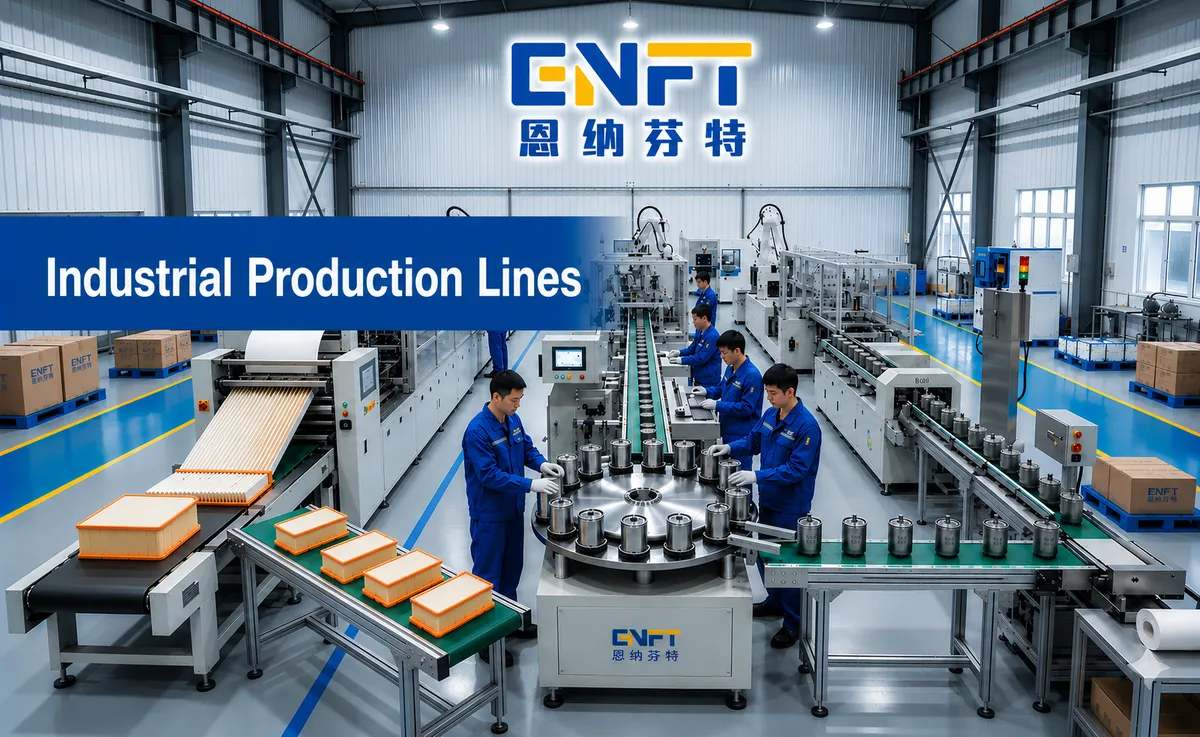
Industrial production lines have become an essential component of modern manufacturing success. They represent the backbone of every production process, whether in the food, plastics, metal, chemical, or specialized manufacturing industries such as automotive oil filter production and industrial air filter manufacturing. With the rapid advancement of automation technologies, modern industrial production lines are now capable of increasing productivity, improving product quality, reducing waste, and lowering operating costs, giving manufacturers a significant competitive advantage in both local and global markets.
In the automotive filter industry, manufacturers rely on advanced production lines equipped with air filter manufacturing machines, filter forming and assembly equipment, as well as inspection and packaging systems to produce high-quality products such as engine air filters, engine air filters and cabin air filters, automotive air conditioning gas filters, and various types of oil filters.
What Are Industrial Production Lines?
Industrial production lines are integrated systems of machines and equipment that operate together in a sequential process to transform raw materials into finished products ready for sale. Each stage of production is performed in a predefined order to ensure speed, precision, and consistent product quality.
The design of a production line varies depending on the industry. It may consist of several standalone machines or a fully integrated automatic manufacturing system.
Objectives of Industrial Production Lines
Increase production capacity.
Standardize product quality.
Reduce manufacturing time.
Minimize production waste.
Reduce dependence on manual labor.
Improve resource utilization.
Practical Example
In an automotive oil filter manufacturing facility, the production line begins by preparing the filter media, followed by pleating the filter paper, assembling the metal components, testing the finished filter, and finally packaging it. Each filter automatically moves from one stage to the next until it is ready for distribution.
The Importance of Industrial Production Lines in Modern Manufacturing
Today's competitive markets demand more than just high-quality products. Manufacturers must also achieve faster production, lower operating costs, and consistent quality—advantages made possible by modern industrial production lines.
Key Advantages
Improve factory efficiency.
Increase daily production output.
Enhance product quality.
Reduce human error.
Minimize raw material waste.
Simplify quality control.
Lower operating costs.
Accelerate large-scale order fulfillment.
Manual Production vs. Industrial Production Lines
Feature | Manual Production | Industrial Production Line |
|---|---|---|
Production Speed | Low | High |
Product Quality | Operator-dependent | Consistent |
Material Waste | High | Low |
Labor Requirements | High | Lower |
Operating Cost | High | Lower in the long term |
For these reasons, modern factories increasingly rely on integrated production lines instead of manual manufacturing processes.
Types of Industrial Production Lines
Industrial production lines can be classified according to the industry they serve or the type of product they manufacture.
By Industry
Production Line Type | Primary Application |
|---|---|
Food Production Lines | Food and beverage manufacturing |
Plastic Production Lines | Injection molding, blow molding, and plastic forming |
Metal Production Lines | Cutting, welding, and metal forming |
Paper Production Lines | Cutting, folding, and printing |
Filter Manufacturing Lines | Air, oil, and fuel filter production |
Packaging Lines | Product packaging and preparation for distribution |
By Product Type
Examples of filter production lines include:
Air filter production lines
Oil filter production lines
Fuel filter production lines
Industrial air filter production lines
Engine air filter and cabin air filter production lines
Automotive air conditioning gas filter production lines
Each production line is equipped with machinery specifically designed for the type of product being manufactured.

Which Production Line Is Right for Your Business?
Choosing the right production line is one of the most important investment decisions. The following table helps match the appropriate production line with your target market.
Target Market | Recommended Production Line |
|---|---|
Automotive repair workshops | Oil filter production line |
Automotive spare parts distributors | Air filter production line |
HVAC companies | Engine air filter and cabin air filter production line |
Modern vehicle manufacturers and suppliers | Automotive air conditioning gas filter production line |
Industrial facilities | Industrial air filter production line |
Selecting the right production line helps direct your investment toward the products with the highest demand in your target market.
Components of Industrial Production Lines
Most industrial production lines consist of interconnected units that operate sequentially throughout the manufacturing process.
Component | Function |
|---|---|
Raw Material Feeding Unit | Feeds raw materials into the production line |
Forming Machine | Shapes the product |
Assembly Unit | Assembles product components |
Conveyor System | Transfers products between production stages |
Inspection Equipment | Performs quality control |
Packaging Unit | Prepares the finished product for shipment |
Control Panel | Manages and monitors production operations |
The number of machines within a production line varies according to the product type and the required production capacity.
Stages of an Industrial Production Line
Products move through several sequential stages to ensure they meet all quality and performance specifications.
Stage 1: Raw Material Preparation
Raw materials are inspected and verified to ensure they meet the required specifications before entering the production line.
Stage 2: Manufacturing
The machines process and shape the raw materials according to the product design.
Stage 3: Assembly
All product components are assembled into the finished product.
Stage 4: Quality Inspection
The completed products undergo comprehensive quality testing to verify compliance with specifications.
Stage 5: Packaging
The finished products are packaged and prepared for storage, transportation, and distribution.
Practical Example
In an air filter manufacturing machine, the following operations are performed:
Cutting the filter paper.
Pleating the filter paper.
Applying industrial adhesive.
Installing the filter frame.
Testing the finished filter.
Packaging the product.
This process results in a consistently high-quality filter ready for market.
How to Choose the Right Industrial Production Line
Selecting an industrial production line should never be based solely on price. Instead, it should be based on a thorough assessment of your project's requirements.
Follow these steps:
1. Identify Your Product
Determine whether you plan to manufacture:
Oil filters
Air filters
Fuel filters
Industrial filters
2. Estimate Market Demand
Avoid purchasing a production line with significantly higher capacity than your market requires, as this can unnecessarily increase your investment costs without fully utilizing the equipment.
3. Define Your Budget
Your budget should cover:
Production line purchase
Factory setup
Raw materials
Operator training
Initial operating expenses
4. Choose a Reliable Supplier
A reputable supplier should provide:
Comprehensive operator training
Product warranty
After-sales service
Genuine spare parts
Ongoing technical support
Practical Example
If you plan to establish a medium-sized factory for manufacturing industrial air filters, it is advisable to choose a production line that allows additional modules to be added in the future, rather than investing in a limited system that cannot easily accommodate increased demand.
Technical Specifications to Consider Before Purchasing an Industrial Production Line
Technical specifications are among the most important factors influencing the success of your investment, as they directly affect product quality, operating efficiency, and production costs.
Specification | Importance |
|---|---|
Production Capacity | Determines daily output |
Operating Precision | Reduces manufacturing defects |
Production Speed | Improves efficiency |
Energy Consumption | Lowers operating expenses |
Ease of Operation | Reduces operator errors |
Safety Systems | Protects personnel |
Ease of Maintenance | Minimizes production downtime |
Spare Parts Availability | Ensures uninterrupted operation |
Production Line Purchase Checklist
✔ Is the production capacity suitable for your manufacturing needs?
✔ Can the production line be upgraded in the future?
✔ Does the supplier provide reliable after-sales support?
✔ Are spare parts readily available?
✔ Does the production line comply with international quality standards?
✔ Does it minimize raw material waste?
Comparison of Production Lines by Project Size
Project Size | Recommended Production Line |
|---|---|
Startup Business | Semi-automatic production line |
Medium-Sized Factory | Partially automated production line |
Large Manufacturing Facility | Fully automatic production line |
Tip: Never base your purchasing decision solely on the initial price of an industrial production line. Consider long-term operating costs, maintenance expenses, production efficiency, and overall reliability. In many cases, a higher-quality production line delivers a significantly greater return on investment by reducing downtime, maintenance costs, and material waste over its operational lifetime.
Types of Industrial Production Lines by Automation Level
Industrial production lines vary in their level of automation. Selecting the right type depends on your project's size, investment budget, and required production capacity.
1. Manual Production Lines
Manual production lines rely heavily on human labor to perform most manufacturing operations. They are best suited for small-scale businesses with limited production requirements.
Advantages
Low initial investment cost.
Simple operation.
Suitable for low-volume production.
Disadvantages
Low production capacity.
Higher error rates.
Increased labor costs.
2. Semi-Automatic Production Lines
Semi-automatic production lines combine manual labor with automated machinery. The machines perform the primary manufacturing processes, while operators handle specific tasks during production.
Advantages
Moderate investment cost.
Higher production capacity than manual systems.
Greater operational flexibility.
3. Fully Automatic Production Lines
Fully automatic production lines perform all manufacturing stages using advanced electronic control systems with minimal human intervention. They are the preferred choice for medium-sized and large manufacturing facilities.
Advantages
Maximum production capacity.
Consistent product quality.
Minimal material waste.
Reduced labor requirements.
Easier production monitoring and management.
Comparison of Automation Levels
Feature | Manual | Semi-Automatic | Fully Automatic |
|---|---|---|---|
Production Capacity | Low | Medium | High |
Labor Requirement | High | Moderate | Low |
Product Quality | Variable | Good | Consistent |
Material Waste | High | Moderate | Low |
Initial Investment | Low | Medium | High |
Latest Technologies Used in Industrial Production Lines
Modern industrial production lines have evolved significantly thanks to advanced technologies that improve productivity and enhance product quality.
PLC Control Systems
Programmable Logic Controllers (PLCs) precisely control every stage of production while allowing operators to adjust production parameters quickly and efficiently.
HMI (Human-Machine Interface)
HMI touchscreens provide an intuitive interface for monitoring production performance, adjusting machine settings, and diagnosing faults.
Industrial Robots
Industrial robots are widely used for assembly, material handling, and packaging operations, particularly in high-speed production lines.
Internet of Things (IoT)
IoT technology enables manufacturers to remotely monitor production lines and analyze operational data in real time.
Artificial Intelligence (AI)
Artificial intelligence helps analyze production data, predict equipment failures, and optimize manufacturing efficiency.
Practical Example
Some modern air filter manufacturing machines are equipped with intelligent sensors that continuously monitor product quality during production. If any deviation from the required specifications is detected, the system automatically stops the production line, reducing defective products and minimizing material waste.
Maintenance of Industrial Production Lines
Regular maintenance is essential to keep industrial production lines operating efficiently while minimizing unexpected downtime.
Types of Maintenance
Maintenance Type | Purpose |
|---|---|
Preventive Maintenance | Prevent equipment failures before they occur |
Routine Maintenance | Maintain optimal operating performance |
Corrective Maintenance | Repair unexpected equipment failures |
Predictive Maintenance | Forecast failures using operational data |
Recommended Maintenance Schedule
Maintenance Interval | Required Tasks |
|---|---|
Daily | Clean the production line and inspect operations |
Weekly | Lubricate moving components |
Monthly | Inspect sensors and electric motors |
Every Six Months | Perform comprehensive maintenance and system calibration |
Best Practices for Maintaining Production Lines
Train operators on proper machine operation.
Use genuine replacement parts.
Clean machinery regularly.
Continuously monitor production performance indicators.
Maintain detailed maintenance records.
Quality Standards in Industrial Production Lines
Product quality depends largely on the efficiency of industrial production lines and strict quality control throughout every stage of manufacturing.
Key Quality Standards
Dimensional accuracy.
High-quality raw materials.
Product consistency.
Performance testing.
Compliance with technical specifications.
Complete production documentation.
Filter Manufacturing Example
In automotive oil filter production lines, several quality tests are performed, including:
Seal integrity testing.
Pressure resistance testing.
Filtration efficiency testing.
Visual inspection.
These inspections ensure that only high-quality products reach customers.
Major Industries That Use Industrial Production Lines
Industrial production lines are widely used across nearly every modern manufacturing sector.
Industry | Typical Production Lines |
|---|---|
Automotive Industry | Vehicle assembly lines |
Filter Manufacturing | Air and oil filter production lines |
Food Industry | Filling and packaging lines |
Plastics Industry | Injection molding and blow molding lines |
Metal Industry | Cutting and forming lines |
Paper Industry | Cutting and printing lines |
Pharmaceutical Industry | Sterile filling lines |
The automotive oil filter manufacturing industry is one of the sectors that relies heavily on advanced production lines to achieve precision, consistent quality, and high-volume production.

Benefits of Investing in Modern Industrial Production Lines
Investing in modern industrial production lines delivers significant short-term and long-term advantages.
Key Benefits
Increased production output.
Improved product quality.
Reduced operating costs.
Lower material waste.
Greater workforce efficiency.
Enhanced competitiveness.
Easier future expansion.
Higher return on investment (ROI).
Practical Example
A factory operating a fully automated industrial air filter production line can often double its output compared to a manually operated facility while reducing production errors and delivering more consistent product quality.
Challenges When Purchasing Industrial Production Lines
Despite their many advantages, several challenges should be considered before investing in an industrial production line.
Challenge | Recommended Solution |
|---|---|
High investment cost | Select a production line that matches your project's scale |
Limited technical expertise | Work with a supplier that provides operator training |
Maintenance complexity | Implement scheduled maintenance programs |
Limited spare parts availability | Choose a reliable manufacturer |
Selecting the wrong production line | Conduct a comprehensive technical feasibility study before purchasing |
Common Mistakes to Avoid
Purchasing a production line based solely on price.
Overlooking after-sales service.
Choosing a production capacity that does not match market demand.
Failing to train operators.
Neglecting preventive maintenance.
Advantages of Purchasing Industrial Production Lines from ENFT
If you are looking for professional industrial production solutions, ENFT offers a comprehensive range of production lines specifically designed to meet the needs of filter manufacturing facilities of all sizes.
Why Choose ENFT?
Advanced production lines for manufacturing air filters, oil filters, and fuel filters.
State-of-the-art air filter manufacturing machines.
Complete solutions for automotive oil filter manufacturing projects.
Production lines designed for small, medium-sized, and large-scale factories.
High-efficiency, high-productivity machinery.
Technical support before and after purchase.
Comprehensive operator and maintenance training.
Genuine spare parts and reliable after-sales service.
Customized production line configurations tailored to each customer's manufacturing requirements.
Whether you are building a new factory or upgrading an existing production line, ENFT helps you select the ideal solution to maximize productivity and achieve superior product quality.
Start Your Project with ENFT
If you are planning to invest in industrial production lines or upgrade your existing manufacturing facility, the ENFT team is ready to help you select the ideal solution based on your business requirements and investment budget.
Contact us today for a free technical consultation and a customized quotation. Let ENFT's engineering experts help you build a fully integrated production line that delivers exceptional quality, maximum productivity, and a strong competitive advantage.