
Feasibility Study for an Automotive Filter Factory
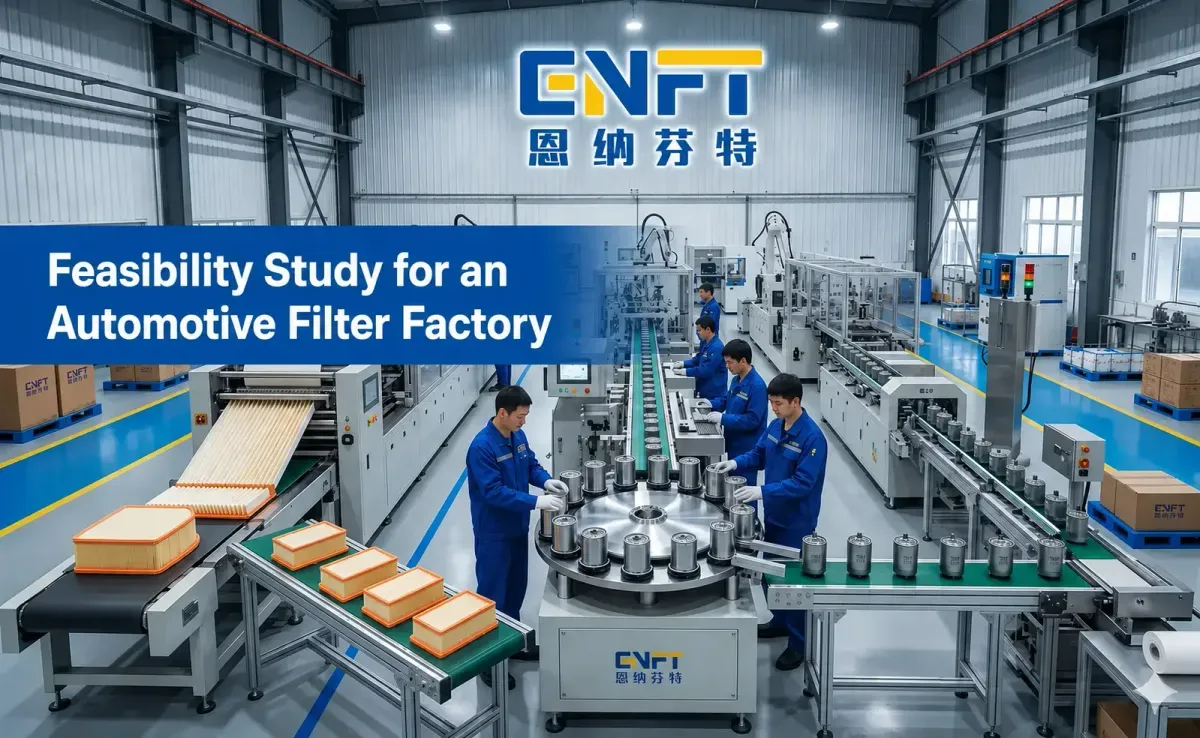
An automotive filter factory feasibility study is the first and most essential step before purchasing equipment, renting a location, or contracting with suppliers. An automotive filter manufacturing project can be a strong industrial opportunity due to the continuous demand for oil, air, and fuel filters. However, its success depends on market research, selecting the right products, the quality of raw materials, and the efficiency of the automotive filter production line—especially when working with a reliable and trusted supplier such as ENFT.
What Is an Automotive Filter Factory Feasibility Study?
An automotive filter factory feasibility study is a comprehensive analysis that explains the viability of establishing and operating a factory to manufacture automotive filters in a profitable and sustainable manner.
It is not limited to calculating the cost of machinery. It also includes an analysis of the market, competitors, required filter types, raw materials, operations, pricing, distribution, risks, and expected profits.
The purpose of the feasibility study is to answer important questions such as:
Is there genuine demand for automotive filters in the target market?
Which types of filters have the highest sales volume?
Should the project begin with oil filters, air filters, or fuel filters?
What level of investment is required?
What is the appropriate production capacity?
What is the production cost of one automotive filter?
When can the initial capital be recovered?
What are the essential machines required for the factory?
Automotive Filter Factory Project Concept
The project involves establishing an automotive filter factory to manufacture filters used in routine vehicle maintenance, such as:
Oil filters
Air filters
Fuel filters
Cabin filters
Filters for trucks and commercial vehicles
Air filters for certain equipment and machinery
The filter manufacturing industry is characterized by continuous and recurring demand because vehicles require filter replacement at regular maintenance intervals. This creates steady demand from maintenance workshops, auto-parts stores, distributors, transportation companies, and vehicle fleets.
However, the success of an automotive filter factory does not depend on production alone. It requires reliable products, accurate dimensions, professional packaging, a strong distribution network, and competitive pricing without compromising quality.
Market Study for an Automotive Filter Factory
Before starting the project, the automotive filter factory feasibility study should include a clear analysis of the target market.
Potential Customers
Customer Category | Their Need from the Factory |
|---|---|
Automotive Spare Parts Dealers | Wholesale quantities and competitive prices |
Maintenance Workshops | Reliable filters that are easy to install |
Service Centers | Consistent quality and regular supply |
Spare Parts Distributors | Branded products with high-quality packaging |
Transportation Companies | Filters for trucks and commercial vehicles |
E-Commerce Stores | Numbered products, product images, and shipping-friendly packaging |
How to Study the Market in Practice
Identify the most common vehicle models in the target market.
Collect the most in-demand filter part numbers.
Ask auto-parts dealers about the fastest-moving products.
Compare the prices of economy, mid-range, and premium-quality products.
Monitor products from local and imported air filter manufacturers.
Identify market gaps, such as poor quality or unavailable filter sizes.
Study distribution, storage, and return costs.
Practical Example
If the target market relies on widely used passenger vehicles with specific models, it is better to begin by manufacturing a limited number of high-demand part numbers rather than producing dozens of sizes from the beginning. This reduces mold and inventory costs and makes production management easier.
Choosing the Right Filter Type for the Project
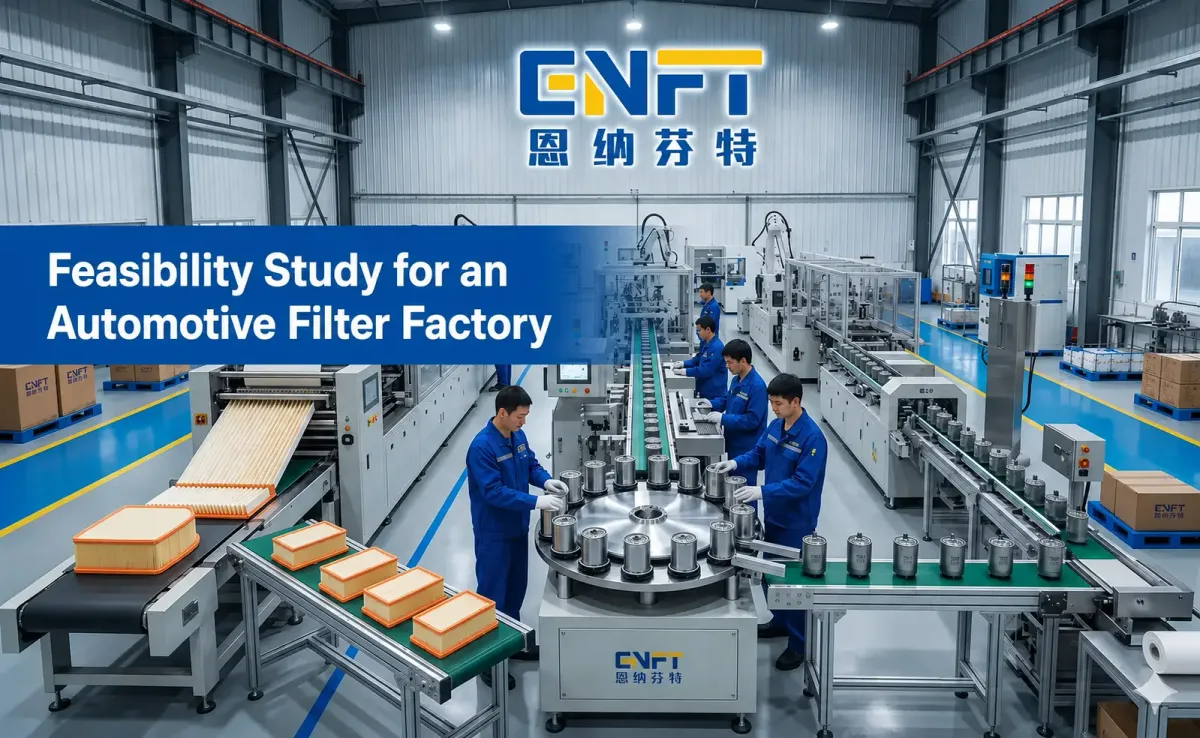
Selecting the filter type is one of the most important decisions in an automotive filter factory feasibility study because each type requires different raw materials, machinery, and testing procedures.
Filter Type | Demand Level | Manufacturing Difficulty | Suitable for Starting? |
|---|---|---|---|
Oil Filter | Very High | Medium | Yes |
Air Filter | Very High | Medium | Yes |
Fuel Filter | High | Medium to High | Yes, after stabilization |
Cabin Filter | Growing | Medium | Suitable for expansion |
Truck Filters | Good | Requires larger sizes | Suitable for specialized markets |
Comparison Between Starting with Oil Filters and Air Filters
Factor | Oil Filter | Air Filter |
|---|---|---|
Outer Structure | Usually metal | Plastic, rubber, or metal |
Most Important Quality Factor | Pressure resistance and leak prevention | Filtration efficiency and airflow |
Required Equipment | Assembly, pressing, and pressure testing | Paper pleating, frame injection, and assembly |
Variety of Sizes | Large | Very large |
Defect Risks | Oil leakage or engine damage | Poor filtration or dust entering the engine |
The project can begin with an automotive filter production line for oil and air filters, then add fuel filters or cabin filters after building a stable customer base.
Location and Required Space for an Automotive Filter Factory
The location of an automotive filter factory should be selected in an industrial area or a site that allows manufacturing, storage, and shipping operations.
Required Space by Project Size
Project Size | Approximate Area |
|---|---|
Small Project | 150 to 300 square meters |
Medium Factory | 500 to 1,000 square meters |
Large Multi-Line Factory | 1,500 square meters or more |
Factory Space Allocation
Raw material warehouse
Filter paper cutting and pleating area
Filter manufacturing and assembly area
Pressing and testing area
Printing and packaging area
Finished product warehouse
Maintenance and spare-parts area
Administration and sales office
Example of a Medium Factory Layout
A medium-sized factory may allocate 25% of its space to raw materials, 35% to production, 15% to testing and packaging, 20% to finished-product storage, and 5% to administration and services.
Raw materials should move through a clear path from receiving to production, then inspection and packaging, without unnecessary overlap.
Essential Infrastructure for an Automotive Filter Factory
The required setup is not limited to automotive filter manufacturing machines. It also includes infrastructure that ensures safe and stable operation.
Equipment or Facility | Importance |
|---|---|
Suitable Industrial Electricity Supply | Operates machinery and motors |
Air Compressor | Operates certain pressing and assembly equipment |
Ventilation System | Important when using adhesives and chemicals |
Storage Shelves | Organizes raw materials and finished products |
Worktables | Used for assembly, inspection, and packaging |
Safety Equipment | Protects workers from industrial hazards |
Measuring and Testing Devices | Ensures product compliance |
Inventory Management System | Tracks raw materials, production, and sales |
Equipment and Machinery Required for an Automotive Filter Factory
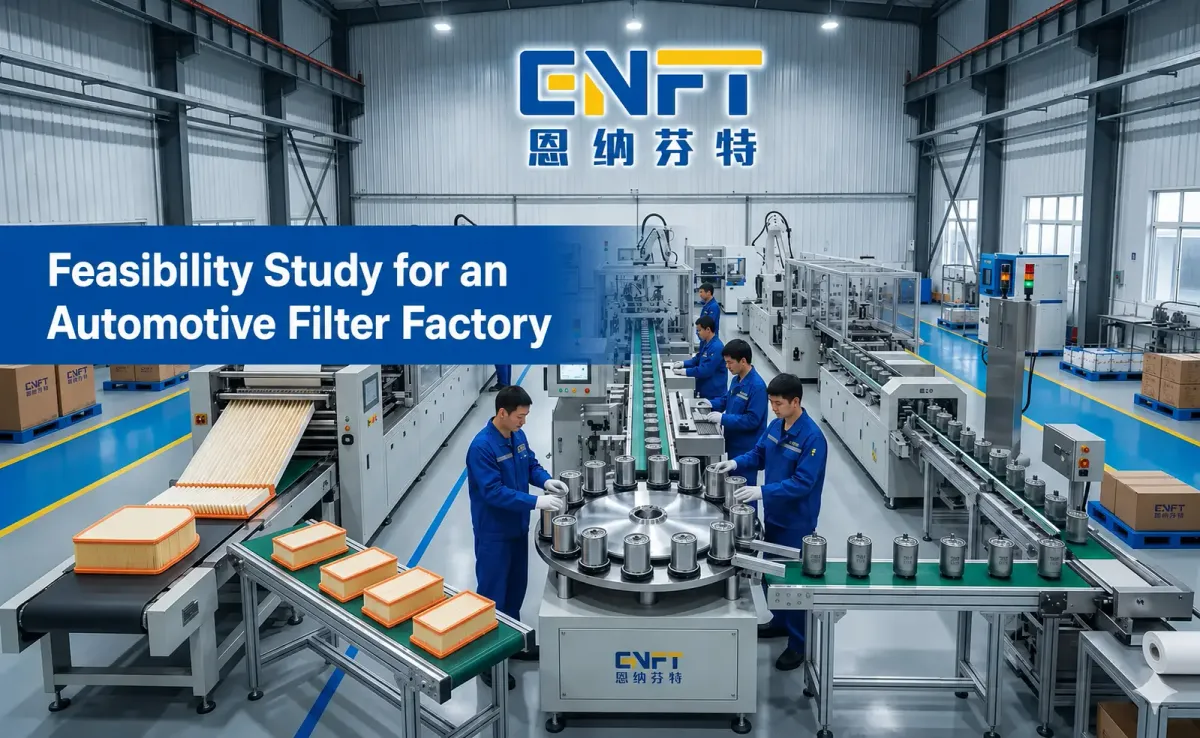
The equipment varies depending on the type of filters being produced. However, an automotive filter production line usually consists of a group of interconnected machines.
Machine | Use |
|---|---|
Filter Paper Cutting Machine | Cuts filter paper to the required dimensions |
Pleating Machine | Forms pleats in filter paper |
Filter Paper Bonding Machine | Secures the edges of filter paper |
Metal Cover Manufacturing Machine | Forms oil filter components |
Filter Assembly Machine | Installs internal and external components |
Filter Pressing Machine | Tightly seals oil or fuel filters |
Polyurethane Injection Machine | Produces air filter edges |
Leak Testing Machine | Tests oil and fuel filters |
Printing Machine | Prints the brand name and part numbers |
Packaging Machine | Prepares filters for sale and distribution |
Automotive Filter Manufacturing Machines by Product Type
Product | Most Important Required Machines |
|---|---|
Oil Filter | Pleating, cover forming, assembly, pressing, and pressure testing |
Air Filter | Pleating, cutting, bonding, frame injection, and assembly |
Fuel Filter | Cutting, assembly, sealing, and leak testing |
Cabin Filter | Cutting, pleating, bonding, frame installation, and packaging |
Raw Materials Required for Manufacturing Automotive Filters
Project success does not depend only on purchasing an automotive filter production line. It also depends directly on the quality of raw materials.
Raw Material | Use |
|---|---|
Filter Paper | Captures dust and impurities |
Metal Sheets | Used for oil filter bodies and covers |
Engineering Plastic | Used for certain filter housings and covers |
Polyurethane | Used for air filter edges and frames |
Industrial Adhesive | Secures filter paper and components |
Rubber and Gaskets | Prevent leaks in oil and fuel filters |
Valves and Springs | Internal components in oil filters |
Industrial Inks | Print product information and brand names |
Cartons and Labels | Packaging and barcodes |
Example of Raw Materials for Manufacturing Automotive Air Filters
Manufacturing automotive air filters requires suitable filter paper, adhesive resistant to heat and moisture, and a plastic, rubber, or polyurethane frame. It also requires packaging materials that protect the filter from moisture and dust before use.
Automotive Filter Manufacturing Stages
The manufacturing process involves several stages that vary according to the filter type. However, the general sequence is as follows:
Determining the target part number and dimensions.
Inspecting raw materials before production begins.
Cutting filter paper according to the required dimensions.
Pleating the paper to increase the filtration surface area.
Securing the paper using glue or hot-melt adhesive.
Preparing the filter body or frame.
Installing internal components.
Assembling, pressing, or sealing the filter.
Conducting quality tests.
Printing product information and packaging.
Storing the finished product and preparing it for distribution.
Example: Oil Filter Manufacturing Stages
The metal filter body is formed first. Then, the paper filtration element is prepared, followed by the installation of the center tube, valve, spring, and rubber gasket. After that, the cover is pressed into place, and the filter is tested for leakage and pressure resistance before packaging.
Labor Requirements for an Automotive Filter Factory
Labor requirements vary according to the level of automation and the size of the factory.
Position | Suggested Number for a Medium-Sized Factory |
|---|---|
Machine Operators | 3 to 6 |
Assembly and Packaging Workers | 4 to 8 |
Maintenance Technicians | 1 to 2 |
Quality Control Officers | 1 to 2 |
Production Supervisor | 1 |
Warehouse Supervisor | 1 |
Sales and Purchasing Staff | 1 to 2 |
An automated line reduces the number of direct labor workers, but it requires technicians who can adjust the machines, perform maintenance, and analyze faults.
Production Capacity of an Automotive Filter Factory
Production capacity depends on the type of production line, operating hours, product variety, labor efficiency, and the time required to change molds and raw materials.
Line Type | Approximate Production Capacity |
|---|---|
Basic or Manual Line | 300 to 1,000 filters per day |
Semi-Automatic Line | 1,000 to 5,000 filters per day |
Automatic Line | 5,000 to 20,000+ filters per day |
Example of Production Capacity Calculation
If a paper pleating machine produces 25 filter elements per minute and the factory operates for 8 hours per day:
25 × 60 × 8 = 12,000 filter elements per day theoretically
However, actual production must be calculated after deducting downtime, raw material changes, maintenance, inspection, and waste. Therefore, actual capacity may be 15% to 30% lower depending on factory management.
How to Calculate the Production Cost of One Automotive Filter
Unit cost is one of the most important parts of an automotive filter factory feasibility study because it determines the selling price and profit margin.
Formula for the Cost of One Filter
Filter Cost = Raw Material Cost + Direct Labor + Energy + Packaging + Waste + Maintenance + Overhead Expenses
Cost Item | Examples of What It Includes |
|---|---|
Raw Materials | Filter paper, metal, plastic, rubber, adhesive |
Labor | Operator, assembly, and packaging wages |
Energy | Electricity, compressed air, and fuel when needed |
Packaging | Cartons, bags, labels, and barcodes |
Waste | Damaged materials or non-compliant products |
Maintenance | Spare parts, oils, and periodic repairs |
Overhead Expenses | Rent, administration, marketing, and transportation |
Simplified Cost Calculation Example
If the raw material cost of an oil filter is $1.40, labor and energy cost $0.30, packaging costs $0.15, and waste, maintenance, and overhead costs total $0.25:
Filter Production Cost = Approximately $2.10
If the filter is sold wholesale for $2.80, the gross profit margin before taxes and additional marketing costs would be approximately $0.70 per filter.
These figures should be adjusted based on raw material prices, wages, energy costs, and selling prices in the target market.
Expected Revenue and Profit from an Automotive Filter Factory
Revenue depends on the number of filters sold, not only the number produced. Therefore, production capacity must be linked to a realistic distribution plan.
Simplified Revenue Example
Item | Assumed Value |
|---|---|
Monthly Sellable Production | 30,000 filters |
Average Wholesale Selling Price | $2.80 |
Monthly Revenue | $84,000 |
Average Filter Cost | $2.10 |
Total Production Cost | $63,000 |
Gross Profit Before Other Expenses | $21,000 |
This example does not represent a fixed figure for every market because profits are affected by raw material prices, competition, demand volume, returns, taxes, shipping costs, and whether products are sold wholesale or retail.
How to Increase the Profitability of an Automotive Filter Factory
Focus on the highest-selling part numbers.
Reduce waste through better quality control.
Purchase raw materials in well-planned quantities.
Develop a reliable brand.
Sell products to multiple distributors rather than relying on one customer.
Offer filters at different quality levels.
Add complementary products such as cabin filters or truck filters.
Quality Standards and Tests for Automotive Filters
Quality is the factor that determines the factory’s ability to continue operating successfully. A poor-quality filter may cause engine damage, customer complaints, or loss of trust in the brand.
Test | Purpose |
|---|---|
Dimensional Test | Ensures the filter fits the vehicle correctly |
Leak Test | Ensures that oil or fuel filters are properly sealed |
Pressure Test | Measures the filter body’s ability to withstand pressure |
Filtration Efficiency Test | Measures the filter’s ability to capture impurities |
Airflow Test | Measures air resistance in air filters |
Crimping Strength Test | Ensures the seal remains secure |
Heat Resistance Test | Tests adhesives, rubber, and raw materials |
Visual Inspection | Ensures proper printing and packaging |
Common Operational Experience
A factory may successfully produce a filter with a good appearance but fail the leak or pressure test because of a weak rubber gasket or inaccurate pressing. Therefore, quality tests must be an integral part of the production line, not a secondary step after manufacturing is complete.
Risks and Challenges in an Automotive Filter Factory Project
Any realistic automotive filter factory feasibility study should explain potential risks and how to manage them.
Challenge | Potential Impact | Management Method |
|---|---|---|
Competition from Low-Cost Products | Pressure on prices | Focus on quality and value |
Fluctuating Raw Material Prices | Higher costs | Diversify suppliers and use contracts |
Poor Quality | Returns and loss of customers | Strict testing and training |
Variety of Part Numbers | Increased inventory and mold costs | Start with the most in-demand products |
Machine Failures | Production downtime | Regular maintenance and available spare parts |
Weak Distribution | Inventory accumulation | Build a distributor network |
Brand Counterfeiting | Loss of trust | Distinctive packaging, barcodes, and trademark registration |
Advantages of Purchasing an Automotive Filter Production Line from ENFT
ENFT provides specialized solutions for businesses seeking to establish or develop an automotive filter factory, from selecting suitable equipment to preparing a scalable production line.
The advantages of working with ENFT include:
Integrated solutions for automotive filter production lines
Machines suitable for manufacturing oil, air, and fuel filters
Automatic and semi-automatic production line options
The ability to prepare molds and dimensions based on the required part numbers
Support in selecting automotive filter manufacturing machines suitable for the target production capacity
Solutions for developing automotive air filter manufacturing
Technical support for installation, operation, and training
The ability to add new machines as the factory grows
Assistance in building a production line that balances quality, cost, and output
Start Your Automotive Filter Factory Feasibility Study with ENFT
If you are planning to establish a new factory or upgrade an existing one, contact ENFT to receive a customized technical quotation based on the types of filters you want to manufacture, the required production capacity, and the available factory space.
Send the ENFT team the following information:
Target filter types
Daily or monthly production capacity
Factory area
Target country or market
Required automation level
Approximate budget
Contact ENFT today to receive an initial consultation and a suitable quotation for an automotive filter production line and automotive filter factory project.