
Automotive Filter Production Line: The Complete Guide to Manufacturing Automotive Filters
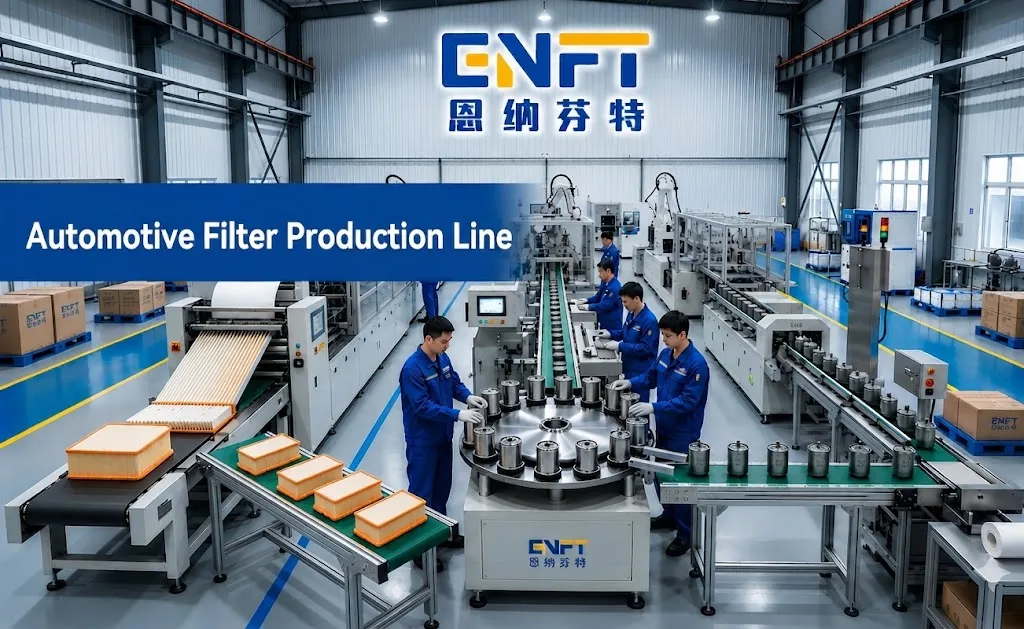
An automotive filter production line is an integrated industrial system used to manufacture, assemble, and test different types of automotive filters, such as car air filters, oil filters, and fuel filters, according to the specifications required for each application. The success of a production line depends on selecting the right machinery, using high-quality raw materials, maintaining precision throughout forming and assembly processes, and conducting the necessary tests to ensure the quality of the finished product.
With the growing demand for automotive spare parts, investing in an automotive filter production line has become an important industrial opportunity for factories targeting the automotive aftermarket or supplying distributors and automotive companies. Modern production lines also help improve productivity, reduce dependence on manual labor, and achieve greater consistency in product quality.
What Is an Automotive Filter Production Line?
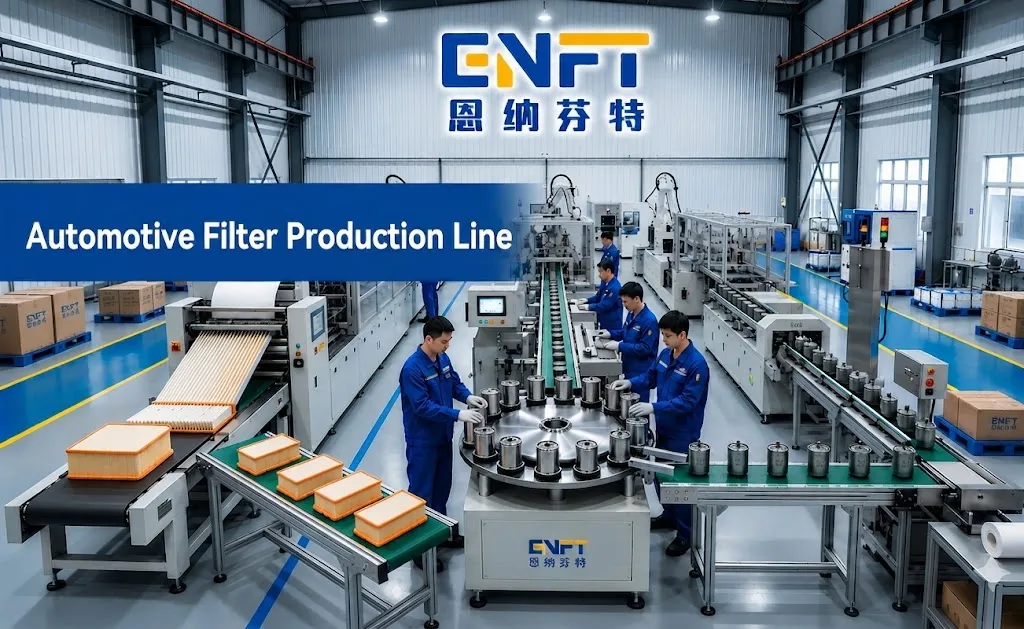
An automotive filter production line is a group of interconnected industrial machines and equipment designed to transform raw materials into a finished automotive filter ready for testing and packaging.
The production line does not necessarily consist of a single machine. Instead, it typically includes several specialized machines, with each machine performing a specific manufacturing stage.
The production line may include:
Filter media preparation equipment.
Filter media cutting and forming machines.
Pleating equipment.
Metal component forming and preparation machines.
Assembly equipment.
Closing and sealing machines.
Testing equipment.
Printing and packaging equipment.
The configuration of an automotive filter production line varies according to the target filter type, filter size, required production capacity, and desired level of automation.
What Types of Automotive Filters Can Be Manufactured?
An automotive filter production line can be designed to manufacture several types of filters, including:
Filter Type | Primary Function | Application |
|---|---|---|
Car Air Filter | Cleans air entering the engine | Cars and vehicles |
Engine Oil Filter | Filters engine oil | Automotive engines |
Fuel Filter | Reduces contaminants in fuel | Fuel systems |
Cabin Air Filter | Cleans air inside the cabin | Passenger vehicles |
Special-Application Filters | Depends on the design | Different vehicles and equipment |
Car Air Filter
A car air filter helps reduce the amount of dust and particles entering the engine. Therefore, it requires suitable filter media and a design that ensures proper airflow through the filtration area.
Car Engine Filter
This term is used in some markets to refer to filters associated with the engine. Depending on the search context, it may refer to an oil filter or an air filter.
Car Air Conditioner Gas Filter
This filter differs from an engine air filter in terms of its function and the system in which it operates. Therefore, the specific product must be clearly identified before designing and configuring the manufacturing line.
Components of an Automotive Filter Production Line
The components vary depending on the product, but an automotive filter production line can generally be divided into several main units.
Filter Media Preparation Unit
This unit prepares the raw filter media according to the required dimensions.
Pleating and Forming Unit
This unit folds the filter media in a consistent pattern to increase the filtration area within the available space.
Frame or Housing Preparation Unit
This unit is used to prepare the components that hold and support the filter media.
Assembly Unit
The assembly unit combines the different components to produce the finished filter.
Closing and Sealing Unit
This unit secures the components and provides the required sealing according to the product design.
Testing Unit
The testing unit helps verify the safety, performance, and compliance of the finished product with the required specifications.
Packaging Unit
The packaging unit prepares the finished products for sale, storage, and distribution.
Simplified production line configuration:
Material preparation → Cutting → Pleating → Assembly → Closing → Testing → Packaging
Automotive Filter Manufacturing Process
The manufacturing process starts with raw materials and ends with a finished product ready for distribution.
1. Raw Material Preparation
Filter media, metal components, rubber components, and other materials are received and inspected before entering the production process.
2. Dimension Setting
The machines are adjusted according to the dimensions and specifications of the target product.
3. Filter Media Cutting
The filter media is prepared and cut to the appropriate dimensions for the filter being manufactured.
4. Filter Media Pleating
The filter media is pleated evenly to achieve the required filtration area.
5. Component Preparation
The filter frame or metal housing and other required components are prepared for assembly.
6. Assembly
The different components are assembled using the designated production equipment.
7. Closing and Securing
The components are securely fixed to achieve the required sealing and structural integrity.
8. Quality Testing
The finished filter is inspected and tested to verify compliance with the required specifications.
9. Packaging
After passing the required quality tests, the filters are packaged for storage and shipment.
Raw Materials Used in Automotive Filter Production
The raw materials depend on the type and design of the filter, but they may include:
Material | Application |
|---|---|
Filter Paper or Filter Media | Filtration element |
Metal Sheets | Housing or metal components |
Plastic | Covers and selected components |
Rubber | Gaskets and sealing components |
Adhesives | Securing selected components |
Metal Mesh | Supporting the filter media |
Packaging Materials | Protecting the finished product |
Why Is Raw Material Quality Important?
Even with an advanced automotive filter production line, it is impossible to manufacture a high-quality product if the raw materials are unsuitable.
Therefore, manufacturers should inspect:
Thickness.
Dimensions.
Filter media quality.
Component strength.
Adhesive properties.
Rubber and sealing material quality.
Types of Automotive Filter Production Lines
Production lines can be classified according to their level of automation.
Manual Production Line
A manual production line relies heavily on workers for a large number of manufacturing stages.
Advantages:
Relatively lower initial investment.
Suitable for limited production volumes.
Good flexibility for certain operations.
Disadvantages:
Lower productivity.
Greater dependence on operator skills.
Greater potential for variation in certain production stages.
Semi-Automatic Production Line
A semi-automatic production line combines automated equipment with human intervention.
It is a suitable option for factories that need to increase production without immediately moving to full automation.
Automatic Production Line
An automatic production line uses automated equipment and control systems to perform a larger number of production stages.
Comparison | Manual | Semi-Automatic | Automatic |
|---|---|---|---|
Human Intervention | High | Medium | Low |
Productivity | Limited | Medium | High |
Investment | Lower | Medium | Higher |
Production Consistency | Medium | Good | High |
Scalability | Limited | Good | Excellent |
Requirements for Establishing an Automotive Filter Factory
Establishing a factory based on an automotive filter production line requires careful planning of the building and infrastructure before purchasing the equipment.
Essential Factory Areas
The factory should ideally be divided into:
Raw material warehouse.
Production area.
Assembly area.
Testing area.
Packaging area.
Finished goods warehouse.
Maintenance area.
Administration and quality offices.
Infrastructure Requirements
The following factors should be evaluated:
Electricity supply.
Required electrical capacity.
Compressed air when required.
Ventilation.
Lighting.
Safety systems.
Material flow between production stages.
The objective is to establish a clear material flow:
Raw Materials → Production → Testing → Packaging → Storage → Shipping
Automotive Filter Production Line Capacity
Production capacity varies from one production line to another, and there is no single production capacity suitable for every factory.
Production capacity depends on:
Machine speed.
Operating hours.
Level of automation.
Filter type.
Product dimensions.
Number of workers.
Line efficiency.
Downtime and maintenance requirements.
Simplified Production Calculation Example
If a production line produces 60 filters per hour and operates for 8 hours per day:
60 × 8 = 480 filters per day
If the factory operates for 26 days:
480 × 26 = 12,480 filters per month
These figures are hypothetical examples for illustration only. Actual production capacity depends on machine specifications, product design, and operating conditions.
Automotive Filter Production Line Cost
There is no fixed price for all automotive filter production lines, because the total cost depends on the configuration and specifications of the line.
The main factors affecting the cost include:
Factor | Cost Impact |
|---|---|
Number of Machines | High |
Level of Automation | High |
Production Capacity | High |
Filter Type | High |
Testing Systems | Medium |
Tooling and Dimensions | Variable |
Packaging | Variable |
Customization | Variable |
Do Not Compare Prices Alone
A production line may be less expensive than another, but it may require more manual intervention or provide lower production capacity.
Therefore, it is better to compare:
Price + Productivity + Component Quality + Energy Consumption + Technical Support + Spare Parts + Scalability
Maintenance of an Automotive Filter Production Line
Preventive maintenance helps reduce unexpected downtime and maintain stable production performance.
Daily Maintenance
Clean production areas.
Remove material residues.
Inspect moving components.
Check for unusual noises.
Periodic Maintenance
Inspect motors.
Review electrical systems.
Check sensors.
Lubricate components according to the manufacturer's instructions.
Calibrate equipment when necessary.
Preventive Maintenance
It is recommended to maintain a detailed maintenance record including:
Maintenance date.
Replaced component.
Cause of the failure.
Downtime duration.
Corrective action taken.
This helps factory management identify recurring problems and take proactive measures.
How to Choose the Best Automotive Filter Production Line
Choosing the best automotive filter production line should begin with identifying the project's actual requirements rather than simply selecting the most expensive machine.
Step 1: Define Your Products
Determine whether you will manufacture:
Air filters.
Oil filters.
Fuel filters.
Multiple filter types.
Step 2: Define Your Target Market
Research the most popular vehicle models and identify your target customers.
Step 3: Determine Production Capacity
Estimate expected demand instead of choosing a production capacity that is significantly higher than the project's actual requirements.
Step 4: Determine the Automation Level
Compare the initial investment with labor costs and expected production output.
Step 5: Review Technical Specifications
Pay attention to:
Production speed.
Product dimensions.
Electrical requirements.
Operating accuracy.
Control systems.
Production flexibility.
Step 6: Verify Technical Support
Ask about:
Installation.
Operator training.
Trial operation.
Spare parts.
Technical support.
Criteria for Selecting an Automotive Filter Production Line Manufacturer
The equipment manufacturer is an essential part of the project's success.
When comparing air filter manufacturers and filter equipment suppliers, it is important to distinguish between companies that manufacture finished filter products and companies that specialize in manufacturing filter production equipment.
Key Supplier Selection Criteria
Industrial Experience:
Choose a supplier with practical knowledge and experience in filter manufacturing technologies.
Equipment Quality:
Verify the quality of the mechanical and electrical components as well as the control systems.
Customization:
The supplier should be capable of designing the production line according to the product type and targeted production capacity.
Technical Support:
Reliable after-sales technical support is an important factor, particularly for industrial projects.
Scalability:
It is preferable to select a production line that allows additional equipment to be installed or production stages to be upgraded in the future.
Practical Example of Automotive Filter Production Line Planning
Suppose an investor wants to establish a small- to medium-sized factory for manufacturing automotive filters.
Instead of purchasing all equipment at once, the project can be planned through the following stages:
Stage 1: Conduct market research and identify the most in-demand vehicle models.
Stage 2: Determine the types of filters the factory will initially manufacture.
Stage 3: Define the target production capacity.
Stage 4: Select the machines required for each production stage.
Stage 5: Prepare the factory, electrical infrastructure, and storage areas.
Stage 6: Install and commission the production line.
Stage 7: Produce a trial batch.
Stage 8: Conduct quality testing and adjust machine settings.
Stage 9: Begin commercial production and expand gradually.
This approach reduces the risk of purchasing equipment that does not match the project's actual requirements.
Advantages of an Automotive Filter Production Line from ENFT
ENFT provides specialized solutions for automotive filter manufacturing equipment and machinery, helping investors and factories configure production lines according to their industrial objectives.
Key advantages include:
Specialized solutions for filter manufacturing.
Complete production line configurations.
Equipment for different manufacturing stages.
Equipment selection based on the required production capacity.
Scalable production solutions.
Technical support for industrial projects.
Assistance in selecting the appropriate production line configuration.
A focus on improving manufacturing efficiency.
For investors planning to establish a factory specializing in automotive air filter manufacturing, working with a specialized supplier can help align the equipment with the product and market requirements instead of purchasing separate machines without comprehensive planning.
Start Your Automotive Filter Production Line with ENFT
Are you planning to establish an automotive filter manufacturing factory or upgrade your existing production facility?
Do not start purchasing machines before determining the filter types, production capacity, automation level, factory space, and market requirements.
Contact ENFT today for specialized solutions for filter manufacturing machines and production lines, and choose the right configuration for your project from the beginning.
ENFT — Specialized industrial solutions for manufacturing automotive filters with greater efficiency and higher quality.