
Automotive Filter Manufacturing Project| The Comprehensive Guide to Starting a Successful Factory and Achieving Sustainable Profits
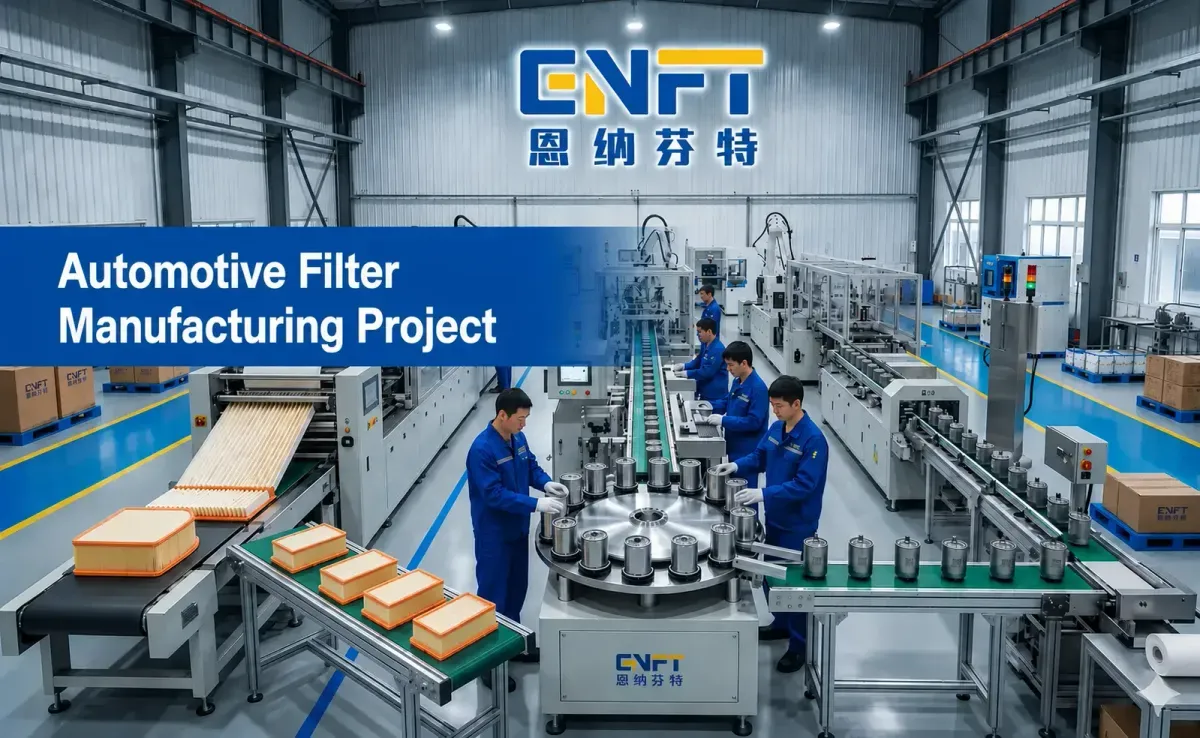
An automotive filter manufacturing project is considered one of the most promising industrial investments in the automotive aftermarket due to the continuous demand for oil filters, air filters, and fuel filters across global markets. As the number of passenger vehicles and commercial fleets continues to grow, investing in an automotive filter manufacturing business has become an excellent opportunity for entrepreneurs seeking a stable industry with recurring demand.
However, the success of the project does not depend solely on purchasing automotive filter manufacturing machines. It begins with conducting a thorough market analysis, selecting the right filter types, determining the required production capacity, choosing suitable machinery and raw materials, and establishing an efficient production system capable of delivering high-quality products at competitive costs.
What Is an Automotive Filter Manufacturing Project?
An automotive filter manufacturing project is an industrial business focused on producing filters that protect various vehicle components from dust, contaminants, and debris by using specialized production lines and manufacturing equipment.
The products that can be manufactured include:
Automotive oil filters
Engine air filters
Engine air filters and cabin air filters
Cabin air filters
HVAC cabin filters
Fuel filters
Industrial air filters for equipment and specialized applications
One of the greatest advantages of this business is that automotive filters are consumable products. Since they require regular replacement during vehicle maintenance, demand remains consistent throughout the year.
Why Is an Automotive Filter Manufacturing Project a Profitable Investment?
Several factors make this one of the most attractive industrial investment opportunities:
Continuous demand due to routine vehicle maintenance.
The ability to start with a single production line and expand gradually.
A diverse customer base, including distributors, repair workshops, service centers, and spare parts dealers.
Multiple filter types can often be manufactured using the same production infrastructure with only minor tooling changes.
High export potential when products meet international quality standards.
Types of Automotive Filters You Can Manufacture
A factory can be equipped to manufacture several different types of filters depending on market demand.
Filter Type | Function | Common Applications |
|---|---|---|
Automotive Oil Filter | Cleans engine oil | Passenger cars and trucks |
Engine Air Filter | Cleans air entering the engine | All vehicle types |
Fuel Filter | Removes contaminants from fuel | Gasoline and diesel vehicles |
Cabin Air Filter | Cleans air entering the passenger compartment | Vehicle HVAC systems |
HVAC Filter | Improves cabin air quality | Passenger vehicles |
Industrial Air Filter | Filters air in industrial equipment | Factories and heavy machinery |
Difference Between an Engine Air Filter and a Cabin Air Filter
One of the most frequently asked questions is the difference between an engine air filter and a cabin air filter.
Feature | Engine Air Filter | Cabin Air Filter |
|---|---|---|
Installation Location | Engine compartment | Vehicle HVAC system |
Primary Function | Protects the engine | Cleans air inside the passenger cabin |
Main Benefit | Improves engine performance | Improves air quality and passenger comfort |
A single factory can manufacture both products by equipping its automotive filter manufacturing machines with the appropriate molds and tooling.
Which Type of Filter Is Best for Your Business?
If Your Target Customers Are... | Start Manufacturing... |
|---|---|
Automotive repair workshops | Automotive oil filters |
Spare parts distributors | Engine air filters |
Owners of modern vehicles | Cabin air filters |
Large maintenance centers | Both engine air filters and cabin air filters |
Industrial customers | Industrial air filters |
Market Research Before Starting an Automotive Filter Manufacturing Project
A successful project begins with understanding the market—not simply purchasing machinery.
Step 1: Identify Your Target Customers
Potential customers include:
Automotive spare parts dealers
Vehicle maintenance centers
Authorized dealerships
Transportation companies
Lubricant distributors
E-commerce businesses
Air filter manufacturers seeking OEM suppliers or complementary products
Step 2: Analyze Your Competitors
Before launching the business, evaluate:
Competitors' product pricing
Product quality
Strengths and weaknesses
Best-selling filter models
Imported versus locally manufactured products
Practical Example
If the target market is dominated by Japanese and Korean vehicles, it is advisable to begin by producing filter part numbers for those vehicle brands before expanding into additional product lines.
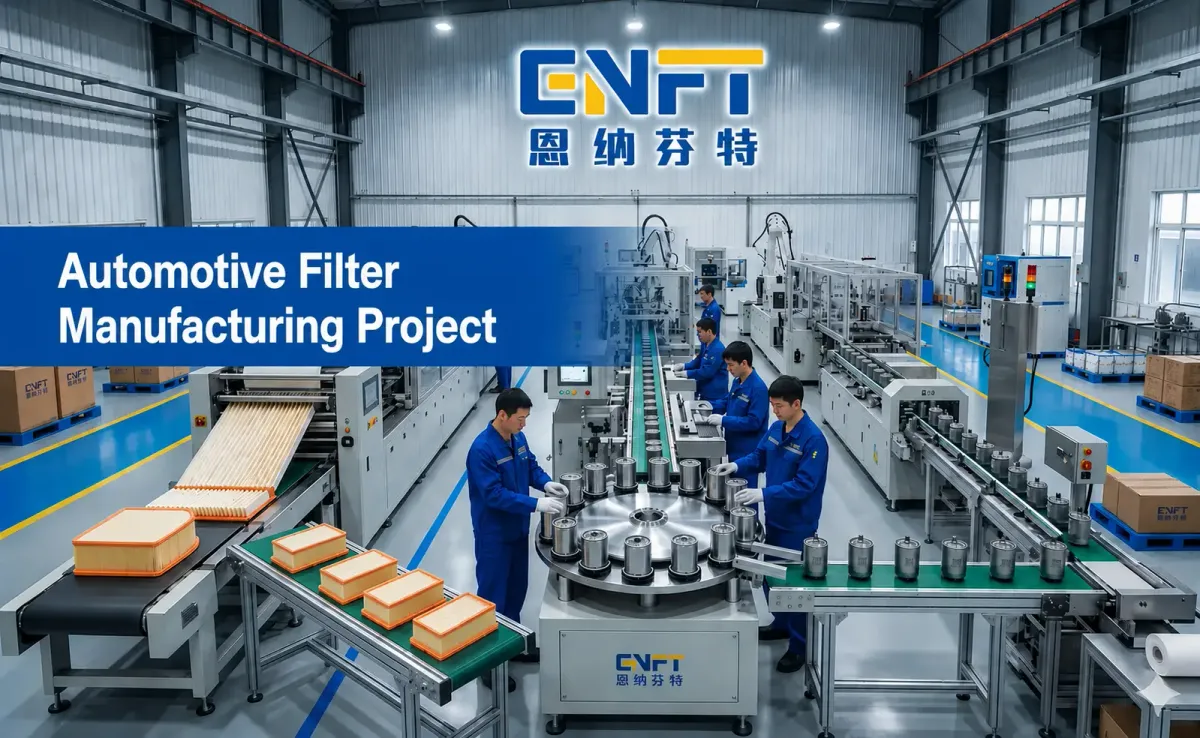
Feasibility Study for an Automotive Filter Manufacturing Project
A comprehensive feasibility study should cover five major areas:
Study Area | Objective |
|---|---|
Market Analysis | Measure market demand |
Technical Study | Define production lines and equipment |
Operational Study | Determine labor and production requirements |
Financial Study | Estimate investment costs and profitability |
Risk Assessment | Reduce potential business risks |
The feasibility study should not focus solely on machinery prices. It must also include infrastructure costs, raw materials, maintenance, packaging, marketing, and operating expenses.
Choosing the Right Factory Location
The factory location has a direct impact on operating costs and distribution efficiency.
Ideally, the facility should be located in an industrial zone that offers:
Industrial electricity
Access to major highways
Easy truck access
Availability of skilled labor
Proximity to raw material suppliers
Recommended Factory Space
According to the ENFT Production Guide, the required factory space varies depending on the production line.
Production Line | Recommended Area |
|---|---|
Eco Air Filter Line | 300 m² |
PP Air Filter Line | 500 m² |
Air Injection Filter Line | 500 m² |
Panel Air Filter Line | 700 m² |
Cylindrical Air Filter Line | 800 m² |
Spin-On Oil Filter Assembly Line | 1,000 m² |
Complete Spin-On Oil Filter Manufacturing Line | 3,000 m² |
The factory should also include dedicated areas for:
Raw material storage
Production
Quality control
Packaging
Finished goods warehouse
Automotive Filter Manufacturing Machines Required
Selecting the right automotive filter manufacturing machines is one of the most important decisions in the project, as both production speed and product quality depend on them.
A complete production line typically includes:
Machine | Function |
|---|---|
Filter Paper Cutting Machine | Prepares filter media |
Filter Paper Pleating Machine | Forms the filter pleats |
Filter Paper Bonding Machine | Bonds the filter element |
Metal Cover Forming Machine | Manufactures the filter housing |
Filter Assembly Machine | Assembles all filter components |
Filter Pressing Machine | Seals the filters securely |
Leak Testing Machine | Performs quality and leak testing |
Printing Machine | Prints product information and branding |
Packaging Machine | Prepares finished products for sale |
Practical Example
If your factory initially manufactures automotive oil filters only, you may not need all the machinery required for air filter production. However, when expanding to manufacture cabin air filters or HVAC filters, additional equipment such as polyurethane injection machines and specialized molds will be required.
Raw Materials Used in Automotive Filter Manufacturing
The quality of an automotive filter depends largely on the quality of the raw materials used during production.
Raw Material | Application |
|---|---|
Filter Paper | The primary filtration medium |
Metal Sheets | Oil filter housing |
Engineering Plastics | Used in certain filter types |
Polyurethane | Air filter frames and seals |
Industrial Adhesive | Bonds the filter paper |
Rubber | Prevents leakage |
Valves | Internal oil filter components |
Springs | Internal mechanical components |
Packaging Materials | Protect the finished product |
The higher the quality of these materials, the greater the filtration efficiency, durability, and service life of the finished filter.
Automotive Filter Manufacturing Process
The manufacturing process consists of several sequential stages to ensure a high-quality finished product.
Inspect the raw materials.
Cut the filter paper.
Form the pleats using a pleating machine.
Bond the filter paper using industrial adhesive.
Manufacture the filter housing or frame.
Assemble all filter components.
Press and seal the filter.
Perform quality control and leak testing.
Print the part number and product information.
Package and store the finished products.
Labor Requirements for an Automotive Filter Manufacturing Project
Labor requirements vary depending on the type of production line. Based on ENFT production data, the typical staffing requirements are as follows:
Production Line | Technicians | Production Workers |
|---|---|---|
Eco Air Filter Line | 1 | 4–10 |
Air Injection Filter Line | 1 | 5–10 |
PP Air Filter Line | 2 | 5–10 |
Cylindrical Air Filter Line | 2 | 11–15 |
Panel Air Filter Line | 2–3 | 24–30 |
Eco Oil Filter Line | 2–3 | 10–15 |
Complete Spin-On Oil Filter Line | 6 | 60–70 |
As the level of automation increases, dependence on manual labor decreases while production accuracy and consistency improve.
Production Capacity of an Automotive Filter Factory
According to ENFT production data, daily production capacity varies significantly depending on the selected production line.
Production Line | Daily Production Capacity |
|---|---|
Eco Air Filter Line | 300 filters |
PP Air Filter Line | 400 filters |
Cylindrical Air Filter Line | 500 filters |
Panel Air Filter Line | 2,000 filters |
Air Injection Filter Line | 3,000 filters |
Eco Oil Filter Line | 3,000 filters |
Complete Spin-On Oil Filter Line | 9,000 filters |
What Do These Numbers Mean?
If you are entering the market for the first time or targeting a relatively small customer base, a production line capable of manufacturing 300 to 500 filters per day may be sufficient for market validation.
However, if your goal is nationwide distribution or export, production lines capable of manufacturing 3,000 to 9,000 filters per day are generally more suitable—provided you have an established sales and distribution network capable of handling that production volume.
Cost of a Car Filter Manufacturing Project
The cost of the project is considered one of the most important factors for any investor before purchasing car filter manufacturing machines. However, it should be noted that the cost varies depending on the type of filters, production capacity, level of automation, and number of machines within the production line.
Based on ENFT guide data, the approximate investment costs can be summarized as follows:
Production Line Costs Overview
Production Line Type | Approximate Investment (USD) | Required Space | Production Capacity |
|---|---|---|---|
Eco Air Filter Line | 22,000 | 300 m² | 300 pcs/day |
Air Injection Filter Line | 70,000 | 500 m² | 3,000 pcs/day |
PP Air Filter Line | 76,000 | 500 m² | 400 pcs/day |
Panel Air Filter Line | 110,000 – 160,000 | 700 m² | 2,000 pcs/day |
Cylindrical Air Filter Line | 110,000 – 200,000 | 800 m² | 500 pcs/day |
Eco Oil Filter Line | 120,000 – 150,000 | 700 m² | 3,000 pcs/day |
Spin-on Oil Assembly Line | 300,000 – 400,000 | 1,000 m² | 3,000 pcs/day |
Full Spin-on Oil Production Line | 800,000 – 900,000 | 3,000 m² | 9,000 pcs/day |
Note: The above prices represent production line costs as stated in the ENFT guide and usually do not include building costs, shipping, customs, installation, additional molds, or initial operational expenses.
What Does the Project Capital Include?
Capital is not limited to purchasing the production line only; it includes several key components:
Item | Importance |
|---|---|
Production line purchase | Largest investment component |
Factory setup | Electricity, ventilation, flooring |
Raw materials | Initial production start |
Initial inventory | Meeting early demand |
Installation & commissioning | Proper operation of the line |
Training | Improving workforce efficiency |
Packaging & branding | Preparing products for market |
Working capital | Covering salaries and initial expenses |
Practical Example
If an investor decides to start with an Eco Oil Filter line with a production capacity of 3,000 filters per day, they will need:
A production line costing between 120,000 to 150,000 USD
A factory space of approximately 700 m²
2 to 3 technicians
10 to 15 production workers
This option is suitable for investors targeting local or regional markets with medium-scale production and future expansion potential.
How Much Capital Is Needed to Start a Car Filter Manufacturing Project?
The required capital depends on the type of production line, production capacity, as well as factory setup costs, raw materials, and initial operational expenses.
Investment is not limited to purchasing car filter manufacturing machines only; it also includes factory preparation, initial inventory, and working capital.
Capital Distribution Example
Item | Approximate Percentage |
|---|---|
Production line purchase | 55–70% |
Factory setup | 10–15% |
Initial raw materials | 10–15% |
Installation & commissioning | 3–5% |
Training | 1–3% |
Working capital | 5–10% |
Practical Example
If you choose an Eco Oil Filter line with an investment ranging from 120,000 to 150,000 USD, it is recommended to allocate additional capital for:
Factory preparation
Purchasing raw materials
Salaries during the first months
Marketing activities
Operational expenses
This ensures smooth factory operation without liquidity shortages in the early stages.
Advice: Do not allocate your entire budget to purchasing the production line. Always keep part of the capital for operational expenses until the factory begins generating steady cash flow.
Profitability of a Car Filter Manufacturing Project
One of the most common questions is: Is the car filter manufacturing project profitable?
The answer is yes, but profitability depends on several factors, including:
Production volume
Waste rate
Raw material cost
Selling price
Operational efficiency
Distribution network strength
Since the provided data does not include selling prices or raw material costs, it is not possible to determine a fixed profit figure accurately.
Profit Formula
Profit = Total Sales − Total Production & Operating Costs
Production costs include:
Raw materials
Labor wages
Electricity
Maintenance
Packaging
Transportation
Marketing
Rent
Illustrative Example
If a production line produces 3,000 filters per day and operates 25 days per month, monthly production will be:
3,000 × 25 = 75,000 filters
Revenue is calculated by multiplying the number of sold filters by the market selling price.
Therefore, higher utilization rates, lower waste, and improved management efficiency significantly increase profit margins.
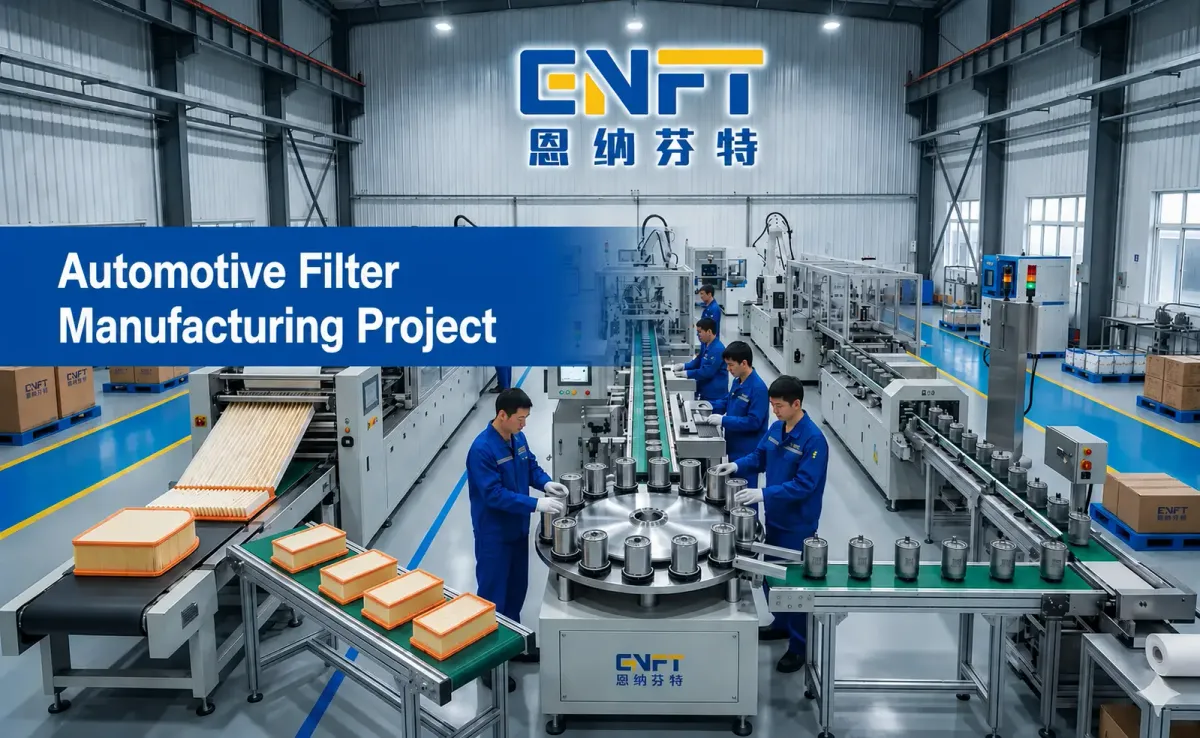
Key Success Factors for a Car Filter Manufacturing Project
Success does not depend only on machinery quality, but on the integration of all project elements.
1. Choosing the Right Production Line
Choosing an oversized line leads to wasted capital, while a small line may limit market demand fulfillment.
2. Raw Material Quality
Even the best machines cannot produce high-quality filters with poor materials, especially:
Filter paper
Rubber
Polyurethane
Adhesives
3. Strict Quality Control System
Each batch should undergo:
Dimensional testing
Pressure testing
Leakage testing
Filtration efficiency testing
4. Product Diversification
It is better not to rely on a single product:
Oil filters
Air filters
Cabin air filters
Industrial air filters
5. Strong Distribution Network
Target customers include:
Spare parts distributors
Repair workshops
Service centers
Transport companies
E-commerce stores
Agents
90-Day Implementation Plan for a Car Filter Manufacturing Project
A structured timeline reduces errors and accelerates production startup:
Timeline
Period | Required Actions |
|---|---|
Week 1–2 | Feasibility study, product selection, budgeting |
Week 3–4 | Contracting machines and preparing factory site |
Month 2 | Installation, technician training, raw material preparation |
Month 3 | Trial production, quality testing, commercial launch |
Practical Example
If the investor begins contracting with ENFT in the first week, the factory can be ready within three months, including installation, testing, and initial production—provided that the site and materials are prepared on time.
Challenges of the Project
Challenge | Solution |
|---|---|
Rising raw material prices | Diversify suppliers |
Price competition | Focus on quality |
Machine breakdowns | Preventive maintenance |
Demand fluctuations | Product diversification |
Skilled labor shortage | Continuous training |
Inventory buildup | Better production planning |
Tips Before Starting
Conduct real market research
Identify most common car models
Choose production capacity based on demand
Do not base decisions only on price
Request full operator training
Ensure spare parts availability
Plan for future expansion
Build a strong brand
Common Mistakes to Avoid
Buying oversized production lines
Using low-quality materials
Skipping product testing
Ignoring maintenance schedules
Relying on a single customer
Neglecting worker training
Not keeping spare parts stock
Competing on price only
Advantages of Purchasing Car Filter Machines from ENFT
ENFT offers integrated solutions for establishing or upgrading car filter manufacturing factories, with a wide range of machines suitable for different project sizes.
Why ENFT?
Integrated solutions for air and oil filter production lines
Multiple options for small, medium, and large projects
Production lines starting from affordable investments to large-scale industrial systems
Capacity up to 9,000 filters per day depending on the line
Support in selecting suitable equipment
Training on operation and maintenance
After-sales technical support
Customizable production lines according to client needs
Start Your Car Filter Manufacturing Project with ENFT
If you are planning to invest in a car filter manufacturing project, choosing the right equipment is the first step toward success.
At ENFT, we help you:
Select the appropriate production line for your budget
Define optimal production capacity
Choose suitable machines and molds
Provide technical support before and after purchase
Offer complete solutions for building a high-quality factory
📞 Contact the ENFT team now for a free consultation and a customized quotation, and let our experts help you build a successful and scalable car filter manufacturing factory.